Applicative
The term applicative describes a number of different grammatical-function-changing phenomena cross-linguistically. They involve the addition of an applicative affix along with a change in function of an oblique object (e.g., locative, instrumental), indirect object, or null object. These come to be expressed as a main object of the verb, often called the applied object. Depending on the language and the particular construction, the applied object may be interpreted as a beneficiary (one that benefits), maleficiary (someone or something that is adversely affected), goal, instrument, location, or motive. Much of the research on applicative constructions has involved the Bantu languages.
We illustrate the applicative construction with a pair of examples from the Kivunjo dialect of Kichaga, a Bantu language (Bresnan and Moshi 1990: 148):
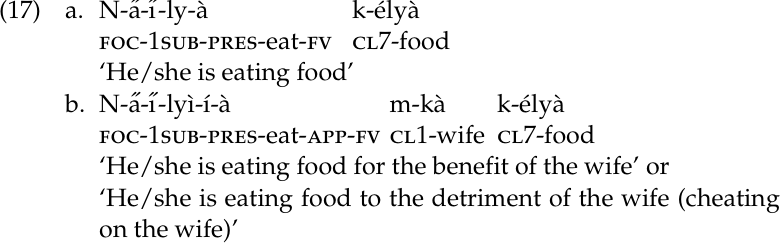
In the glosses for (17a–b), FOC is a focus morpheme; 1SUB is an agreement morpheme for subject, class 1; PRES is a present morpheme; APP is the applicative morpheme; and FV is a final vowel. Diacritics on the Kichaga words represent tones; they are not important here. We see that (17b) has an additional object not found in (17a). The appearance of this object is made possible by the addition of the applicative suffix -í to the verb. (17b) has two possible interpretations, as we have shown. In the first, the wife is considered the beneficiary; in the second a maleficiary.
In (18) we show that the same verb allows instrumental, locative, and motive applied objects (Bresnan and Moshi 1990: 149). In (18b), <r̟>is a retroflex r:
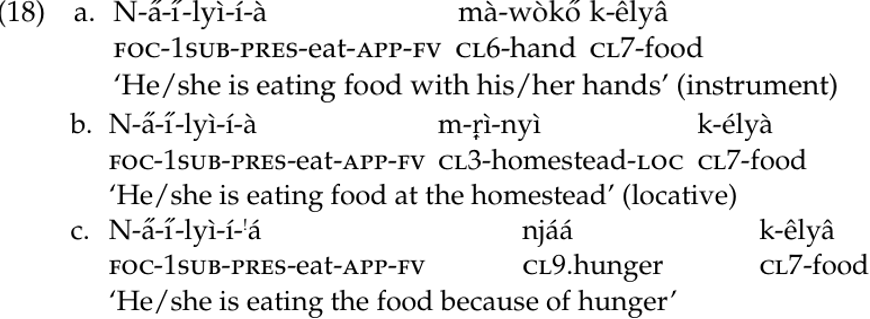
In their analysis of the Kichaga applicative construction, Bresnan and Moshi write that the applicative construction is the only means by which the semantic notions of beneficiary, maleficiary, instrumental, locative, and motive can be expressed. There are no prepositions or case markers in the language that might provide an alternative means. Languages differ in this respect. In some languages with the applicative construction, paraphrases of it may be possible.








