Subject and object marking
We saw that Kujamaat Jóola verbs agree with their subjects for noun class. Kujamaat Jóola also possesses a set of bound personal pronouns. Freestanding personal pronouns, which we won’t present here, may be used in place of the bound ones to convey emphasis.
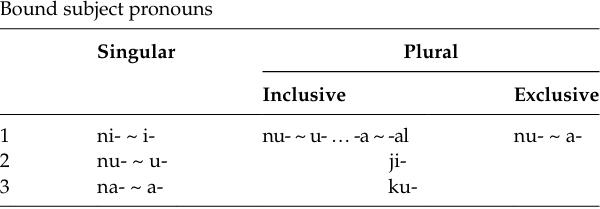
Two forms are given for all but the second person plural and third person plural prefixes. In general, the full forms are used with the initial verb of a clause or in the absence of preceding prefixes or proclitics, and the shorter forms in other contexts. The alternation in the second portion of the first person plural inclusive suffix is morphophonemically determined, with the final /l/ surfacing before vowels but not consonants.
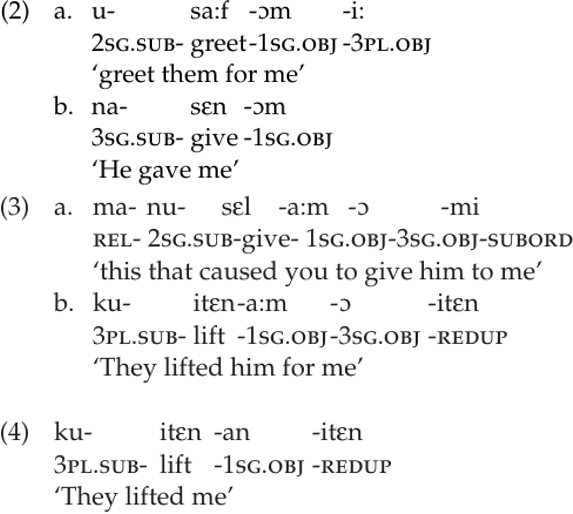
The shorter form of the subject prefixes may substitute for the full form, as in the following example, to indicate an imperative or interrogative, or, somewhat surprisingly, to emphasize the subject. A priori, we might have expected the longer form to convey greater emphasis. The explanation involves markedness and the relationship between context and form: the short form of the subject prefix is marked, and therefore more salient, when it occurs with a verb that is initial in its clause:

The Kujamaat Jóola bound object pronouns are presented below. These may be used for direct or indirect objects.
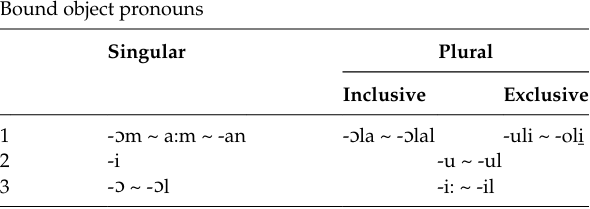
As with the bound subject pronouns, the alternations shown in the table of bound object pronouns are morphophonemically determined, with the exception of the two first person plural exclusive pronominals, which are regional variants. As seen below, ɔm is the basic form of the first-person singular object marker (2). The variant -a:m appears when the verb includes a reduplicant or the simple subordinate marker -m/-mi (3), but is replaced by -an when immediately followed by a reduplicant that begins with a vowel (4). Notice that an indirect object pronoun always precedes a direct object pronoun.