Aspect
Kujamaat Jóola does not have a tense system that expresses time-related notions like ‘past’ and ‘present’ directly.1 Instead, it has an aspectual system. This means that it expresses notions such as duration, completeness, and doubt, which have more to do with the nature of the action of the verb or with the speaker’s attitude than with time. The unmarked form of the verb can be interpreted as either present or past, as seen in (5):

The suffix -ε:n, the so-called dubitive-incompletive, is used to indicate that an action has not been completed (much like the imperfect aspect familiar from English or the Romance languages) or that it is in doubt.2 In (6), the final /n/ of the past absolute suffix assimilates in place with the following labial stop, surfacing as [m]:

In (6), it is understood that the subject no longer has money. Thomas and Sapir (1967) present another example: Fuken nij••njaw kabaak, εmitey dεs ɔfɔm məniləñu ‘Yesterday I was going to Kabâk, but the rain overtook me (en route) and I returned (without getting there).’ Here the verb nijεεn jaw (jεεn < -jaw-ε:n ‘go’ + INC) ‘was going’ indicates that the action of going was not completed. Without the dubitive-incompletive marker, this sentence would mean instead that the subject went to Kabâk despite the rain.
The dubitive-incompletive marker -ε:n may co-occur with other position-1 suffixes. It may precede or follow -εrit (habitual negative), -ut (negative), ɔrut ‘not yet’, ɔrulɔ:t ‘toward speaker’ (negative), and -ulɔ ‘toward speaker’. This fact suggests that they are in the same position. However, it always precedes the other variants of -ulɔ, -u, and -ul, as well as the habitual marker -ε and the second portion of the first person plural inclusive subject circumfix -a ̴-al.
Doubling the dubitive-incompletive marker emphasizes it. Such doubling occurs only in contrastive constructions. This is a good illustration of compositional semantics: it is as though each suffix contributes a degree of meaning:
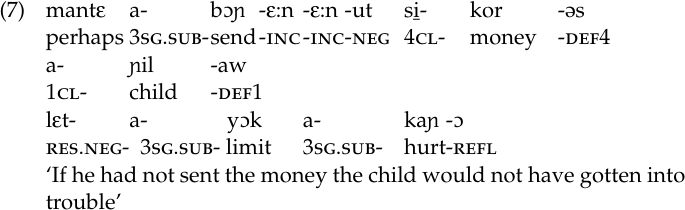
We learned immediately above that there is some flexibility regarding the placement of the dubitive-incompletive suffix -ε:n with respect to other first-position suffixes. The second member of the emphatic construction -ε:n … -ε:n is even more flexible: it may be placed anywhere with respect to the first-position suffixes except directly after the habitual -ε.3 It can even follow an object pronoun.
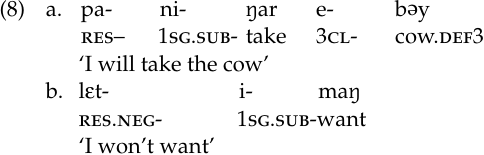
Future in Kujamaat Jóola is expressed by using the resultative and resultative negative markers pan- and lε-∼lεt-, which appear outside of inflectional morphology for subject, as we see in the following examples (the /-n/ of pan- is dropped before nasals):
In relative clauses, the future is expressed by a resultative clitic pi that combines with the marker agreeing with the relativized subject or object (Sapir 1965: 92). We see this in (9):

Lastly, combining the dubitive-incompletive suffix with the resultative prefix lεt-, a negative marker, results in a construction that indicates an action that missed taking place or that will not be accomplished. We might translate it as ‘might have’ or ‘might not have’.

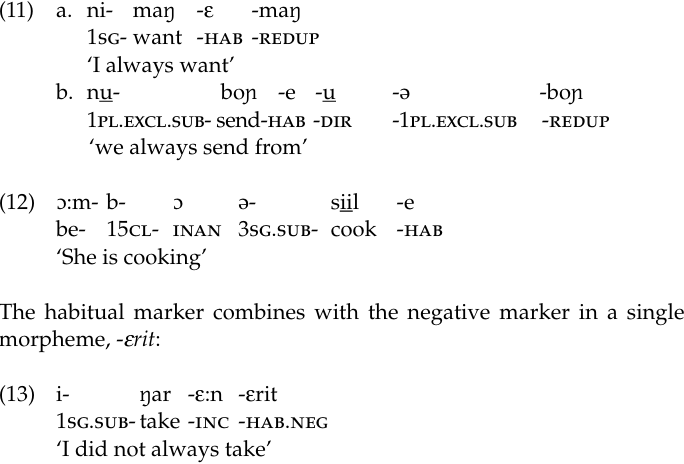
The Kujamaat habitual marker is seen in (11). Gero and Levinsohn (1993) point out that it has a progressive use as well, in which case it occurs with the verb ‘be’ (12) (example from Gero and Levinsohn 1993: 82):
1 Neither does English, in fact.
2 In Sapir (1965), the suffix -ε:n is considered a past marker, and its reduplicated form, which we learn below is emphatic dubitive-incompletive, is considered an indicator of remote past. He revises this analysis in his 1967 paper.
3 This is probably due to a phonological constraint against superlong vowels, which we would have if the habitual e were to merge with ε:n. Furthermore, if the illicit sequence */ε+ε:n/ were to be reduced to /ε:n/, the habitual meaning would be unrecoverable.








