Emphasis and subordination
We have seen two forms of emphasis in the Kujamaat Jóola verb system already. The short form of the subject pronoun can be used where the full form is expected (e.g., in the first verb in a clause) to emphasize the subject. The dubitive-incompletive marker itself can be emphasized by reduplication.
Reduplication serves to create emphasis of the Kujamaat Jóola verb stem as well. This process highlights its action, in contrast to its arguments:

The noun emphasis (ne) suffix -ε places emphasis on either the subject or a complement that precedes the verb:
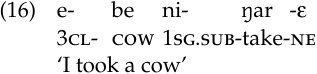
As might be expected, the use of this marker interacts with word order in complex ways.
The noun emphasis marker occupies the same position class as the object and passive markers. This could be accidental, and the fact that they never co-occur could be explained as a logical impossibility. A second, more enticing possibility is that they share the same position because they contribute the same sort of information. The discussion in Sapir (1965: 101–2), together with an examination of the sentences in the grammar and other published texts, indicates that the presence of either the object or the noun emphasis marker prevents a corresponding noun phrase from occurring in postverbal position. It is possible that the presence of an object or noun emphasis marker in the morphology eliminates the need for the corresponding noun phrase in the syntax. The same can be said, of course, for the passive marker. If this hypothesis is on the right track, the positional similarity between the object, noun emphasis, and passive markers may correspond to a functional similarity.
Sapir (1965) presents the simple subordinate -m∼-mi with emphasis markers because it “shifts emphasis from the verb to its immediate, usually post-verb, environment” (p. 35). It occurs most often in relative clause constructions or verb strings. The /u/ in (17a) is epenthetic:
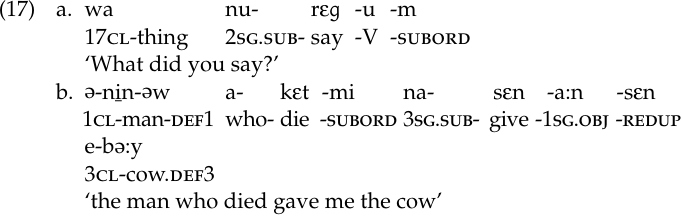
The actual use of -mi is more complicated than what is presented here, and in many ways it is akin to the noun emphasis marker (whose usage is also more complex than our discussion would indicate), as is brought out by Gero and Levinsohn (1993). We refer the reader to that paper, as well as to Hopkins (1990), for further information.
The past subordinate (ps), marked by the circumfix ba … εr, sets off a subordinate clause (18a–c). As its name indicates, the information within the subordinate clause typically refers to an event or state that precedes the action described by the main verb, although the opposite is true when the subordinated verb bears the suffix ɔrut ‘not yet’ (18b). In negative constructions, the second element of the circumfix, -εr, is dropped (18a–b). What might this suggest about the true nature of this circumfix?
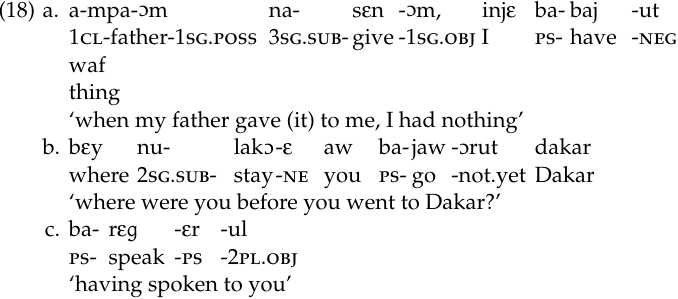
Although we classify the second portion of the past subordinate as a position-1 suffix, following Sapir (1965), it may co-occur with the dubitive-incompletive marker, which it always follows, and the ‘toward speaker’ marker -u∼-ul, which it precedes. It does not co-occur with any other first-position suffix.








