Semantic constraints
Productivity can also be constrained by semantic factors. Barker (1998) studies the English suffix -ee found in words like advisee, addressee, enlistee, or employee using a large set of naturally occurring examples such as the following (p. 720):
(9) a. There was the Asian influenza casualty … who was replaced gallantly by an influenza recoveree, Mr Robert Harben.
b. [experiment involving shining lights into the subject’s eyes] The adaptee then cannot tell the difference between yellow and white, i.e., is yellow-blind.
c. These young musicians were chosen from over 200 auditionees.
d. The ground rules were simple: to find ways to relax that required absolutely no effort on the part of the relaxee.
e. The paella didn’t turn out very well, but fortunately my dinees were quite understanding.
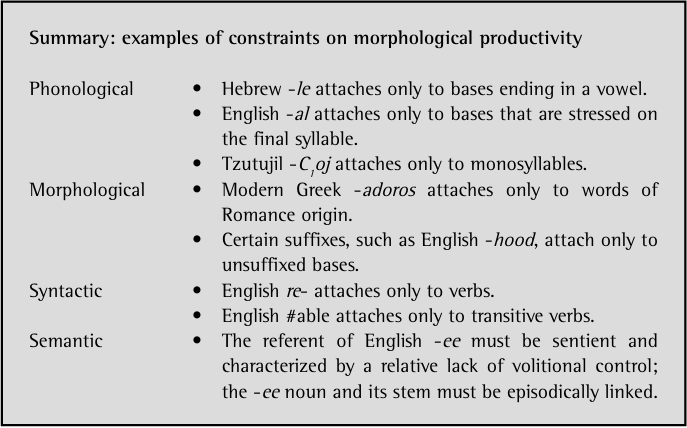
Barker finds that -ee suffixation is constrained by three semantic factors. First, the referent of the newly derived noun must be sentient. Second, the referent of the -ee noun is typically characterized by a relative lack of volitional control: the dinees in (9e) have no control over the paella they are served, and the adaptee (9b) does not manipulate the lights. Finally, the -ee noun and the stem must be episodically linked. Barker (1998: 712) gives the example of the noun lessee, from the verb lease: “every leasing qualifies some individual as a lessee, and for every lessee, there must be a leasing event which qualifies them as a lessee.” He continues by pointing out that it is not the case that all deverbal nouns must be episodically linked to their stems. We can dump a pencil sharpener into a wastebasket without the wastebasket qualifying as a dump. Someone who consorts does not automatically become a consort, and so on.