Realizations of the Subject
There are two main types of unit that can fulfil Subject function: nominal groups and clauses.
A Nominal Groups – That man is crazy
Nominal groups are the most typical realization of subject, as they refer basically to persons and things. They can range from simple heads to the full complexity of NG structures:
Cocaine can damage the heart as well as the brain.
The precise number of heart attacks from using cocaine is not known.
It is alarming.
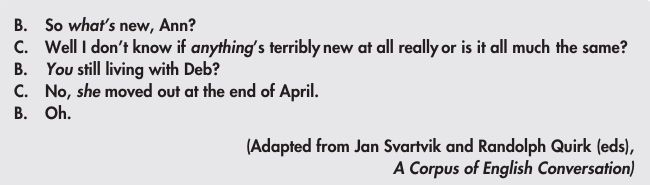
Pronouns account for a high percentage of subjects in the spoken language, as can be seen in the following recorded dialogue:
B Finite and Non-finite clauses
Clauses can realize every element or function of clause structure except the predicator. Cognitively, this means that we as speakers encode, as the main elements of clauses, not only persons and things but facts, abstractions and situations.
(a) Finite clauses: The main types of embedded finite clause are that-clauses and wh-clauses; the latter include nominal relative clauses. These are illustrated below:
That-clauses at subject represent an attitude, usually that of the writer.
That we’ve gotten to this point is astonishing to me. (AmE) (The Guardian)
That he failed his driving test surprised everybody. (that-clause)
Wh- interrogatives encode indirect questions.
Why the library was closed for months was not explained. (wh-interrogative)
What he said shocked me. (wh-nominal relative clause)
They do not take the inversion characteristic of ordinary interrogatives, however:
*Why was the library closed for months was not explained is not acceptable.
(b) Non-finite clauses are commonly of the -ing type or the to-inf type. The latter can be introduced by a wh-word. A less commonly used type is the bare infinitive:
To take such a risk was rather foolish (to-inf clause)
Having to go back for the tickets was a nuisance. (-ing clause)
Sign the petition was what we did. (bare inf clause)
(c) To-infinitive and -ing clause with own subject
To-infinitive and –ing clauses at subject can have their own subject; bare inf clauses cannot. A to-inf clause with its own subject is introduced by for
For everyone to escape was impossible. For + S + to-inf.
Sam’s/Sam/His/Him forgetting the tickets was unfortunate. S + ing-cl.
The pronominal subject of an –ing clause may be in the genitive or the objective case, as in the examples above. The objective form is the less formal. With short NGs such as proper names the ‘s genitive can be used, and is preferred when it is initial in the sentence. Many speakers, however, would prefer to avoid both genitive and objective forms, if another option is available. This could be anticipatory it + a that-clause:
It was unfortunate that Sam forgot the tickets.
C Anticipatory it + end-placed subject
That- clauses at subject tend to sound formal in English and are reserved for formal speech and writing. They are more acceptable if they are preceded by ‘the fact’, which makes them complement to an NG (the fact) functioning as subject. Even so, they can be awkward and rather top-heavy:
The fact that he failed his driving test surprised everyone.
A ‘lighter’ alternative, anticipatory it, is now generally preferred, particularly in spoken English, both BrE and AmE. It is much easier to handle and the pronoun it is the lightest possible subject filler. The that-clause or to- inf clause are then placed at the end of the sentence. This is known as ‘extraposition’ with the that- clause as ‘extraposed subject’. It also expresses an attitude.
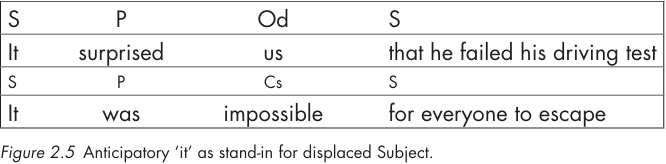
In this way, a long and heavy subject is placed at the end, in accordance with the informational and stylistic principle of ‘end-weight’.
For clauses such as ‘It is (high) time (that) he stopped fooling around’. Though apparently extraposed, there is no corresponding pattern with the clause in initial position (*That he stopped fooling around is high time.) Extraposition is then said to be obligatory.
Likewise, the clause following it + the verbs seem, appear, happen, turn out is obligatorily extraposed:
It turns out you were right after all. (* That you were right after all turns out)
It seems the driver lost control. (*That the driver lost control seems)
D Minor realizations: dummy it; unstressed there
D1 Dummy it – It’s hot
This is a non-referential or semantically empty use of it , which occurs in expressions of time, weather etc.
It’s nearly three o’clock. It’s raining. It’s a long way from here to London.
Syntactically, English requires the presence of a subject even in such situations, in order to distinguish grammatically between declaratives and interrogatives. Is it raining? How far is it from here to London?
D2 Unstressed there – There’s plenty of time
Unstressed there fulfils several of the syntactic criteria for subject: position, inversion with auxiliaries and repetition in tag phrases; but unlike normal subjects, it cannot be replaced by a pronoun. Concord, when made, is with the following NG:
There was only one letter delivered today, wasn’t there?
There were only two letters delivered yesterday, weren’t there?
Concord is made in writing, but not always in informal spoken English with the present tense of be, and is never made when the NG is a series of proper names:
How many are coming? Well, there’s Andrew and Silvia, and Jo and Pete.
*There are Andrew and Silvia, and Jo and Pete.
Because of the lack of concord and pronominalization, unstressed there can be considered as a subject ‘place-holder’ or ‘syntactic filler’, rather than a full subject, since the unit following is clearly the notional subject. For its function as a presentative device.
D3 Adjectival NG head.
The AdjG as such does not function as subject. However, certain adjectives, preceded by the definite article to denote (a) human characteristics or condition such as the brave and the beautiful, the fast and the furious, the poor, the rich, the good, the bad, the handicapped, the wounded, the computer-savvy, the I-Pad fixated or (b) abstractions such as the impossible, the supernatural are quite common:
The handicapped are given special facilities in public places.
The novel plunges the reader into a universe in which the comic, the tragic, the real and the imagined dissolve into one another.








