THE INDIRECT OBJECT (Oi)
Syntactic and semantic features
The indirect object occurs only with verbs which can take two objects such as give, send. Its position in clause structure is between the verb and the direct object: I sent them a fax. It:
• is typically realized by a NG, but occasionally by a wh-nominal clause. As a pronoun, it is in the objective case.
• is associated with two semantic roles, Recipient (the one who receives the goods or information), and the Beneficiary or ‘intended recipient’. The differences between the two are reflected in the syntax.
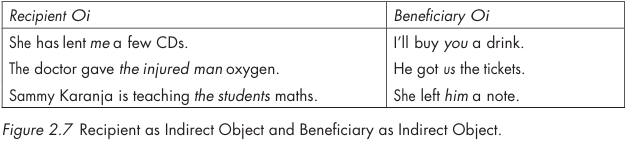
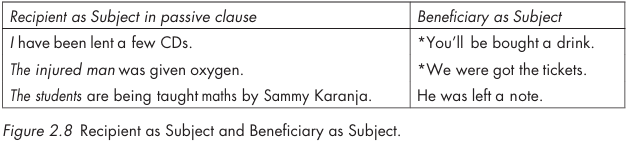
In passive counterparts the Recipient Oi corresponds to the subject. By contrast, most Beneficiary Objects do not easily become subject in a passive clause, although this restriction is not absolute, at least for some speakers:
• Both Recipient and Beneficiary Oi have an optional prepositional paraphrase, which functions as a PC or PO. For the Recipient, the preposition is to, for the Beneficiary it is for. The prepositional form is often used to bring the Oi into focus, particularly when it is longer than the Od:
The doctor gave oxygen to the injured man. I’ll buy drinks for you all.
She lent a few CDs to her next-door neighbor. He got the tickets for us all.
He is teaching maths to the first-year students. She left a note for her husband.
• The Oi can generally be left unexpressed without affecting the grammaticality of the clause:
The doctor gave oxygen. I’ll buy the drinks.
He doesn’t like lending his CDs. He got the tickets.
Sammy Karanja is teaching maths. She left a note.
• With some verbs (show, tell, teach, etc.) the Od may be unexpressed:
Who told you (the answer)?
Perhaps you could show me (how to do it).
He’s teaching immigrant children (maths).








