WH-INTERROGATIVES
Wh-interrogatives contain an element of missing information which is embodied in the wh-word. What the speaker is seeking in this type of interrogative is the identity of that element. The rest is presupposed, that is, taken as given. For instance, What do you want? presupposes that you want something. The wh-word can fill a syntactic function of the clause or be part of a group or phrase.
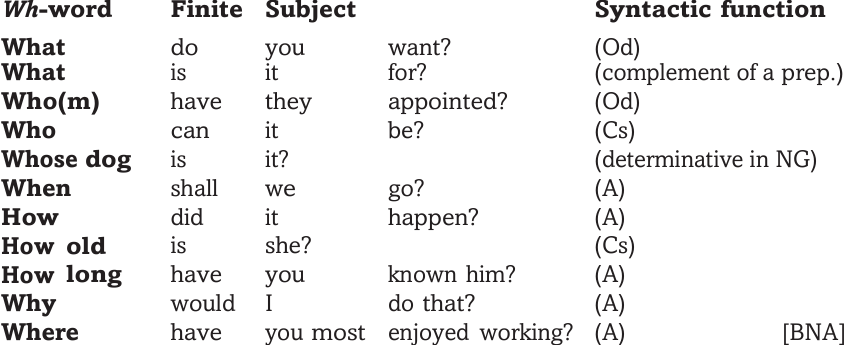
There is one exception to the Finite-Subject order in wh-interrogative clauses. This is when the wh-element itself functions as subject or as part of a NG at subject:

The functional motivation for the ordering of interrogatives in English is that whatever is questioned comes first. If it is the polarity that is questioned, the finite operator comes first. If it is the identity of an unknown element, a wh-element comes first, followed by the Finite-Subject ordering. If the unknown element is the Subject, that (in the form of a wh-element), comes first.
This means that, basically, the entire interrogative system in English has Finite- Subject ordering, except when the Subject’s identity is itself questioned.
Note that, in some languages, interrogative inversion is that of the Subject and the whole verbal group, as in Spanish ¿Ha llegado Pedro? We must be aware that this variation is ungrammatical in English (*Has arrived Peter?), except with primary verbs (be and have) in simple tenses. Compare: Has Peter a bicycle? is possible, but *Has had Peter lunch? is ungrammatical. Furthermore, certain languages rely on intonation to express a question, using only the declarative form. This is also possible in English but it does not regularly replace the use of the interrogative structures.
The following dialogue between two friends illustrates declarative clauses and the two main interrogative types. Finite elements are italicized:
So what did you do at the weekend, Janet?
Well, Jeff and I went off to Whitby to visit our in-laws. We took the dog with us and we all ended up having a walk along the beach.
Can you walk right along the cliffs to Robin Hood’s Bay?
I think you probably could do, but it’s quite dangerous. You can get through occasionally when the tide’s out, but it doesn’t stay out for very long and you can get caught.
(authors’ data)
The combination of a wh-interrogative word with -ever acts as an intensifier expressing the surprise, perplexity or disbelief of the speaker. Why ever is often spelt as two words, the other items as either one or two:
Whoever would believe such a story?
Wherever did you hear that?
Why ever didn’t he let us know he was coming?
Alternatively, wh-interrogative words can be intensified informally by certain lexical items which include on earth, in the world, and other more marked colloquialisms including semi-taboo words, such as the devil, the hell.
Why on earth didn’t you get in touch?








