Let’s and Let us
Another feature of the imperative in English is the use of let’s to form a 1st person plural imperative with the implicit Subject we. Its typical use is to suggest or urge a collaborative action that includes both speaker and addressee(s). It is also used, however, as a disguised order by speakers in authority, as in the third example. The tag question used with 1st person imperatives is Shall we?
Let’s take a few photos, shall we?
Let’s go home, shall we?
Let’s have some silence now!
Let’s is historically derived from let us and in very formal settings, including church services, the unabbreviated form is heard:
Let us pray.
Let us consider the possible alternatives.
It may be that let’s is beginning to function as an unanalyzed pragmatic particle, as in non-standard let’s you and I do it. The negative form of let’s is let’s not, although don’t let’s is also heard:
Let’s not waste any more time. [AMB]
Oh, don’t let’s talk about it, Len. [GVT]
Let’s is not to be confused with the normal imperative of the lexical verb let meaning permit, allow, as in:
Let me do it! Let me help you.
As an illustration of the differences between the particle let and lexical let (= allow), compare:
Let’s go and see that new film! (particle let)
Please let us go and see that new film. (lexical let)
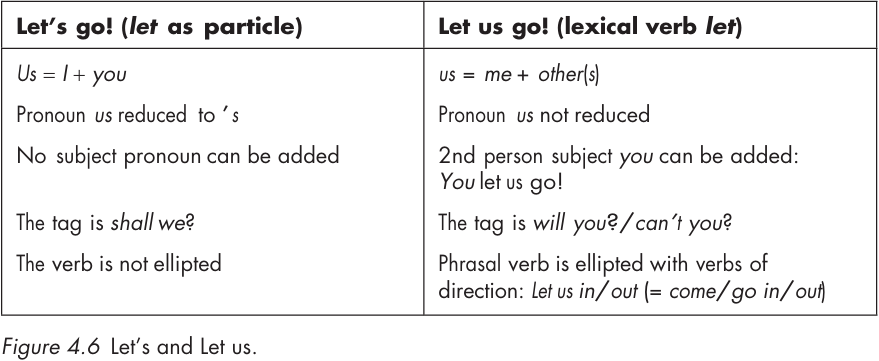
Obviously, both uses of let can occur in the same clause, as in Let’s let them in now. The pragmatic particle let can also introduce a wish (the optative mood) as in Let there be light and is used only in formal registers (for inclusive and exclusive we/us.








