THE COMPLEMENT ELEMENT
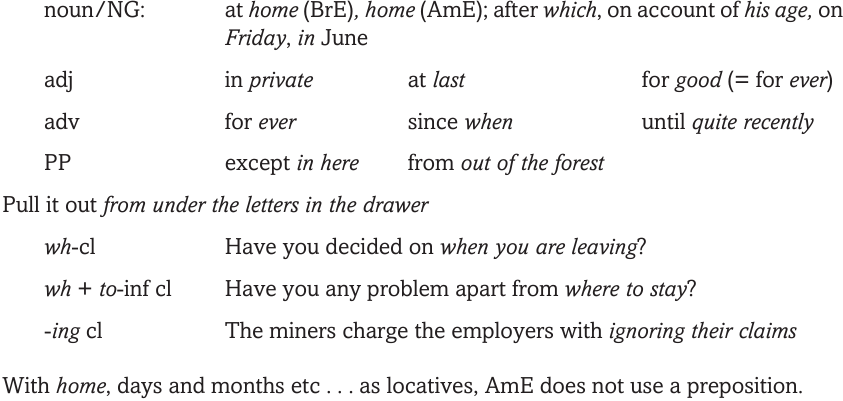
The complement of a preposition is most typically realized by a noun or common use. A PP as complement of a preposition is totally regular, as are –ing and wh-clauses:
I don’t sleep nights for thinking of my daughter.
‘I’d much rather stay home tonight,’ he said.
Summers, I visit my father in Maryland.
The following restrictions exist on the types of complement possible:
Adjectival and adverbial groups are infrequent and are limited to idiomatic expressions such as at last, for good, for ever, as in:
At last I’m free! [GWH]
. . . the family left Ireland for good and made its future in England [EDA]
I could stay here for ever, it’s so beautiful.
Clauses as complements of prepositions
English prepositions are not followed by that-clauses. The only type of finite clause admissible is the wh-clause, and the only non-finite type the -ing clause. To-inf clauses are not admissible after a preposition either, except when introduced by a wh-item, as in apart from where to stay. Combinations 1b and 2b , therefore, are ungrammatical. An -ing clause can often provide an acceptable alternative, as in 1a and 2a:
1a I was pleased about our team winning the prize /that our team won the prize.
1b *I was pleased about that our team won the prize.
2a We were disappointed at not getting any news from you.
2b *We were disappointed at not to get any news from you.
Use of -ing clauses
‘To’+ the base form of a verb is a ‘to-infinitive’, and must be distinguished from the preposition to, which can take an -ing clause, as in the first example below. Most other prepositions likewise take the -ing form, as this is the most nominal among clauses:
He devoted his career to helping needy and deprived children.
The intruder escaped by climbing over a back fence.
But and except may be followed by to-infinitives. They typically follow a negative element: Jean and Bill will have no choice but to send their children to another school.
The following continuation of the recorded student–teacher conversation shows that the largest number of complements are realized by nouns, pronouns and full NGs, with a sprinkling of finite and non-finite clauses:
The ‘Green’ Party
A: It’s really making a come-back all of a sudden.1
B: Seems to come in and out of fashion.2
A: Yeah.
B: We had elections at school 3 and the ‘Green’ party did win, actually.
A: So did we. It was a big surprise to everyone,4 so many anti-establishment adherents amongst us.5
T: I get the impression that it’s a non-vote, just a comfortable way of not having to take a decision.6
B: Yeah, a pressure vote, so that you don’t have to vote either for the Conservatives7 or for the Labor Party.8 People just can’t be bothered with comparing programs and thinking9 about who to vote for.10
T: And you think this has a significant impact on the way the other parties have formed their policies?11
B: Yeah, but it’s . . . it’s just waffle, just an excuse for getting votes.12
T: Do you feel very cynical about them,13 then?
B: Suppose I do, a bit.
T: One of the things people say about, well, at least some of the younger generation,14 not all of them,15 but on the whole16 is, there’s no radicalism among people today17 who are in their late teens and twenties.18 It’s what the forty-year-olds say about the twenty-year-olds.19 They think back to when they were young20 and what they were like then21 and say that the younger generation don’t have any radical or controversial views any more.
A: I don’t think radicalism has disappeared. Maybe it has been channeled into that ‘green’ area.22
B: Yeah. A lot of former ideas have been ditched in favor of moving towards a position much closer to the center than before.








