RNA Processing:- RNA Enzymes Are the Catalysts of Some Events in RNA Metabolism
The study of posttranscriptional processing of RNA molecules led to one of the most exciting discoveries in modern biochemistry—the existence of RNA enzymes. The best-characterized ribozymes are the self-splicing group I introns, RNase P, and the hammerhead ribozyme (discussed below). Most of the activities of these ribozymes are based on two fundamental reactions: trans esterification and phosphodiester bond hydrolysis (cleavage). The substrate for ribozymes is often an RNA molecule, and it may even be part of the ribozyme itself. When its substrate is RNA, an RNA catalyst can make use of base-pairing interactions to align the substrate for the reaction. Ribozymes vary greatly in size. A self-splicing group I intron may have more than 400 nucleotides. The hammerhead ribozyme consists of two RNA strands with only 41 nucleotides in all (Fig. 1). As with protein enzymes, the three-dimensional structure of ribozymes is important for function. Ribozymes are inactivated by heating above their melting temperature or by addition of denaturing agents or complementary oligonucleotides, which disrupt normal base-pairing patterns. Ribozymes can also be inactivated if essential nucleotides are changed. The secondary structure of a self-splicing group I intron from the 26S rRNA precursor of Tetrahymena is shown in detail in Figure 26–26.
Enzymatic Properties of Group I Introns Self-splicing group I introns share several properties with enzymes besides accelerating the reaction rate, including their kinetic behaviors and their specificity. Binding of the guanosine cofactor to the Tetrahymena group I rRNA intron (Fig. 2) is saturable (Km ≈ 30 M) and can be competitively inhibited by 3-deoxyguanosine. The intron is very precise in its excision reaction, largely due to a segment called the internal guide sequence that can base-pair with exon sequences near the 5splice site (Fig. 2). This pairing promotes the alignment of specific bonds to be cleaved and rejoined. Because the intron itself is chemically altered during the splicing reaction—its ends are cleaved—it may appear to lack one key enzymatic property: the ability to catalyze multiple reactions. Closer inspection has shown that after excision, the 414-nucleotide intron from Tetrahymena rRNA can, in vitro, act as a true enzyme (but in vivo it is quickly degraded). A series of intramolecular cyclization and cleavage reactions in the excised intron leads to the loss of 19 nucleotides from its 5end. The remaining 395 nucleotide, linear RNA— referred to as L-19 IVS—promotes nucleotidyl transfer reactions in which some oligonucleotides are lengthened at the expense of others (Fig. 26–27). The best substrates are oligonucleotides, such as a synthetic (C)5 oligomer, that can base-pair with the same guanylate rich internal guide sequence that held the 5exon in place for self-splicing.
The enzymatic activity of the L-19 IVS ribozyme results from a cycle of transesterification reactions mechanistically similar to self-splicing. Each ribozyme molecule can process about 100 substrate molecules per hour and is not altered in the reaction; therefore, the intron acts as a catalyst. It follows Michaelis-Menten kinetics, is specific for RNA oligonucleotide substrates, and can be competitively inhibited. The kcat/Km (specificity con stant) is 103 M-1 s-1, lower than that of many enzymes, but the ribozyme accelerates hydrolysis by a factor of 1010 relative to the uncatalyzed reaction. It makes use of substrate orientation, covalent catalysis, and metal ion catalysis—strategies used by protein enzymes.
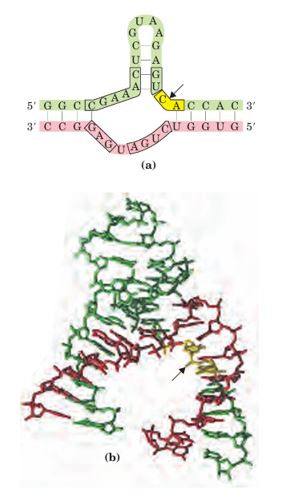
FIGURE 1 Hammerhead ribozyme. Certain virus like elements called virusoids have small RNA genomes and usually require another virus to assist in their replication and/or packaging. Some virusoid RNAs include small segments that promote site specific RNA cleavage reactions associated with replication. These segments are called hammerhead ribozymes, because their secondary structures are shaped like the head of a hammer. Hammerhead ribozymes have been defined and studied separately from the much larger viral RNAs. (a)The minimal sequences required for catalysis by the ribozyme. The boxed nucleotides are highly conserved and are required for catalytic function. The arrow indicates the site of self-cleavage. (b)Three-dimensional structure (PDB 1D 1MME). The strands are colored as in (a). The hammerhead ribozyme is a metalloenzyme; Mg2 ions are required for activity. The phosphodiester bond at the site of self-cleavage is indicated by an arrow.
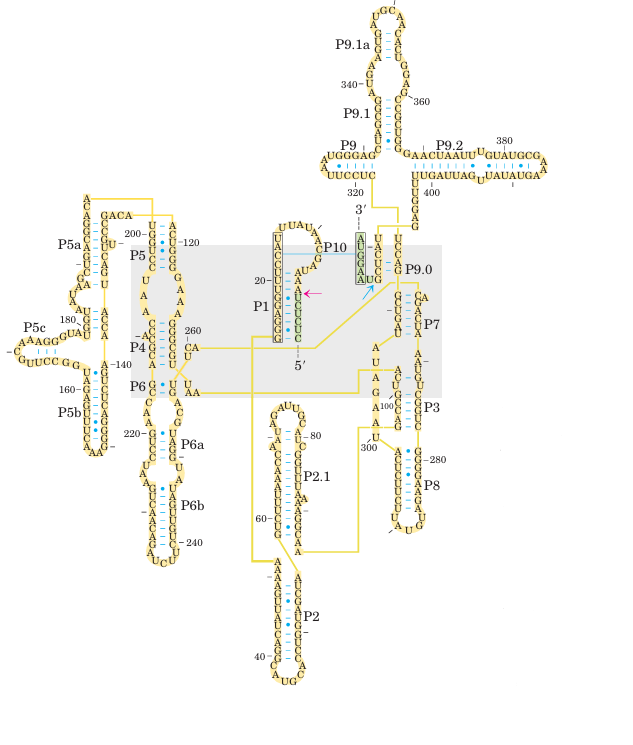
FIGURE 2 Secondary structure of the self-splicing rRNA intron from Tetrahymena. Intron sequences are shaded yellow, exon sequences green. Each thick yellow line represents a bond between neighboring nucleotides in a continuous sequence (a device necessitated by showing this complex molecule in two dimensions; similarly, an oversize blue line between a C and G residue indicates normal base pairing); all nucleotides are shown. The catalytic core of the self-splicing activity is shaded. Some base-paired regions are labeled (P1, P3, P2.1, P5a, and so forth) according to an established convention for this RNA molecule. The P1 region, which contains the internal guide sequence (boxed), is the location of the 5splice site (red arrow). Part of the internal guide sequence pairs with the end of the 3exon, bringing the 5 and 3 splice sites (red and blue arrows) into close proximity.
Characteristics of Other Ribozymes E. coli RNase P has both an RNA component (the M1 RNA, with 377 nucleotides) and a protein component (Mr 17,500). In 1983 Sidney Altman and Norman Pace and their coworkers discovered that under some conditions, the M1 RNA alone is capable of catalysis, cleaving tRNA precursors at the correct position. The protein component apparently serves to stabilize the RNA or facilitate its function in vivo. The RNase P ribozyme recognizes the three-dimensional shape of its pre-tRNA substrate, along with the CCA sequence, and thus can cleave the 5 leaders from diverse tRNAs . The known catalytic repertoire of ribozymes continues to expand. Some virusoids, small RNAs associated with plant RNA viruses, include a structure that promotes a self-cleavage reaction; the hammerhead ribozyme illustrated in Figure 1 is in this class, catalyzing the hydrolysis of an internal phosphodiester bond. The splicing reaction that occurs in a spliceosome seems to rely on a catalytic center formed by the U2, U5, and U6 snRNAs . And perhaps most important, an RNA component of ribosomes catalyzes the synthesis of proteins (Chapter 27). Exploring catalytic RNAs has provided new insights into catalytic function in general and has important implications for our understanding of the origin and evolution of life on this planet, a topic discussed in Section 26.3.
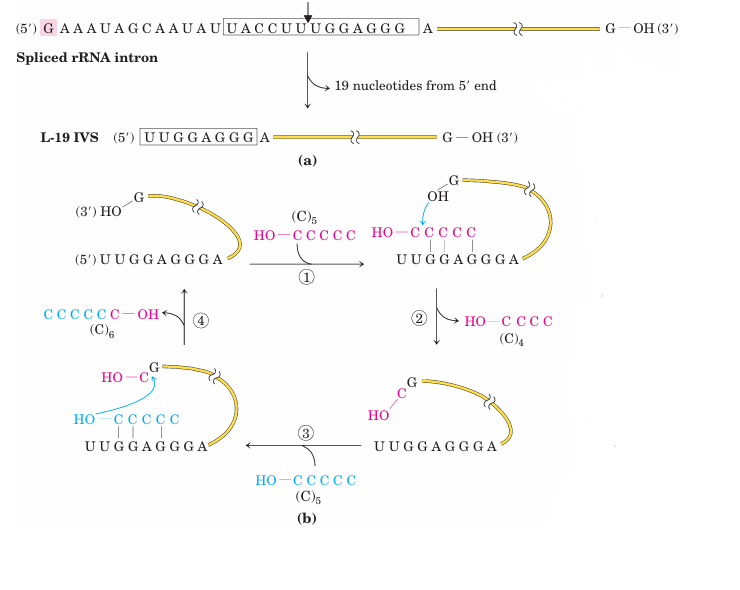
FIGURE 3 In vitro catalytic activity of L-19 IVS. (a) L-19 IVS is generated by the autocatalytic removal of 19 nucleotides from the 5end of the spliced Tetrahymena intron. The cleavage site is indicated by the arrow in the internal guide sequence (boxed). The G residue (shaded pink) added in the first step of the splicing reaction is part of the removed sequence. A portion of the internal guide sequence remains at the 5end of L-19 IVS. (b) L-19 IVS lengthens some RNA oligonucleotides at the expense of others in a cycle of transesterification reactions (steps 1 through 4). The 3OH of the G residue at the 3end of L-19 IVS plays a key role in this cycle (note that this is not the G residue added in the splicing reaction). (C)5 is one of the ribozyme’s better substrates because it can base-pair with the guide sequence remaining in the intron. Although this catalytic activity is probably irrelevant to the cell, it has important implications for current hypotheses on evolution, discussed at the end of this chapter.








