‘GOOD LANGUAGE TEACHERS” DECLARATIVE KNOWLEDGE OF THE LANGUAGE SYSTEMS
The first research question focused on the declarative dimension of teacher language awareness, and whether ‘Good Language Teachers’ possess, as one might anticipate, high levels of knowledge of the language systems. The data shedding light on this particular question were the subjects’ Language Awareness test papers. As mentioned above, the test focused specifically on grammar and vocabulary.
Table 1 below shows the performance of the three subjects on the grammar component of the test. All the figures in the table are percentages. For purposes of comparison, the mean scores of a large group of subjects who took the same grammar test (Andrews 1999a) are also shown in the table. In Andrews (1999a), 187 serving teachers of English in Hong Kong secondary schools, all graduates without professional training, took the grammar test. The scores in Table 1 are arranged in order of the relative difficulty of the four tasks (as indicated by test scores in Andrews 1999a), starting with the easiest: identifying and correcting errors. As argued in Andrews (1999c), this sequence of mean scores reflects the cognitive burden associated with each of the four tasks, error correction and the recognition of metalinguistic terminology being perceived as cognitively less demanding than the production of metalanguage or the explanation of errors (Andrews 1999c:152). It is, however, interesting to note that Bonnie’s results pattern differs from the norm, since her score for the task requiring production of grammatical terminology is actually higher than her score for the task requiring mere recognition of such metalanguage.
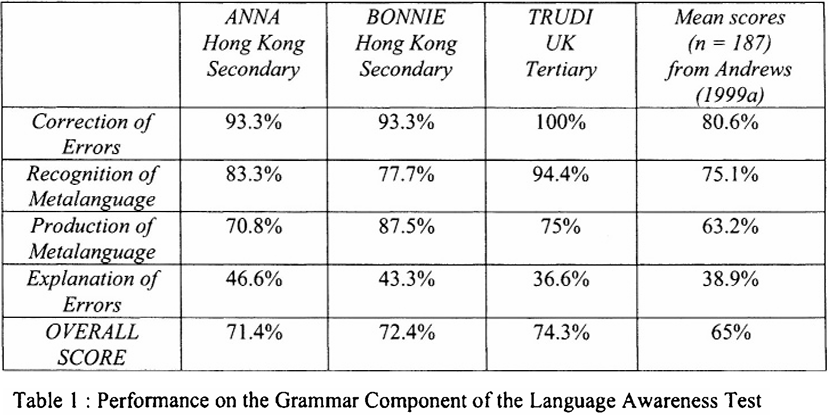
From Table 1, we can see that all three ‘Good Language Teachers’ achieved scores several percentage points (between 6.4% and 9.3%) above the mean of the teachers in Andrews (1999a). What is perhaps most noteworthy about this, however, is that the performance of the ‘Good Language Teachers’ is not more markedly above the mean. The subjects in Andrews (1999a) all lacked a professional qualification, and the vast majority had relatively few years of teaching experience. As the results in Andrews (1999a) reveal, quite a large number of the 187 subjects achieved scores on the Language Awareness test well above those of the subjects in the present study. For instance, among the main study group in Andrews (1999a), i.e. those teachers whose language awareness in relation to grammar was investigated in depth, eight out of 17 (47%) scored better than the ‘Good Language Teachers’, the top score among those 17 being 90%.
Apart from this, it is also noticeable that all three ‘Good Language Teachers’ performed to a very similar level overall. The unusual pattern in Bonnie’s test scores has been noted above, but there are nevertheless major similarities in the subjects’ performance. All three, for example, performed very well on the error correction task. This is not surprising, since the task is primarily a test of language proficiency, and these are subjects with very good English. All three, however, performed poorly when required to explain their correction of those errors, with Trudi (the UK-based tertiary teacher) obtaining a score below the mean for the 187 teachers in Andrews (1999a). Given the relevance of the task to pedagogical practice, and the relative simplicity of the errors to be explained, this is a worrying finding.
For the vocabulary component of the test, there was no previous large-scale administration that might have allowed for comparison. Table 2 below therefore records just the results of the three ‘Good Language Teachers’. Although there are no data for comparison, Table 2 reveals some intriguing patterns which could usefully be investigated further by administering the test to larger populations, each constituting a representative sample of teachers with a homogeneous background (linguistic, educational, and professional). For instance, while the two Hong Kong secondary school teachers, Anna and Bonnie, performed to a similar level overall, their performance is in marked contrast to Trudi, whose score of 85.7% was more than double that recorded by Bonnie. Anna and Bonnie both performed far worse on the vocabulary component of the Language Awareness test than on the grammar component, whereas Trudi obtained a higher score on the vocabulary component. Most worrying from the teacher educator perspective is the fact that two teachers labelled ‘Good Language Teachers’ by the award of a Distinction grade at the end of their professional training should score so low on the task involving the explanation of errors, since (as noted above in relation to the grammar component) this is a task which forms part of the L2 teacher’s routine practice in most settings. Anna, for example, could correct all but one of the 15 sentences containing a vocabulary error, but was able to score only 23.3% for her explanations of those same errors. Bonnie, meanwhile, managed to correct only ten of the 15 sentences, but performed marginally better in her explanation of those corrections.
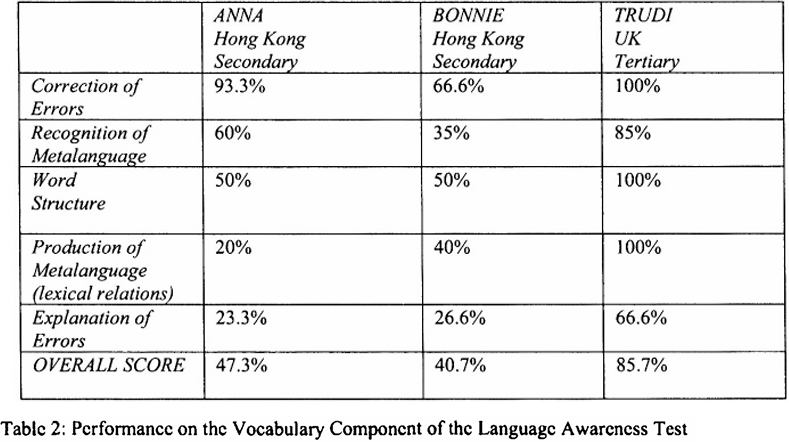
In attempting to explain these patterns, one can only speculate. The relatively consistent similarity of the performance of the two Hong Kong teachers is noteworthy, however, and calls for some comment. One might hypothesize, for example, that Anna and Bonnie’s low performance on the vocabulary component of the Language Awareness test (and markedly better performance on the grammar component) is associated with the emphasis traditionally placed on grammatical competence in L2 teaching and learning in Hong Kong, and the relative lack of attention paid to vocabulary. Trudi’s high vocabulary score, on the other hand, might be seen as a reflection of her educational background in Germany, the nature of her philological studies, and her strong personal interest in words. As mentioned above, further research will be required before any generalizations can be made.








