Pre-Service ESL Teachers’ Knowledge about Language and its Transfer to Lesson Planning
LEARNING TO TEACH LANGUAGE THROUGH CONTENT
The present research grew out of a desire to learn more about why our students, who are native English-speaking preservice language teachers, struggled to apply the knowledge they were learning in their English Grammar course to the lesson plans they wrote in their pedagogy courses. We saw that they were learning the content of the grammar class, but few linguistic objectives appeared when they were writing lesson plans, especially plans that originated from authentic content materials or tasks. We argue that while all teachers need KAL (Fillmore and Snow, 2000), it is central to the work of ESL teachers. They need to develop and apply KAL to make decisions in the classroom, from issues of curriculum design to the question of whether and how to offer corrective feedback. ESL teachers must be skilled at gathering linguistic information from their students to choose suitable linguistic structures to teach and to assess students’ linguistic development. They have to be able to predict what language will be problematic in a text or class activity and then decide how to address the language in the lesson. They need to decide whether instruction should be proactive (i.e., planned instruction) or reactive (e.g., recasts), implicit or explicit, inductive or deductive (see Doughty and Williams (1998) for full discussion on decisions related to focus on form). KAL informs what materials, tasks and assignments are best suited to students according to their global literacy skills and their syntactic development. KAL is core to the everyday work of language teachers.
Despite its important role, little is known about how language teachers come to acquire KAL and transfer this knowledge to decisions related to instruction. While there has been a fair amount of research on grammar teaching techniques, tailored to specific forms and to specific teaching contexts very little is known “about the actual difficulties of novice teachers who embark on the venture of CBI or the problems of experienced teachers who are being retrained to do CBI” (Brinton, 2000, p. 50). Additionally, while there has been an impressive amount of research on language teachers’ metalinguistic knowledge and beliefs about grammar instruction and their match to classroom practice (Andrews, 1999; Borg, 1998, 1999a, 1999b), there needs to be more research on how KAL develops and transfers to teachers’ planning decisions, specifically in the preservice ESL teacher. Just as language learners may know the conventions of a language in a formal sense and yet not be able to apply these conventions to meaningful language use, we have observed that teachers often possess KAL yet are not able to apply it to their teaching practice. This study explores the process of achieving that transfer in a teacher education program.
We chose to examine KAL transfer specifically for content-based language instruction (CBI) because we have noticed that our students struggle with using their KAL to find language objectives when teaching with academic content. There are many benefits to teaching with content, all of which are strongly represented in our program. CBI presumes that language is best learned through meaningful, communicative and experiential content instruction. CBI allows for form-meaning connections that are important for language development and gives ESL students access to grade-level content as soon as they enter the school system. Furthermore, teachers who focus learner attention on linguistic form during communicative interactions are more effective than those who never do so or who only do so in decontextualized grammar lessons (Larsen-Freeman, 2001). Nevertheless, CBI presents some tensions for ESL teachers. Language instruction in CBI often does not match ESL teachers’ preconceptions of how language should be taught. Teachers often believe that language instruction must be explicit and use teacher-led explanations, followed by student practice (Short, 2002). CBI, on the other hand, often involves choosing implicit rather than explicit approaches for targeting a grammatical form. This is not an issue that is limited to the K-12 context or to novice teachers. Pica’s (2002) study of experienced ESL teachers of adult classes using literature, film and American culture as content found that teacher-fronted discussions were the most frequent interactional activity and that this format did not tend to focus learner attention on form. We have observed in our classes and concur with Short that “most teachers address content objectives in their lessons but less frequently include language goals. For English language learners, this is a critical area for increased teacher attention” (2002, p. 22). Often in CBI, the teacher’s focus moves almost entirely to content. However, we agree with the proactive stance Master (2000) takes: “It is ultimately the CBI instructor who must make sure that grammar is sufficiently covered, both in terms of range and explanation” (p. 102). The ability to integrate content and language begins at the planning level (Met, 1994; Snow, Met, & Genesee, 1992), so our analysis of transfer centers on lesson-planning assignments. Defining language-learning outcomes can be a difficult skill for preservice teachers (Brown, 1995; Graves, 2000). This was confirmed in our program in a yearlong study of our preservice language teachers’ development of planning skills (Bigelow & Ranney, 2001). We found that when they tried to integrate language-related objectives, those objectives were mainly related to vocabulary or the broad skills of speaking, listening, reading and writing. Language objectives targeting linguistic forms in an integrated fashion were uncommon. Moreover, the range of forms the group chose was extremely limited. While we would argue that engaging and relevant content should be at the center of effective language instruction, we also would argue that ESL teachers need to develop their KAL alongside their skills in choosing, planning and assessing language-learning tasks. This will have a direct impact on the development of students’ language skills.
We see that teachers who use academic content in their lessons begin their planning roughly from one of two places: the content or the language. Figure 1 illustrates these two paths. A teacher may begin by identifying a linguistic issue in a structural syllabus or one that students are struggling with and then choose relevant content to contextualize the form, finally arriving at the language objectives of the lesson (Path 1). On the other hand, the teacher may begin with content materials. In this case the materials or tasks are analyzed for challenging linguistic items and then the language objectives are developed (Path 2).
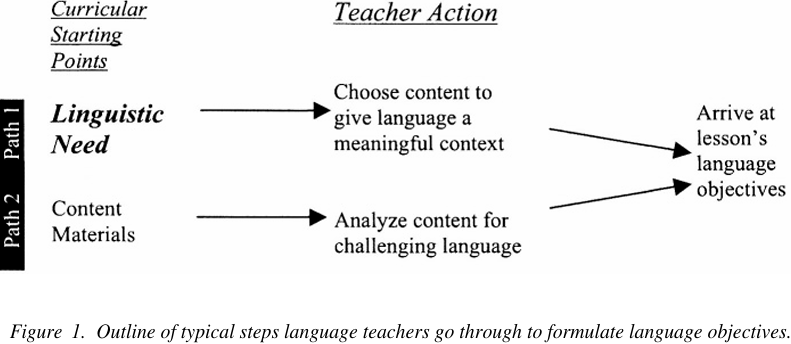
KAL is needed to follow either path and ESL teachers must be prepared to follow both paths as they plan for instruction. They require this flexibility because there is a frequent alternation between using materials from mainstream classes and designing lessons to focus on specific and troublesome structures. In this study, we wished to explore the processes involved in transfer as well as how our own practice interacted with these processes. Specifically, we formulated the following questions to guide our research:
1. What evidence of transfer of KAL do we see in preservice teachers’ lesson planning?
2. What are the main obstacles to transfer of metalinguistic knowledge to planning for CBI?
3. How can we facilitate transfer of metalinguistic knowledge to planning for CBI?








