Cognitive approaches to grammar
Cognitive Grammar
The symbolic alternative to traditional concepts of grammar
Cognitive Grammar dispenses with both the descriptive and the generative definitions of grammar and views grammar as “a structured inventory of conventional linguistic units” (Langacker 1987: 37). This construal of the term grammar is also known as the symbolic alternative (to traditional/structural/generative grammar) because it rests on the assumption that any linguistic expression is an association between a semantic and a phonological structure, i.e. any linguistic expression is a symbol. For example, the lexical item cat is regarded as consisting of a semantic pole (i.e. what would traditionally be called both its denotative and its connotative meaning, abbreviated as [CAT]) and a phonological pole (abbreviated as [kæt]). Apart from the two poles and the details concerning how they are linked (i.e. their symbolic links), no other entities (e.g. traces, empty elements, etc.), (independent) levels/modules (e.g. syntax, logical form, etc.), or principles (e.g. the projection principle) are recognized in Cognitive Grammar. Further, a linguistic unit is a symbolic structure which has unit status, i.e. it is accessed in largely automatic fashion or, to put it differently, is entrenched. A linguistic unit is conventional if it is shared by a substantial number of individuals. Further, by the term “inventory” in his definition of grammar, Langacker means that a grammar is not a generative algorithm but, rather, a collection of conventional symbolic units. Crucially, such an inventory is not a list, but is structured because symbolic units, as schemas abstracted from usage events, are related by way of categorizing relationships. For example, the clause I love you is an instantiation or elaboration of the transitive construction; hot meaning “spicy”, as in hot mustard, is a metaphorical extension of hot from the domain of temperature to that of taste.
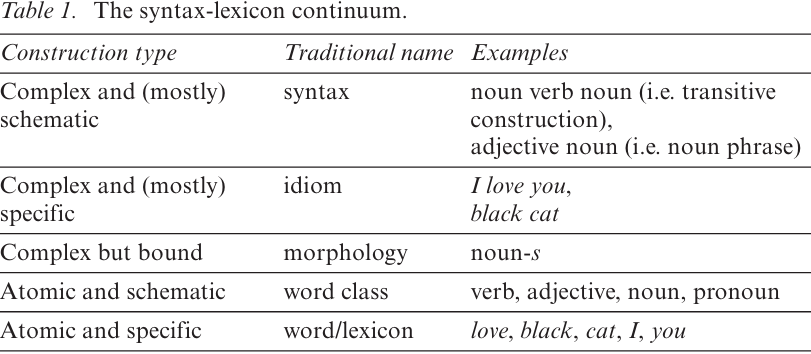
The Cognitive Grammar definition of grammar has important consequences. First, linguistic units can be of any length. Grammar includes symbolic assemblies of any internal complexity rather than just atomic units like cat. Complex constructions like the ditransitive construction (e.g. He gave her a present) are part and parcel of grammar and are not taken to be projected from a verb’s argument structure (as in generative grammar). Second, linguistic units can be of any degree of specificity. Grammar includes both very specific patterns (e.g. I love you, which can be considered an entrenched unit in the English language although its meaning is transparent, unlike idioms such as kick the bucket, give up the ghost, etc.) and general schemas that may subsume them (e.g. grammar includes the transitive construction, of which I love you is an elaboration or instantiation). From these two observations regarding complexity and specificity, it follows that there are no clear boundaries between what are traditionally referred to as the lexicon, morphology and syntax (this is known as the syntax-lexicon continuum hypothesis). These labels refer to symbolic assemblies differing from one another only in terms of structural complexity and schematicity (or specificity), as is illustrated in Table 1 below (adapted from Croft 2001: 17). Indeed, any entrenched symbolic assembly is regarded as a construction in Cognitive Grammar (as well as in Radical Construction Grammar) irrespective of either its internal complexity or its specificity. More generally, Cognitive Grammar constantly underlines that much in language is a matter of degree. Since grammar is an integral part of human cognition and since human cognition rests, among other abilities, on categorization (which operates by way of instantiation and extension relations rather than feature-listing), sharp boundaries should not be expected in grammar.
The Cognitive Grammar definition of grammar also implies that linguistic analyses should always be checked against two omnipresent fallacies in linguistic argumentation, namely the exclusionary fallacy and the rule/list fallacy. The gist of the former is that “one analysis […] for a linguistic phenomenon necessarily precludes another” (Langacker 1987: 28). For example, if we take the noun computer and say that this word is derived by rule (i.e. the suffix -er is added to the verb base compute), we cannot account for the fact that computer means more than “something that computes”. By contrast, if we regard it as an item listed in the lexicon (on the assumption that the lexicon is an independent level of the linguistic system corresponding to an unstructured inventory of linguistic forms), we fail to capture the productivity of the verb + -er derivational pattern.
The rule/list fallacy is the assumption that “particular statements (i.e. lists) must be excised from the grammar of a language if general statements (i.e. rules) that subsume them can be established” (Langacker 1987: 29). For example, the fact that most plural nouns can be derived from the corresponding singular forms by adding -s does not necessarily imply that specific plural forms like cats, dogs, etc. are not listed in the grammar. In other words, the best grammar is not the shortest grammar according to Cognitive Grammar since redundancies are an integral feature of the Cognitive Grammar model. Both computer and cats are analyzed as linguistic units in Cognitive Grammar since they are probably accessed automatically or, at least, without much constructive effort. Further, they are regarded as instantiations of (i.e. are categorized by) two other linguistics units, namely the verb + -er schema and the noun-s schema, respectively. This also means, incidentally, that what are traditionally called morphemes (see also Table 1) are in fact schemas which involve at least one more (phonologically unspecified) element, e.g. a verb in the case of-er and a noun in the case of-s.
Although the symbolic links between the semantic pole and the phonological pole of a construction may often be regarded as arbitrary (e.g. it is arbitrary that a doer is often signalled morphologically by way of the -er morpheme), Cognitive Grammar does not neglect the issue of motivation behind symbolic links. For example, the form of the prepositional dative construction (e.g. He sent a letter to Susan) is not arbitrary but emphasizes “the path traversed by the letter with Susan as a goal” (Langacker 1987: 39), as is signalled by the motion preposition to. Conversely, the double object construction (e.g. He sent Susan a letter) is said to emphasize the possessive relation between Susan and the letter by way of their “juxtaposition and linear order” (Langacker 1987: 39). Cognitive Grammar claims that the meaning of these two constructions is not necessarily identical because, among other things, they impose different construals (i.e. “views”) on a common conceptual content. The prepositional dative construction construes transfer of possession in motion terms while the double object construction construes transfer of possession in terms of its outcome, i.e. the establishment of a relation of possession (or, more generally, control) between the indirect object and the direct object.








