Metonymy as a usage event
Metonymy as usage events: two case studies
Red hot doorbuster
(Red hot) doorbuster
The leading question is: How can one make sense of door-buster as a conceptually motivated morphological structure? Let us look at the components (constituent morphemes) of this word and the meanings that are usually assigned to them:
(31) a. door ‘movable panel used to close off an entrance’
b. bust ‘burst, break’
c.-er ‘person who (professionally or habitually) performs an action’1
Taken at face value, these individual meanings would yield the combined or compositional meaning:
(32) doorbuster ‘someone who (professionally or habitually) busts doors’
However, this meaning obviously does not make sense in the given context of a large-scale sale in a department store. Another meaning that would also be possible– given the polysemy of-er nominals– is an instrumental meaning: This meaning is actually fairly entrenched: a doorbuster is a tool (sometimes even a firearm) to bust doors. But it is unlikely though perhaps not impossible that the ad is about doorbusters as tools. A third meaning would be an event reading as in Come to our annual doorbuster!, a meaning that is actually quite plausible. None of these readings is however meant in the present context. The meaning of doorbuster that makes most sense in the context is what Panther and Thornburg (2001, 2002) have termed a ‘purpose patient’ reading. A purpose patient is an object designed or produced for the purpose of being used, consumed, etc. (e.g. fryer, poster). But contrary to fryer and poster, there is only a very indirect relation between the meaning of the base doorbust- and its target meaning ‘sales items at low prices’. A fryer is something to be fried (usually a chicken), a poster is something to be posted, but a doorbuster is not something to be doorbusted. Nevertheless, “doorbusting” plays a role in the elaborated target meaning. A paraphrase of the meaning of doorbuster in the context of the advertisement is something like (33):
(33) doorbuster denotes a retail item that has been newly paired with a “special”, i.e. temporary, price that is unexpectedly and sufficiently low to motivate consumers to rush to the store, forcefully overcome any obstacle– i.e. burst through (even break down) the doors– to obtain the item while it is available at the new, low price. Doorbuster may also denote the “special” low price itself.
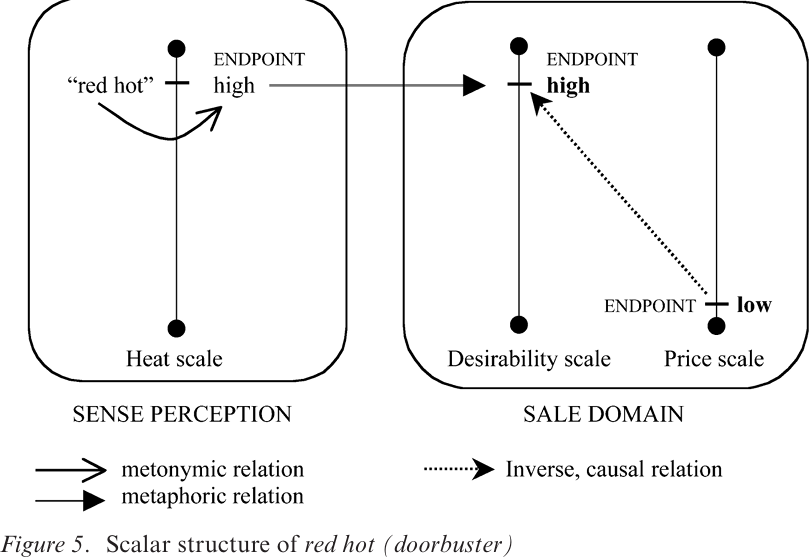
This meaning is not derivable on the basis of the component meanings listed in (31a–c). However, a closer look reveals that (33) contains the content ‘busting the door of the store by avid customers’ although the busting does not necessarily (or even likely) occur, nor is it intended to occur. The noun doorbuster thus has a metaphorical interpretation of “door-busting”: The customers behave like people who are busting doors in order to achieve a desired goal.2 What is more, there is a conceptual link between someone who busts a door and the reason why this person (metaphorically) busts the door, namely to acquire a highly desirable item that is sold at a reduced price. This link can be inferred in the given context. One can conclude then that the meaning of doorbuster is not predictable, but it is not arbitrary either. The base doorbust forms the starting point of a metonymic chain that, in conjunction with the meaning of the suffix-er, yields a conceptually motivated sense that relates it– albeit in a somewhat indirect fashion– to the constituent morphemes door, bust, and-er.
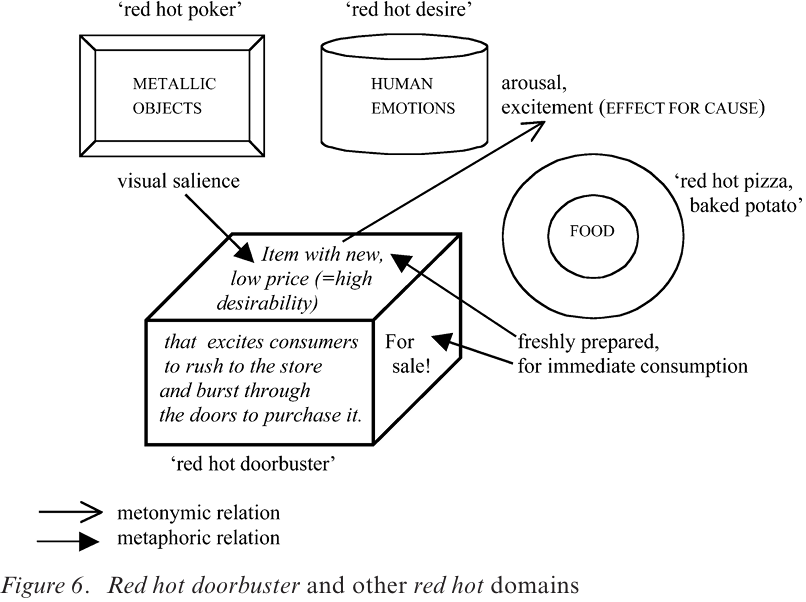
I illustrate in Figure 6 how the meaning of red hot doorbuster fits into a larger network of expressions usable with the modifier red hot. These expressions belong to different conceptual frames, two of which have been already mentioned: the domains of metallic objects/substances and of human emotions. It is clear, however, that other domains are part of this network; I will briefly comment on the domain of food. Expressions such as red hot pizza and red hot baked potato can be used alongside piping hot buns, steaming hot apple pie, etc. Notice that red hot pizza is not as “literal” as red hot poker because red hot pizza lacks a fiery glow even though it may have just come out of the oven. Furthermore, the modifier red hot, combined with a noun denoting food, strongly suggests that the food item has been freshly prepared and should be consumed within a short time period. These attributes are paralleled in the meaning of red hot doorbuster: ‘freshly (recently) prepared food’ corresponds to ‘items with new low prices’; ‘for immediate consumption’ corresponds to ‘for immediate purchase’; and in both domains red hot is associated with the scalar value ‘highly desirable’.
1. This definition is proposed as the basic sense of-er nominals in Panther and Thornburg (2001, 2002).
2. Alternatively one might also assume a hyperbolic interpretation, based on a metonymic shift from a lower value on a behavioral scale, i.e. a relatively civilized way of rushing into a store, to a higher scalar value, i.e. stampede-like behavior that does not shy away from rudeness, aggression and physical force.








