X IS LIKE Y: The emergence of similarity mappings in children’s early speech and gesture
Developmental changes in children’s production of ‘X IS LIKE Y’ construction in their speech
Types of ‘X IS LIKE Y’ constructions in children’s speech
Children produced two types of ‘X IS LIKE Y’ constructions: those involving a comparison of an action to an ongoing action (i.e., action-based comparison), and those involving a comparison of an entity (a person or an object) to another entity present in the immediate context (i.e., feature-based comparison).
The action-based comparisons typically involved specifying the source action encoded by a demonstrative pronoun (this, that) and were actualized in three distinct ways based on the specification of the target domain. In the first and most frequent type of action-based comparison, the source domain was conveyed with a demonstrative pronoun (i.e., like this/ that) and the target domain could be inferred from context (see examples 13, 14).
(13) Like this + CHILD DIPS WASHCLOTH IN WATER AND WIPES HER FACE WITH IT [2;2]
‘Wash face like wash it by wiping it with washcloth’
(14) Like this + CHILD PRETENDS TO TYPE VERY RAPIDLY ON TOY COMPUTER [2;6]
‘Type like type rapidly on keyboard’
In the second type of action-based comparison, the source domain was conveyed by a demonstrative pronoun (like this/that) and the target domain was conveyed with a strong verb (e.g., walk/eat/swim) (see examples 15–17).
(15) I want to climb like that + CHILD ATTEMPTS TO CLIMB UP ON A LADDER [2;2]
‘I want to climb like I climb up using a ladder’
(16) It can run like that + CHILD MAKES DOLL RUN WITH OUTSTRETCHED LEGS [2;6]
‘Doll can run like run by stretching its legs’
(17) We have to rock her like this + CHILD ROCKS DOLL GENTLY IN THE TOY CAR SEAT [2;10]
‘We have to rock the doll like rock her gently’
In the third type of action-based comparison, the source domain was conveyed with a demonstrative pronoun (like this/that) and the target was conveyed by a bleached verb (go, do) (see examples 18–20).
(18) I go like this + CHILD HOPS UP AND DOWN LIKE A FROG [2;6]
‘I go like I hop like a frog’
(19) You do it like this + CHILD PAINTS PICTURE BY STAMPING ON IT [2;6]
‘You do the picture like you paint by stamping on it’
(20) No go like that + CHILD RIDES BIKE BY WALKING HIS FEET ON THE SIDES [2;10]
‘Go like you ride bike by walking your feet on the sides’
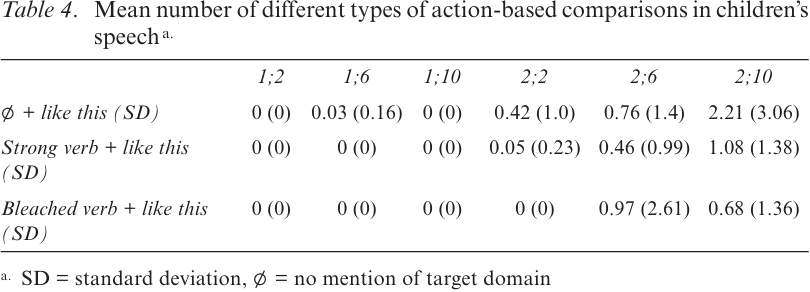
Of the three types of action-based comparisons, the first type in which the target had to be inferred from context was the most frequent and the first to emerge. As Table 4 illustrates, children used the ‘like+ demonstrative pronoun’ construction at age 2;2 (M=0.42) and increased their use of this construction over time (M=2.21 at age 2;10). ‘Like this/that’ constructions were followed by ‘strong verb+ like this’ type constructions. Only a few children produced this construction at age 2;2 (M=0.05) but these constructions became more frequent at age 2;6 (M=0.46) and by age 2;10, half of the children were using the ‘strong verb+ like this’ construction (M=1.08). The ‘bleached verb + like this/that’ type constructions emerged later. Children did not begin to use bleached verbs to express the target domain until age 2;6 and then only 8 of the 40 children used this construction (M=0.97). Children remained relatively stable in their use of bleached verbs to mark the target domain through age 2;10 (M=0.68).
The feature-based comparisons highlighted similarities in perceptual features (e.g., shape, size, color) between two entities. The most typical linguistic construction for feature-based comparisons consisted of a noun encoding the source domain without any mention in speech of the target domain; the verb look often accompanied these constructions (see examples 1–3, repeated below).
(1) Look like a house + CHILD IS LOOKING AT A CHURCH PAINTING [2;2]
‘Church painting looks like a house’
(2) Just like potato-head + CHILD IS PLAYING A COMPUTER GAME SIMILAR TO POTATO-HEAD [2;6]
‘Computer game is like potato-head’
(3) Like a mean monster + CHILD HAS BEEN TALKING ABOUT TORNADOS [2;10]
‘Tornado is like a mean monster’
In the second type of feature-based comparison, both the source and target domains were encoded in a noun or a pronoun, frequently accompanied by the verb look. Interestingly, most of these feature-based comparisons highlighted the general appearance of the two objects, without specifying the exact basis of the comparison, as can be seen in examples 21-to-23.
(21) That looks like Scooby + CHILD IS LOOKING AT A DOG PICTURE [2;2]
‘Dog picture looks like Scooby the dog’
(22) It looks like a skirt + CHILD IS HOLDING HER UNDERSKIRT [2;6]
‘Underskirt looks like a skirt’
(23) I want to make a boat like that one + CHILD HAS BEEN BUILDING BOATS WITH BLOCKS [2;10]
‘I want to make a boat like my previous boat’
There were, however, a few feature-based comparisons, which specified the basis of comparison between the two objects. The two dimensions that were explicitly mentioned were color (examples 24–25) and size (example 26).
(24) It is like blue like this one + CHILD POINTS TO BLUE SCRIBBLE WHILE PLAYING WITH A BLUE TOY [2;6]
‘Blue toy is blue like the blue scribble’
(25) It is brown like my hair + CHILD IS DRAWING WITH A BROWN CRAYON [2;10]
‘Brown crayon is brown like child’s brown hair’
(26) It is big like that + CHILD IS MAKING CHURCHES OF DIFFERENT SIZES WITH BLOCKS [2;10]
‘Church A is big like church B’
The children were also able to highlight these dimensions using contextual cues (see examples 27–28 for color, example 29 for size, and examples 30–31 for shape).
(27) Like the man with the yellow hat + CHILD IS PLAYING WITH YELLOW TRIANGLE [2;10]
‘Yellow triangle is yellow like the man with the yellow hat’
(28) And this one is like this + CHILD COMPARES GREEN CRAYON TO GREEN STRIPE ON HIS SHIRT [2;10]
‘Green crayon is green like green stripes’
(29) Like this + CHILD PINCHES FINGERS TO PRODUCE THE ICONIC GESTURE OF SMALL [2;10]
‘Size of ponytail is small like the size of my finger’
(30) Like a tunnel + CHILD HOLDS HAND IN THE SHAPE OF AN ELONGATED HOLLOW OBJECT [2;10]
‘Child’s hand is elongated like a tunnel’
(31) Like a circle + CHILD IS PLAYING WITH LETTER O [2;10]
‘Letter O is circular like a circle’
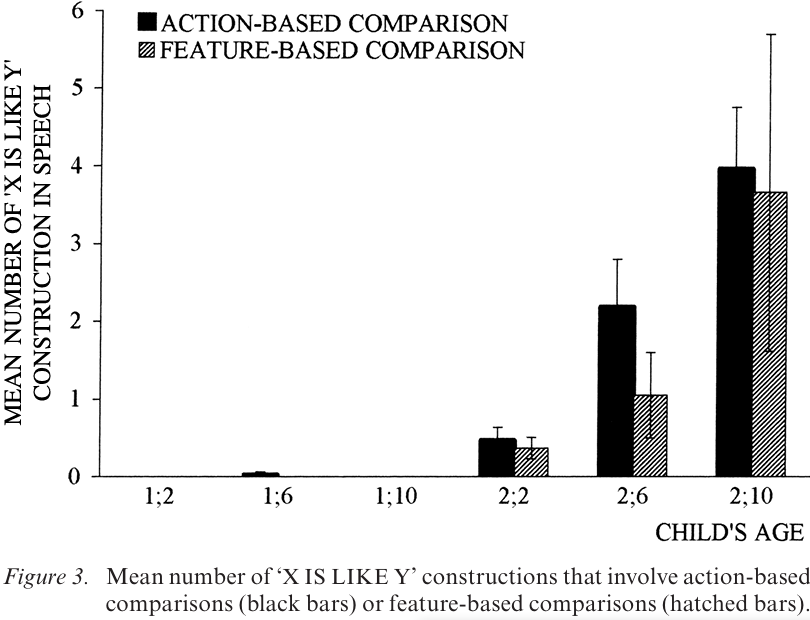
Children’s production of action-based and feature-based comparisons showed a main effect of age (F(5, 170)=6.96, p<0.001), but no effect of comparison type (F(1, 34)=0.63, ns) and no interaction (F(5, 170)=0.39, ns). As can be seen in Figure 3, children reliably increased their production of both action-based (F(5, 170)=16.49, p<0.0001) and feature-based comparisons (F(5, 170)=2.78, p<0.05) over time, with significant changes occurring between ages 2;2 and 2;10 (p’s<0.001, Schéffe). However, their production of action-based and feature-based comparisons was comparable at each age.
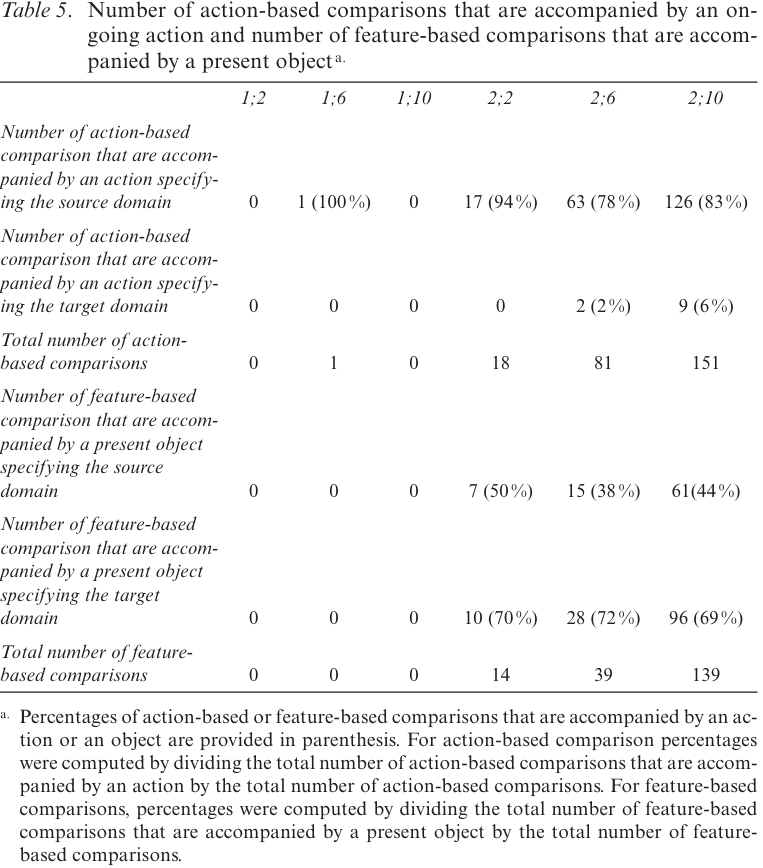
To summarize thus far, children produced two types of ‘X IS LIKE Y’ constructions in their speech– those comparing two actions, and those comparing two objects. They used each type of comparison at roughly equal rates, and their production of each type increased with age. Note that the children in our study produced ‘X IS LIKE Y’ constructions in their spontaneous speech earlier than children have been reported to produce or understand these constructions in experimental settings. One of the reasons for this early appearance of the construction may be that there was typically a great deal of contextual support for these constructions. Children relied on a variety of non-verbal tools to specify both their action- and feature-based comparisons. As can be seen in Table 5, across the different ages, 80 to100% of action-based comparisons were accompanied by an ongoing action that specified the source domain (see examples 13–20), and 40 to 70% of feature-based comparisons were accompanied by a present object that clarified either the source or the target domain (see examples 21–23). Thus, children’s initial uses of the ‘X IS LIKE Y’ construction were highly context-dependent, typically accompanied by an ongoing action, visible object, or gesture. We will focus on one of these non-verbal devices, namely gesture, asking whether gestures play a role in helping children to convey the ‘X IS LIKE Y’ construction before they can convey it entirely in speech.