Born: 5 May 1580 in Ulm, Germany
Died: 1635 in Ulm, Germany
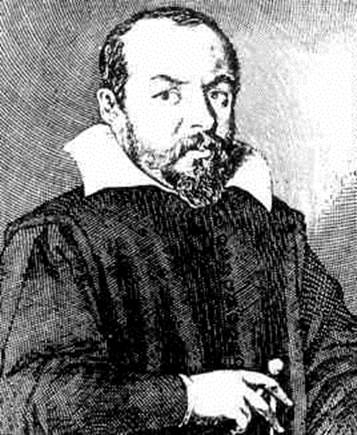
Johann Faulhaber was trained as a weaver. However he was taught mathematics in Ulm and showed such promise that the City of Ulm appointed him city mathematician and surveyor. He opened his own school in Ulm in 1600 but he was in great demand because of his skill in fortification work.
His expertise saw him working on fortifications for Basel, Frankfurt and many other cities. He also designed waterwheels in Ulm and made mathematical and surveying instruments, particularly ones with military applications.
Among the scientists with whom Faulhaber collaborated were Kepler and van Ceulen. He was a Rosicrucian, a brotherhood combining elements of mystical beliefs with an optimism about the ability of science to improve the human condition. He made a major impression on Descartes with both his scientific and Rosicrucian beliefs and influenced his thinking.
Faulhaber was a 'Cossist', an early algebraist. He is important for his work explaining logarithms associated with Stifel, Bürgi and Napier. He made the first German publication of Briggs' logarithms.
Faulhaber's most major contribution, however, was in studying sums of powers of integers. Let N = n(n+1)/2. Define ∑ nk to be the sum ∑ ik where the sum is from 1 to n. Then N = ∑ n1. In 1631 Faulhaber published Academia Algebra in Augsburg. It was a German text despite the Latin title.
In Academia Algebra Faulhaber gives ∑ nk as a polynomial in N, for k = 1, 3, 5, ... ,17. He also gives the corresponding polynomials in n. Faulhaber states that such polynomials in N exist for all k, but gave no proof. This was first proved by Jacobi in 1834. It is not known how much Jacobi was influenced by Faulhaber's work, but we do know that Jacobi owned Academia Algebra since his copy of it is now in the University of Cambridge.
Faulhaber did not discover the Bernoulli numbers but Jacob Bernoulli refers to Faulhaber in Ars Conjectandi published in Basel in 1713, eight years after Jacob Bernoulli died, where the Bernoulli numbers (so named by De Moivre) appear.
Academia Algebra contains a generalisation of sums of powers. Faulhaber gave formulae for m-fold sums of powers defined as follows.
Define ∑0nk = nk and ∑m+1nk = ∑m1k + ∑m2k + ... + ∑mnk.
Faulhaber gives formulae for many of these m-fold sums including giving a polynomial for ∑11n6. Knuth, in [7] remarks:-
His polynomial ... turns out to be absolutely correct, according to calculations with a modern computer. ... One cannot help thinking that nobody has ever checked these numbers since Faulhaber himself wrote them down, until today.
At the end of Academia Algebra Faulhaber states that he has calculated polynomials for ∑ nk as far as k = 25. He gives the formulae in the form of a secret code, which was common practice at the time. Knuth, in [8], suggests he is the first to crack the code: (the task [of cracking the code] is relatively easy withmodern computers) and shows that Faulhaber had the correct formulae up to k = 23, but his formulae for k = 24 and k = 25 appear to be wrong.
- P A Kirchvogel, Biography in Dictionary of Scientific Biography (New York 1970-1990).
http://www.encyclopedia.com/doc/1G2-2830901390.html
Books:
- I Schneider, Johannes Faulhaber (1580-1635): Rechenmeister in einer Zeit des Umbruchs (Basel, 1993).
- K Hawlitschek, Johann Faulhaber 1580 - 1635 Eine Blütezeit der mathematischen Wissenschaften in Ulm (Ulm, 1995).
Articles:
- A F Beardon, Sums of powers of integers, Amer. Math. Monthly 103 (1996), 201-213.
- A W F Edwards, Sums of powers of integers : a little history, Mathematical Gazette 66 (1982), 22-29.
- A W F Edwards, A quick route to sums of powers, Amer. Math. Monthly 93 (1986), 451-455.
- H Keefer, Johannes Faulhaber, der bedeutendste Ulmer Mathematiker und Festungsbaumeister,Württembergische Schulwarte 4 (1928), 1-12.
- D E Knuth, Johann Faulhaber and Sums of Powers, Mathematics of Computation 61 (1993), 277-294.
- G Zweckbronner, Rechenmeister, Ingenieur und Bürger zu Ulm - Johann Faulhaber (1580-1635) in seiner Zeit, Technikgeschichte 47 (2) (1980), 114-132








