Born: 11 July 1904 in Aalen, Württemberg, Germany
Died: 5 June 1986
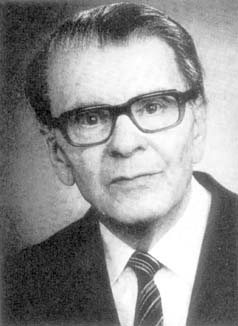
Helmut Grunsky's father was Heinrich Grunsky and his mother was Lydia Stahl. Helmut was brough up in Aalen where he attended high school. At this stage, although he took a great interest in mathematics, it was not the topic which he intebded to pursue at university, rather he was interested in physics and engineering. In 1922 he entered the Institute of Technology in Stuttgart where he studied physics.
After three years at the Institute of Technology in Stuttgart, in 1925 he entered the Institute of Technology in Berlin. After two years study there he was awarded the degree Diplom-Ingenieur. At this stage he began to undertake research in mathematics at the University of Berlin with a view to a doctorate in mathematics. Grunsky worked on complex analysis for his doctorate but he took a job before submitting his thesis.
In November 1930 Grunsky took a job with the journal Jahrbuch über die Fortschritte der Mathematik which was published by the Preussische Akademie der Wissenschaften. For his doctorate he was using contour integration to study different problems concerning functions which are univalent in a domain of finite connectivity. He submitted his thesis Neue Abschätzungen zur konformen Abbildung ein- und mehrfach zusammenhängender Bereiche to the University of Berlin in 1932 and was awarded his Dr. phil.
At this stage Grunsky continued his work for the journal Jahrbuch über die Fortschritte der Mathematik while he worked on his habilitation thesis. In 1935 Grunsky married Irma Schenk; they had three children Wolfgang (born in 1936), Hiltrud (born in 1938), and Eberhard (born in 1941). In the same year that he married Grunsky became editor of the journal and, three years later he published Koeffizientenbedingungen für schlicht abbildende meromorphe Funktionen in Mathematische Zeitschrift. This was Grunsky's thirteenth paper which was written as an habilitation dissertation. As for his doctoral thesis, this work again looks at applications of contour integration [2]:-
This paper presents a study of coefficients for functions in a domain of finite connectivity on the sphere containing the point at infinity.
Grunsky became qualified to lecture just before the start of World War II. The war made it impossible for him to begin an academic career at this stage and he also had to leave his position as editor of the Jahrbuch über die Fortschritte der Mathematik in 1939. Difficulties at the end of the war did not allow him to enter university teaching even then so in 1945 Grunsky took a position as a high school teacher in Trossingen, Württemberg. He continued to teach mathematics at the high school until 1949 when he became a Privatdozent at the University of Tübingen. It is worth noting that due to various circumstances Grunsky did not enter university teaching until he was 45 years old.
Grunsky have an invited address at the International Congress of Mathematicians held at Cambridge, Massachusetts in 1950. For the academic year 1950-51 he was Visiting Professor at Washington State College in Pullman, Washington. Returning to Germany he was appointed as Extraordinary Professor at the University of Mainz. In 1958 Grunsky moved to the University of Würzburg where he became a full Professor. In 1963-64 he spent the academic year as a visiting professor at the Middle East Technical University in Ankara, Turkey. He remained in this position at Würzburg until he retired in 1972. Following this he had some other positions, first as research consultant at Washington University, St Louis in 1973, then visiting professor at the State University of New York in Albany in 1975, finally back to Washington University, St Louis as research consultant in 1977.
Grunsky published three books and 44 papers, and he supervised eight doctoral students. All are listed in [2]. Of the three book one was Lectures on the theory of functions in multiply connected domains published in 1978. It [2]:-
... is most closely related to Helmut Grunsky's overall activity and consists of a reworking of some of his most significant contributions to function theory, in many cases with a considerable simplification of exposition.
The final book he wrote was [1] The general Stokes' theorem published in 1983. Grunsky writes that the aim of the book is to give [1]:-
... an intrinsic and easily comprehensible presentation of Stokes's theorem.
The treatise begins with an intuitive discussion of Stokes's theorem in the plane, which is then used as a model for generalising the result to higher dimensions. Grunsky first proves Stokes's theorem for suitable k-dimensional region in Rk, and then for k-dimensional regions in Rn. He then introduces the calculus of alternating multilinear forms and gives a proof of Stokes's theorem for manifolds.
Books:
- H Grunsky, The general Stokes' theorem (Boston, MA, 1983).
Articles:
- J A Jenkins, Helmut Grunsky, Jahresber. Deutsch. Math.-Verein. 91 (4) (1989), 159-167.








