تاريخ الرياضيات

الاعداد و نظريتها
تاريخ التحليل
تار يخ الجبر
الهندسة و التبلوجي
الرياضيات في الحضارات المختلفة
العربية
اليونانية
البابلية
الصينية
المايا
المصرية
الهندية
الرياضيات المتقطعة
المنطق
اسس الرياضيات
فلسفة الرياضيات
مواضيع عامة في المنطق
الجبر
الجبر الخطي
الجبر المجرد
الجبر البولياني
مواضيع عامة في الجبر
الضبابية
نظرية المجموعات
نظرية الزمر
نظرية الحلقات والحقول
نظرية الاعداد
نظرية الفئات
حساب المتجهات
المتتاليات-المتسلسلات
المصفوفات و نظريتها
المثلثات
الهندسة
الهندسة المستوية
الهندسة غير المستوية
مواضيع عامة في الهندسة
التفاضل و التكامل
المعادلات التفاضلية و التكاملية
معادلات تفاضلية
معادلات تكاملية
مواضيع عامة في المعادلات
التحليل
التحليل العددي
التحليل العقدي
التحليل الدالي
مواضيع عامة في التحليل
التحليل الحقيقي
التبلوجيا
نظرية الالعاب
الاحتمالات و الاحصاء
نظرية التحكم
بحوث العمليات
نظرية الكم
الشفرات
الرياضيات التطبيقية
نظريات ومبرهنات
علماء الرياضيات
500AD
500-1499
1000to1499
1500to1599
1600to1649
1650to1699
1700to1749
1750to1779
1780to1799
1800to1819
1820to1829
1830to1839
1840to1849
1850to1859
1860to1864
1865to1869
1870to1874
1875to1879
1880to1884
1885to1889
1890to1894
1895to1899
1900to1904
1905to1909
1910to1914
1915to1919
1920to1924
1925to1929
1930to1939
1940to the present
علماء الرياضيات
الرياضيات في العلوم الاخرى
بحوث و اطاريح جامعية
هل تعلم
طرائق التدريس
الرياضيات العامة
نظرية البيان

Andreas Floer
 المؤلف:
Andreas Floer 1956-1991
المؤلف:
Andreas Floer 1956-1991
 المصدر:
in The Floer memorial volume
المصدر:
in The Floer memorial volume
 الجزء والصفحة:
...
الجزء والصفحة:
...
 21-3-2018
 909
909




+
-
20
Born: 23 August 1956 in Duisburg, Germany
Died: 15 May 1991 in Bochum, Germany
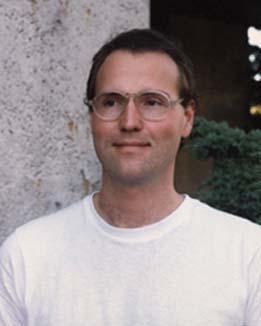
Andreas Floer studied at the Ruhr University in Bochum, a new university founded in 1965. He received the degree Diplom-Mathematiker in 1982 after studying with R Stöcker and E Zehnder. His main interests were in algebraic topology and, in the autumn of 1982, he went to the University of California at Berkeley to continue his research. There he worked for his doctorate with Clifford Taubes on gauge theory and with Alan Weinstein on symplectic geometry but, before completing his thesis with Taubes on monopoles on 3-manifolds, he returned to Germany in the summer of 1984 to undertake military service.
Back in Germany he returned to the Ruhr University at Bochum where, supervised by Zehnder, he undertook research on V I Arnol'd's fixed-point conjecture for symplectic maps. He quickly wrote a dissertation and by December 1984 he had received his doctorate. Together with Zehnder, he published Fixed point results for symplectic maps related to the Arnol'd conjecture in the Proceedings of the conference Dynamical systems and bifurcations held in Groningen in 1984. The authors state in their introduction:-
Our aim is to present some recent results and open questions concerning the fixed point problem of symplectic maps related to the Arnol'd conjecture.
Floer was appointed as a research assistant at the University of California at Berkeley and he returned to the United States in early 1985 to take up the appointment. Back in Berkeley he began to develop a fundamental theory which is now named Floer homology. Floer obtained a postdoctoral fellowship in mathematical physics at the State University of New York at Stony Brook where he worked for a year before being appointed Courant Instructor at New York University where he spent the following two years. In 1988 he returned to Berkeley as an Assistant Professor and he was promoted to full Professor in 1990.
John Addison, Andrew Casson, and Alan Weinstein in an obituary of Floer describe his fundamental observation:-
... Floer developed a new method for "counting" the solutions of maximum-minimum problems arising in geometry. A certain quantity called the "index" traditionally used to classify solutions was infinite, and therefore unhelpful, in many important but apparently intractable problems. Andreas realized that the difference between the indices of any two solutions could still be defined and could be used where the index itself was useless. Combining this observation with detailed, careful analysis, and using work of many other mathematicians as well as his own, Andreas developed a theory that led to the solution of a number of outstanding problems. The value of his work was grasped immediately by specialists in differential geometry, topology, and mathematical physics, for whom "Floer homology" has become an essential part of their problem-solving toolkit.
In 1987 Floer published Morse theory for fixed points of symplectic diffeomorphisms in the Bulletin of the American Mathematical Society. In this paper he proves a special case of Arnol'd's conjecture on the number of fixed points of an exact deformation of a compact symplectic manifold. He was soon in demand as a speaker in conferences throughout the world. He accepted invitations to speak in Moscow, Oxford, Paris, and Zurich. The most prestigious invitation of all was the invitation to present a plenary address at the International Congress of Mathematicians held in Kyoto in August 1990. He addressed the conference on Elliptic methods in variational problems in which he spoke of his work on Morse theory for infinite-dimensional manifolds. After reviewing Morse theory in finite dimensions, Floer went on to outline applications to symplectic geometry, working on the loop space on a symplectic manifold. He then outlined the applications to gauge theory on a 3-manifold via the Chern-Simons function on the space of connections in a bundle over the manifold.
Donaldson discusses Floer's work in [2]. In particular he looks there at Floer's progress on the Arnol'd conjecture and instanton homology, and at Floer's instanton homology and 4-dimensional cobordisms.
His promotion to full Professor at Berkeley came at a time when he was considering a number of offers of chairs from different universities. One offer came from Bochum and he obtained leave from Berkeley to take up the professorship at the Ruhr-Universität Bochum for session 1990-91.
Floer's attitude to teaching is discussed by John Addison, Andrew Casson, and Alan Weinstein:-
Although Andreas' fame came from his research, he had an intense personal concern with questions of teaching. Thanks in part to his German education, he was dissatisfied with the traditional American "by the book" approach to undergraduate courses. While teaching a course in real analysis, he had taken the material apart from top to bottom, reanalysing standard concepts and theorems in order to prepare his students for mathematics as it is done today.
They end with this tribute:-
Andreas is survived by his mother, Marlies Floer, and his brothers, Detlef and Rainer Floer. ... The death of such a brilliant young mathematician at the height of his creative powers is a special tragedy: we rejoice and marvel at the deep and seminal insights he had already had, but mourn the loss to science and mankind of the further beautiful and important discoveries he would have made.
H Hofer, A Weinstein and E Zehnder write in [4]:-
Andreas Floer's life was tragically interrupted, but his mathematical visions and striking contributions have provided powerful methods which are being applied to problems which seemed to be intractable only a few years ago.
Articles:
- Andreas Floer 1956-1991, in The Floer memorial volume (Basel, 1995), ix-xii.
- S K Donaldson, On the work of Andreas Floer, Jahresber. Deutsch. Math.-Verein. 95 (3) (1993), 103-120.
- H Hofer and E Zehnder, Andreas Floer, 1956-1991, in Topological and geometrical methods in field theory, Turku, 1991 (River Edge, NJ, 1992), xi.
- H Hofer, A Weinstein and E Zehnder, Andreas Floer : 1956-1991, Notices Amer. Math. Soc. 38 (8) (1991), 910-911.
 الاكثر قراءة في 1940to the present
 اخر الاخبار
اخبار العتبة العباسية المقدسة

الآخبار الصحية


مواضيع ذات صلة
 قسم الشؤون الفكرية يصدر كتاباً يوثق تاريخ السدانة في العتبة العباسية المقدسة
 "المهمة".. إصدار قصصي يوثّق القصص الفائزة في مسابقة فتوى الدفاع المقدسة للقصة القصيرة
 (نوافذ).. إصدار أدبي يوثق القصص الفائزة في مسابقة الإمام العسكري (عليه السلام)