q-Binomial Coefficient
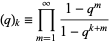
The  -binomial coefficient is a q-analog for the binomial coefficient, also called a Gaussian coefficient or a Gaussian polynomial. A
  -binomial coefficient is given by
![[n; m]_q=((q)_n)/((q)_m(q)_(n-m))=product_(i=0)^(m-1)(1-q^(n-i))/(1-q^(i+1)),](http://mathworld.wolfram.com/images/equations/q-BinomialCoefficient/NumberedEquation1.gif) |
(1)
|
where
 |
(2)
|
is a q-series (Koepf 1998, p. 26). For  ,
,
![[n; k]_q=([n]_q!)/([k]_q![n-k]_q!),](http://mathworld.wolfram.com/images/equations/q-BinomialCoefficient/NumberedEquation3.gif) |
(3)
|
where ![[n]_q!](http://mathworld.wolfram.com/images/equations/q-BinomialCoefficient/Inline4.gif) is a q-factorial (Koepf 1998, p. 30). The
is a q-factorial (Koepf 1998, p. 30). The  -binomial coefficient can also be defined in terms of the q-brackets
 ![[k]_q](http://mathworld.wolfram.com/images/equations/q-BinomialCoefficient/Inline6.gif) by
by
![[n; k]_q=<span style=]() {product_(i=1)^(k)([n-i+1]_q)/([i]_q) for 0<=k<=n; 0 otherwise. " src="http://mathworld.wolfram.com/images/equations/q-BinomialCoefficient/NumberedEquation4.gif" style="height:72px; width:229px" /> {product_(i=1)^(k)([n-i+1]_q)/([i]_q) for 0<=k<=n; 0 otherwise. " src="http://mathworld.wolfram.com/images/equations/q-BinomialCoefficient/NumberedEquation4.gif" style="height:72px; width:229px" /> |
(4)
|
The  -binomial is implemented in the Wolfram Language as QBinomial[n, m, q].
For  , the
, the  -binomial coefficients turn into the usual binomial coefficient.
The special case
![[n]_q=[n; 1]_q=(1-q^n)/(1-q)](http://mathworld.wolfram.com/images/equations/q-BinomialCoefficient/NumberedEquation5.gif) |
(5)
|
is sometimes known as the q-bracket.
The  -binomial coefficient satisfies the recurrence equation
![[n+1; k]_q=q^k[n; k]_q+[n; k-1]_q,](http://mathworld.wolfram.com/images/equations/q-BinomialCoefficient/NumberedEquation6.gif) |
(6)
|
for all  and
and  , so every
  -binomial coefficient is a polynomial in
  . The first few
  -binomial coefficients are
From the definition, it follows that
![[n; 1]_q=[n; n-1]_q=sum_(i=0)^(n-1)q^i.](http://mathworld.wolfram.com/images/equations/q-BinomialCoefficient/NumberedEquation7.gif) |
(11)
|
Additional identities include
The  -binomial coefficient
 ![[n; m]_q](http://mathworld.wolfram.com/images/equations/q-BinomialCoefficient/Inline35.gif) can be constructed by building all
can be constructed by building all  -subsets of
 ![<span style=]() {1,2,...,n}" src="http://mathworld.wolfram.com/images/equations/q-BinomialCoefficient/Inline37.gif" style="height:14px; width:69px" />, summing the elements of each subset, and taking the sum
{1,2,...,n}" src="http://mathworld.wolfram.com/images/equations/q-BinomialCoefficient/Inline37.gif" style="height:14px; width:69px" />, summing the elements of each subset, and taking the sum
![[n; m]_q=sum_(i)q^(s_i-m(m+1)/2)](http://mathworld.wolfram.com/images/equations/q-BinomialCoefficient/NumberedEquation8.gif) |
(14)
|
over all subset-sums  (Kac and Cheung 2001, p. 19).
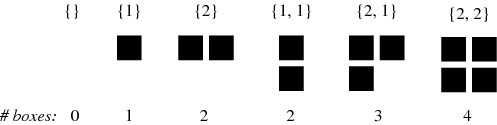
The  -binomial coefficient
 ![[m+n; m]_q](http://mathworld.wolfram.com/images/equations/q-BinomialCoefficient/Inline40.gif) can also be interpreted as a polynomial in
can also be interpreted as a polynomial in  whose coefficient
  counts the number of distinct partitions of
  elements which fit inside an
  rectangle. For example, the partitions of 1, 2, 3, and 4 are given in the following table.
 |
partitions |
| 0 |
![<span style=]() {}" src="http://mathworld.wolfram.com/images/equations/q-BinomialCoefficient/Inline46.gif" style="height:14px; width:10px" /> {}" src="http://mathworld.wolfram.com/images/equations/q-BinomialCoefficient/Inline46.gif" style="height:14px; width:10px" /> |
| 1 |
![<span style=]() {{1}}" src="http://mathworld.wolfram.com/images/equations/q-BinomialCoefficient/Inline47.gif" style="height:14px; width:27px" /> {{1}}" src="http://mathworld.wolfram.com/images/equations/q-BinomialCoefficient/Inline47.gif" style="height:14px; width:27px" /> |
| 2 |
![<span style=]() {{2},{1,1}}" src="http://mathworld.wolfram.com/images/equations/q-BinomialCoefficient/Inline48.gif" style="height:14px; width:67px" /> {{2},{1,1}}" src="http://mathworld.wolfram.com/images/equations/q-BinomialCoefficient/Inline48.gif" style="height:14px; width:67px" /> |
| 3 |
![<span style=]() {{3},{2,1},{1,1,1}}" src="http://mathworld.wolfram.com/images/equations/q-BinomialCoefficient/Inline49.gif" style="height:14px; width:122px" /> {{3},{2,1},{1,1,1}}" src="http://mathworld.wolfram.com/images/equations/q-BinomialCoefficient/Inline49.gif" style="height:14px; width:122px" /> |
| 4 |
![<span style=]() {{4},{3,1},{2,2},{2,1,1},{1,1,1,1}}" src="http://mathworld.wolfram.com/images/equations/q-BinomialCoefficient/Inline50.gif" style="height:14px; width:232px" /> {{4},{3,1},{2,2},{2,1,1},{1,1,1,1}}" src="http://mathworld.wolfram.com/images/equations/q-BinomialCoefficient/Inline50.gif" style="height:14px; width:232px" /> |
Of these, ![<span style=]() {}" src="http://mathworld.wolfram.com/images/equations/q-BinomialCoefficient/Inline51.gif" style="height:14px; width:10px" />,
{}" src="http://mathworld.wolfram.com/images/equations/q-BinomialCoefficient/Inline51.gif" style="height:14px; width:10px" />, ![<span style=]() {1}" src="http://mathworld.wolfram.com/images/equations/q-BinomialCoefficient/Inline52.gif" style="height:14px; width:17px" />,
{1}" src="http://mathworld.wolfram.com/images/equations/q-BinomialCoefficient/Inline52.gif" style="height:14px; width:17px" />, ![<span style=]() {2}" src="http://mathworld.wolfram.com/images/equations/q-BinomialCoefficient/Inline53.gif" style="height:14px; width:17px" />,
{2}" src="http://mathworld.wolfram.com/images/equations/q-BinomialCoefficient/Inline53.gif" style="height:14px; width:17px" />, ![<span style=]() {1,1}" src="http://mathworld.wolfram.com/images/equations/q-BinomialCoefficient/Inline54.gif" style="height:14px; width:32px" />,
{1,1}" src="http://mathworld.wolfram.com/images/equations/q-BinomialCoefficient/Inline54.gif" style="height:14px; width:32px" />, ![<span style=]() {2,1}" src="http://mathworld.wolfram.com/images/equations/q-BinomialCoefficient/Inline55.gif" style="height:14px; width:32px" />, and
{2,1}" src="http://mathworld.wolfram.com/images/equations/q-BinomialCoefficient/Inline55.gif" style="height:14px; width:32px" />, and ![<span style=]() {2,2}" src="http://mathworld.wolfram.com/images/equations/q-BinomialCoefficient/Inline56.gif" style="height:14px; width:32px" /> fit inside a
{2,2}" src="http://mathworld.wolfram.com/images/equations/q-BinomialCoefficient/Inline56.gif" style="height:14px; width:32px" /> fit inside a  box. The counts of these having 0, 1, 2, 3, and 4 elements are 1, 1, 2, 1, and 1, so the (4, 2)-binomial coefficient is given by
![[4; 2]_q=1+q+2q^2+q^3+q^4,](http://mathworld.wolfram.com/images/equations/q-BinomialCoefficient/NumberedEquation9.gif) |
(15)
|
as above.
REFERENCES:
Gasper, G. and Rahman, M. Basic Hypergeometric Series. Cambridge, England: Cambridge University Press, 1990.
Kac, V. Cheung, P. Quantum Calculus. New York:Springer-Verlag, 2001.
Koekoek, R. and Swarttouw, R. F. "The q-Gamma Function and the q-Binomial Coefficient." §0.3 in The Askey-Scheme of Hypergeometric Orthogonal Polynomials and its q-Analogue. Delft, Netherlands: Technische Universiteit Delft, Faculty of Technical Mathematics and Informatics Report 98-17, pp. 10-11, 1998.
Koepf, W. Hypergeometric Summation: An Algorithmic Approach to Summation and Special Function Identities. Braunschweig, Germany: Vieweg, p. 26, 1998.a








