

Grammar


Tenses


Present

Present Simple

Present Continuous

Present Perfect

Present Perfect Continuous


Past

Past Simple

Past Continuous

Past Perfect

Past Perfect Continuous


Future

Future Simple

Future Continuous

Future Perfect

Future Perfect Continuous


Parts Of Speech


Nouns

Countable and uncountable nouns

Verbal nouns

Singular and Plural nouns

Proper nouns

Nouns gender

Nouns definition

Concrete nouns

Abstract nouns

Common nouns

Collective nouns

Definition Of Nouns

Animate and Inanimate nouns

Nouns


Verbs

Stative and dynamic verbs

Finite and nonfinite verbs

To be verbs

Transitive and intransitive verbs

Auxiliary verbs

Modal verbs

Regular and irregular verbs

Action verbs

Verbs


Adverbs

Relative adverbs

Interrogative adverbs

Adverbs of time

Adverbs of place

Adverbs of reason

Adverbs of quantity

Adverbs of manner

Adverbs of frequency

Adverbs of affirmation

Adverbs


Adjectives

Quantitative adjective

Proper adjective

Possessive adjective

Numeral adjective

Interrogative adjective

Distributive adjective

Descriptive adjective

Demonstrative adjective


Pronouns

Subject pronoun

Relative pronoun

Reflexive pronoun

Reciprocal pronoun

Possessive pronoun

Personal pronoun

Interrogative pronoun

Indefinite pronoun

Emphatic pronoun

Distributive pronoun

Demonstrative pronoun

Pronouns


Pre Position


Preposition by function

Time preposition

Reason preposition

Possession preposition

Place preposition

Phrases preposition

Origin preposition

Measure preposition

Direction preposition

Contrast preposition

Agent preposition


Preposition by construction

Simple preposition

Phrase preposition

Double preposition

Compound preposition

prepositions


Conjunctions

Subordinating conjunction

Correlative conjunction

Coordinating conjunction

Conjunctive adverbs

conjunctions


Interjections

Express calling interjection

Phrases

Sentences


Grammar Rules

Passive and Active

Preference

Requests and offers

wishes

Be used to

Some and any

Could have done

Describing people

Giving advices

Possession

Comparative and superlative

Giving Reason

Making Suggestions

Apologizing

Forming questions

Since and for

Directions

Obligation

Adverbials

invitation

Articles

Imaginary condition

Zero conditional

First conditional

Second conditional

Third conditional

Reported speech

Demonstratives

Determiners


Linguistics

Phonetics

Phonology

Linguistics fields

Syntax

Morphology

Semantics

pragmatics

History

Writing

Grammar

Phonetics and Phonology

Semiotics


Reading Comprehension

Elementary

Intermediate

Advanced


Teaching Methods

Teaching Strategies

Assessment
Possessive Pronoun
المؤلف:
YOURDICTIONARY.COM
المصدر:
...
الجزء والصفحة:
...
23-5-2021
1353
What Is a Possessive Pronoun?
Understanding the different types of pronouns can be a bit confusing. So when the question, "What is a possessive pronoun?" arises, students may try to run for the door.
There's nothing to be afraid of though. Possessive pronouns are simply the replacement team for nouns or noun phrases that run the risk of sounding repetitive. And, of course, they also show possession. One of the best ways to understand possessive pronouns is to know how they function in a sentence. Let's take a look.
Defining Possessive Pronouns:
Possessive pronouns do exactly what it seems like they should do. They are the pronouns that help us show possession or ownership in a sentence. There are two types of possessive pronouns:
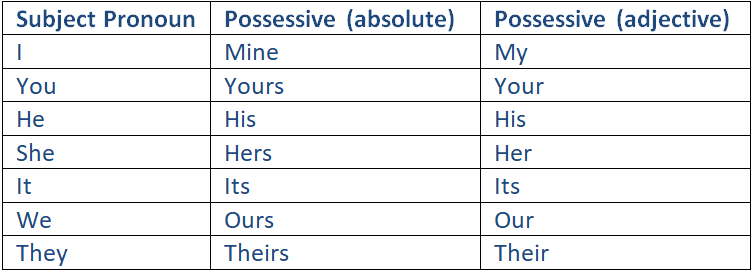
The strong (or absolute) possessive pronouns are mine, yours, his, hers, its, ours, yours, and theirs. They refer back to a noun or noun phrase already used, replacing it to avoid repetition: "I said that phone was mine."
The weak possessive pronouns (also called possessive adjectives) are my, your, his, her, its, our, your, and their. They function as determiners in front of a noun to describe who something belongs to: "I said that's my phone."
When we want to use a pronoun to show possession, we cannot use subject pronouns. Does the following make sense?
This is my brother. He name is Alex.
No. And here's why. "He" is a subject pronoun. Now, if you replace it with the appropriate possessive pronoun, it will make a lot more sense:
This is my brother. His name is Alex.
Providing Clarity:
Without doubt, possessive pronouns help us to be more concise and use less words when explaining the same idea.
The more concise you can be, the greater the chance the readers will follow what you're saying. Take a look at the examples below and see if you can understand one sentence better than the other:
Those are my Converse sneakers. They are not your Converse sneakers.
Those are my Converse sneakers. They are not yours.
I didn't have my textbook for English class, so Brian lent me his textbook.
I didn't have my textbook for English class, so Brian lent me his.
Your travel plans sound just as exciting as my travel plans!
Your travel plans sound just as exciting as mine!
Generally, you will use possessive pronouns to talk about a person, place, or thing that has already been explained. In the examples above, you can see that each sentiment was neatly expressed in fewer words with a strong possessive pronoun.
Now that you understand how they work, try using some of these possessive pronouns in your own sentences. Here's a reminder of the possessive forms:
الاكثر قراءة في Possessive pronoun
اخر الاخبار
اخبار العتبة العباسية المقدسة
الآخبار الصحية

قسم الشؤون الفكرية يصدر كتاباً يوثق تاريخ السدانة في العتبة العباسية المقدسة
"المهمة".. إصدار قصصي يوثّق القصص الفائزة في مسابقة فتوى الدفاع المقدسة للقصة القصيرة
(نوافذ).. إصدار أدبي يوثق القصص الفائزة في مسابقة الإمام العسكري (عليه السلام)


