English grammar – Zero conditional
Form
If + present simple + present simple
Meaning
Zero conditional is used to talk about facts or situations which are always true.
If you heat water, eventually it boils.
If people don’t eat or drink, they die.
Zero conditional in detail
What is a conditional sentence?
Conditional sentences consist of two clauses, an independent clause and an adverb clause of condition.
Here’s an independent clause:
Water boils.
And here’s an adverb clause of condition:
If you heat water
Adverb clauses are a type of dependent clause. Dependent clauses don’t make sense on their own. We need to join them to an independent clause for them to make sense. Let’s do that with this one::
If you heat water, it boils.
(We’ve replaced the noun “water” in the independent clause with the pronoun “it”, to avoid repetition.)
We’ve joined together the two clauses to make a conditional sentence. Conditional sentences tell us that something will or might happen (some kind of result or consequence) if a certain condition is met.
The adverb clause “If you heat water” gives us the condition, and the independent clause “it boils” gives us the result or consequence.
There are different ways we can put together conditional sentences, depending on whether we want to talk about conditions that are likely, unlikely or impossible to be met, results that are certain or just likely, and depending on whether we’re talking about the past, the present or the future.
One of these is what we call zero conditional.
Zero conditional form
We form zero conditional with the present tense in both the condition clause and the result clause:
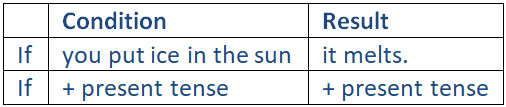
Zero conditional meaning
So what can we say about the sentence above? Well, first of all, there is a real possibility of the condition being met. There is nothing to stop us putting ice in the sun. What about the result? Well, in the event that the condition is met, it is always true that ice melts, and so we can say that the result is certain.
And so that gives us the meaning of zero conditional sentences. We use them when the result of a real condition is always true or is a fact. Because of this we often use it for things like scientific laws. Here are some more examples:
. If you heat water to 100 degrees, it boils.
. If I eat too much, I get sick.
. If I am lost I look at a map.
. If you call to the dog, he comes.
Zero conditional additional points
Using present continuous and modal verbs in zero conditional
All of the examples above use present simple in both clauses. We’re not limited to this though. In the condition clause we can use present continuous:
If I’m driving, I don’t talk on my phone.
If I’m working, my boss is happy.
We can also use modal verbs in the result clause.
If I don’t wear my glasses I can’t see.
Other clause markers in zero conditional
A clause marker is a word which introduces a dependent clause. The most common clause marker we use in conditional sentences is “if”, but it isn’t the only one we can use. Have a look at these zero conditional sentences:
Unless I wear my glasses, I can’t see.
Unless you keep ice away from the sun, it melts.
“Unless” has the meaning of “if not”, and so with a little restructuring of the condition clause (changing “I don’t wear my glasses” to “I wear my glasses”) we end up with the same meaning as when we used “if”. Now have a look at these pairs of sentences:
If I’m happy, I smile.
When I’m happy, I smile.
If I do sport I feel relaxed.
When I do sport I feel relaxed.
Because zero conditional sentences tell us about results that are always true, it can sometimes sound more natural to use “when” rather than “if”.
Order of clauses in zero conditional
We can put the two clauses in either order in zero conditional sentences:
If you heat water, it boils.
Water boils if you heat it.








