

Grammar


Tenses


Present

Present Simple

Present Continuous

Present Perfect

Present Perfect Continuous


Past

Past Simple

Past Continuous

Past Perfect

Past Perfect Continuous


Future

Future Simple

Future Continuous

Future Perfect

Future Perfect Continuous


Parts Of Speech


Nouns

Countable and uncountable nouns

Verbal nouns

Singular and Plural nouns

Proper nouns

Nouns gender

Nouns definition

Concrete nouns

Abstract nouns

Common nouns

Collective nouns

Definition Of Nouns

Animate and Inanimate nouns

Nouns


Verbs

Stative and dynamic verbs

Finite and nonfinite verbs

To be verbs

Transitive and intransitive verbs

Auxiliary verbs

Modal verbs

Regular and irregular verbs

Action verbs

Verbs


Adverbs

Relative adverbs

Interrogative adverbs

Adverbs of time

Adverbs of place

Adverbs of reason

Adverbs of quantity

Adverbs of manner

Adverbs of frequency

Adverbs of affirmation

Adverbs


Adjectives

Quantitative adjective

Proper adjective

Possessive adjective

Numeral adjective

Interrogative adjective

Distributive adjective

Descriptive adjective

Demonstrative adjective


Pronouns

Subject pronoun

Relative pronoun

Reflexive pronoun

Reciprocal pronoun

Possessive pronoun

Personal pronoun

Interrogative pronoun

Indefinite pronoun

Emphatic pronoun

Distributive pronoun

Demonstrative pronoun

Pronouns


Pre Position


Preposition by function

Time preposition

Reason preposition

Possession preposition

Place preposition

Phrases preposition

Origin preposition

Measure preposition

Direction preposition

Contrast preposition

Agent preposition


Preposition by construction

Simple preposition

Phrase preposition

Double preposition

Compound preposition

prepositions


Conjunctions

Subordinating conjunction

Correlative conjunction

Coordinating conjunction

Conjunctive adverbs

conjunctions


Interjections

Express calling interjection

Phrases

Sentences


Grammar Rules

Passive and Active

Preference

Requests and offers

wishes

Be used to

Some and any

Could have done

Describing people

Giving advices

Possession

Comparative and superlative

Giving Reason

Making Suggestions

Apologizing

Forming questions

Since and for

Directions

Obligation

Adverbials

invitation

Articles

Imaginary condition

Zero conditional

First conditional

Second conditional

Third conditional

Reported speech

Demonstratives

Determiners


Linguistics

Phonetics

Phonology

Linguistics fields

Syntax

Morphology

Semantics

pragmatics

History

Writing

Grammar

Phonetics and Phonology

Semiotics


Reading Comprehension

Elementary

Intermediate

Advanced


Teaching Methods

Teaching Strategies

Assessment
Third Conditional
المؤلف:
EF.COM
المصدر:
...
الجزء والصفحة:
...
16-6-2021
2405
Type 3 Conditional
Form
In a Type 3 conditional sentence, the tense in the 'if' clause is the past perfect, and the tense in the main clause is the perfect conditional or the perfect continuous conditional.
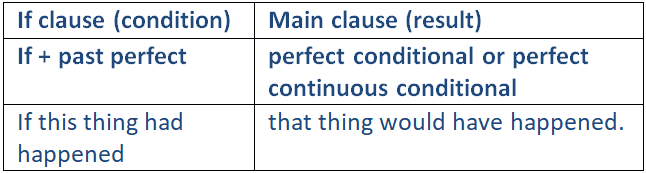
As in all conditional sentences, the order of the clauses is not fixed. You may have to rearrange the pronouns and adjust punctuation when you change the order of the clauses, but the meaning is identical.
Examples
. If it had rained, you would have gotten wet.
. You would have gotten wet if it had rained.
. You would have passed your exam if you had worked harder.
. If you had worked harder, you would have passed your exam.
. I would have believed you if you hadn't lied to me before.
. If you hadn't lied to me before, I would have believed you.
Function
The type 3 conditional refers to an impossible condition in the past and its probable result in the past. These sentences are truly hypothetical and unreal, because it is now too late for the condition or its result to exist. There is always some implication of regret with type 3 conditional sentences. The reality is the opposite of, or contrary to, what the sentence expresses. In type 3 conditional sentences, the time is the past and the situation is hypothetical.
Examples
If I had worked harder I would have passed the exam. (But I didn't work hard, and I didn't pass the exam.)
If I had known you were coming I would have baked a cake. (But I didn't know and I didn't bake a cake.)
I would have been happy if you had called me on my birthday. (But you didn’t call me and I am not happy.)
In type 3 conditional sentences, you can also use modals in the main clause instead of “would” to express the degree of certainty, permission, or a recommendation about the outcome.
Examples
. If I had worked harder I might have passed the exam.
. You could have been on time if you had caught the bus.
. If he called you, you could go.
. If you bought my school supplies for me, I might be able to go to the park.
Contractions
Both would and had can be contracted to 'd, which can be confusing if you are not confident with type 3 conditional sentences. Remember 2 rules:
1. would never appears in the if-clause so if 'd appears in the if clause, it must be abbreviating had.
2. had never appears before have so if 'd appears on a pronoun just before have, it must be abbreviating would.
Examples
. If I'd known you were in hospital, I'd have visited you.
. If I had known you were in hospital, I would have visited you.
. I'd have bought you a present if I'd known it was your birthday.
. I would have bought you a present if I had known it was your birthday.
. If you'd given me your e-mail, I'd have written to you.
. If you had given me your e-mail, I would have written to you.
The perfect conditional tense
The perfect conditional of any verb is composed of three elements:
would + have + past participle
Have followed by the past participle is used in other constructions as well. it is called the "perfect infinitive".
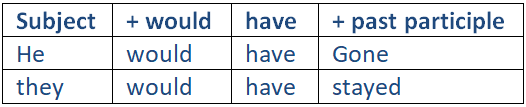
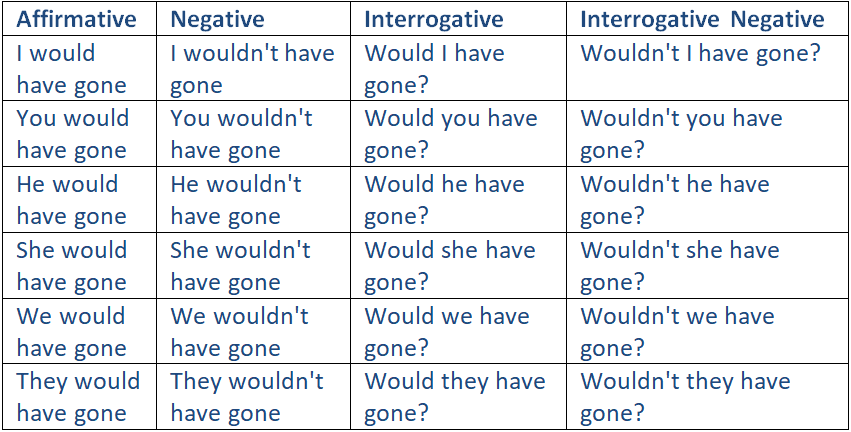
To Go: perfect conditional
الاكثر قراءة في Third conditional
اخر الاخبار
اخبار العتبة العباسية المقدسة
الآخبار الصحية

قسم الشؤون الفكرية يصدر كتاباً يوثق تاريخ السدانة في العتبة العباسية المقدسة
"المهمة".. إصدار قصصي يوثّق القصص الفائزة في مسابقة فتوى الدفاع المقدسة للقصة القصيرة
(نوافذ).. إصدار أدبي يوثق القصص الفائزة في مسابقة الإمام العسكري (عليه السلام)


