0
EN
1
المرجع الالكتروني للمعلوماتية

Grammar

Tenses

Present

Present Simple

Present Continuous

Present Perfect

Present Perfect Continuous

Past

Past Simple

Past Continuous

Past Perfect

Past Perfect Continuous

Future

Future Simple

Future Continuous

Future Perfect

Future Perfect Continuous

Parts Of Speech

Nouns

Countable and uncountable nouns

Verbal nouns

Singular and Plural nouns

Proper nouns

Nouns gender

Nouns definition

Concrete nouns

Abstract nouns

Common nouns

Collective nouns

Definition Of Nouns

Animate and Inanimate nouns

Nouns

Verbs

Stative and dynamic verbs

Finite and nonfinite verbs

To be verbs

Transitive and intransitive verbs

Auxiliary verbs

Modal verbs

Regular and irregular verbs

Action verbs

Verbs

Adverbs

Relative adverbs

Interrogative adverbs

Adverbs of time

Adverbs of place

Adverbs of reason

Adverbs of quantity

Adverbs of manner

Adverbs of frequency

Adverbs of affirmation

Adverbs

Adjectives

Quantitative adjective

Proper adjective

Possessive adjective

Numeral adjective

Interrogative adjective

Distributive adjective

Descriptive adjective

Demonstrative adjective

Pronouns

Subject pronoun

Relative pronoun

Reflexive pronoun

Reciprocal pronoun

Possessive pronoun

Personal pronoun

Interrogative pronoun

Indefinite pronoun

Emphatic pronoun

Distributive pronoun

Demonstrative pronoun

Pronouns

Pre Position

Preposition by function

Time preposition

Reason preposition

Possession preposition

Place preposition

Phrases preposition

Origin preposition

Measure preposition

Direction preposition

Contrast preposition

Agent preposition

Preposition by construction

Simple preposition

Phrase preposition

Double preposition

Compound preposition

prepositions

Conjunctions

Subordinating conjunction

Correlative conjunction

Coordinating conjunction

Conjunctive adverbs

conjunctions

Interjections

Express calling interjection

Phrases

Sentences

Clauses

Part of Speech

Grammar Rules

Passive and Active

Preference

Requests and offers

wishes

Be used to

Some and any

Could have done

Describing people

Giving advices

Possession

Comparative and superlative

Giving Reason

Making Suggestions

Apologizing

Forming questions

Since and for

Directions

Obligation

Adverbials

invitation

Articles

Imaginary condition

Zero conditional

First conditional

Second conditional

Third conditional

Reported speech

Demonstratives

Determiners

Direct and Indirect speech

Linguistics

Phonetics

Phonology

Linguistics fields

Syntax

Morphology

Semantics

pragmatics

History

Writing

Grammar

Phonetics and Phonology

Semiotics

Reading Comprehension

Elementary

Intermediate

Advanced

Teaching Methods

Teaching Strategies

Assessment

قم بتسجيل الدخول اولاً لكي يتسنى لك الاعجاب والتعليق.

The word and above Phonological units above the syllable

المؤلف:  April Mc Mahon

المصدر:  An introduction of English phonology

الجزء والصفحة:  117-10

21-3-2022

1491

+

-

20

The word and above

Phonological units above the syllable

Native speakers who are not linguists may be slightly surprised by the discovery, that they can count syllables and determine the boundaries between them. However, they will typically be much more consciously aware of the word as a linguistic unit, probably because words are meaningful units; moreover, in a highly literate society, we are familiar with orthographic words, which conveniently appear with white space on each side. Individual spoken or written words can also appear in isolation: three of the four conversational turns in (1) consist, entirely appropriately and comprehensibly, of single words.
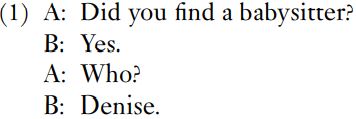
However, words, like other linguistic units, are not entirely straightforward and trouble-free for native speakers or for linguists. In particular, there are cases where it is difficult to determine how many words we are dealing with. For example, is washing-machine one word or two? Is it easier or more difficult to decide if we write it as washing machine, without the hyphen? And if we conclude that this is two words, then where does that leave teapot, where two acceptable independent words seem to make up one larger one? It seems that compounds like this take some time to become accepted in the speech community as single words: for a while, they appear as two written words, though signaling one distinct concept semantically (thus, a washing-machine washes clothes, not dishes, for which we have dishwashers, or cars, which go through a carwash). As they are encountered more commonly, they begin to be written with a hyphen, which ultimately drops to leave a single orthographic word – although speakers may think of a compound as a single word before this stage is reached. Conversely, although didn’t, can’t or it’s appear as single written words, speakers will tend to regard these as sequences of two words, contracted by the deletion of a vowel, as signaled by the apostrophe. So, it’s (in It’s Saturday) is a short form of it is, and therefore in a sense two words, as distinct from its (in The cat ate its dinner), which is a single word however you look at it.

For phonological purposes, we can simply note these tricky exceptional cases, and accept that native speakers typically have a good intuitive idea of what a word is (although this is an issue of considerable interest to morphologists). What we are interested in are the phonological properties of words; and the most important of these, in English at least, is stress. As we shall see, although each word has its own characteristic stress pattern when uttered in isolation, words are generally produced in strings, combining into phrases and whole sentences; and phonological processes also operate at these higher levels. First, the position of stress on the isolated word may change when that word forms part of a larger unit; and secondly, some segmental processes, affecting vowels or consonants, may also apply between words.


اخر الاخبار

اشترك بقناتنا على التلجرام ليصلك كل ما هو جديد

