Vowels FACE
This is one of the few variables for which there appears to be a consistent difference between the Black Country and Birmingham conurbations.
As Wells (1982: 210–211) explains, the West Midlands variety has undergone long mid diphthonging, producing diphthongs rather than pure vowels in FACE. It appears from the BCDP data that Birmingham typically has  , much as in South-East England, while the Black Country typically has
  . In more formal styles,
  occurs in both areas.
According to Wells (1982: 357), the long mid mergers were generally carried through in the Midlands, so that distinctions are no longer made between pairs like mane and main.
Mathisen (1999: 109) maintains that Sandwell speakers typically have [æi], compared to Bm  ; elderly speakers also have [εi], or [ε] as in TAKE. Hughes and Trudgill (1996: 55) have WM
  . Painter (1963: 30) similarly has BC
  , realized as
  , alternating with /e/, realized as
  , the latter presumably in the TAKE subset. Chinn and Thorne (2001: 22) maintain that Bm speakers’ realization here is typically “very open, similar to (…) Cockney speakers” (
  ), e.g. in break, way, waist, weight. However, he notes [ε] in various verb forms of the TAKE subset, e.g. make, made, take.
There is evidence for various non-short realizations (quality unclear – possibly  ):
):
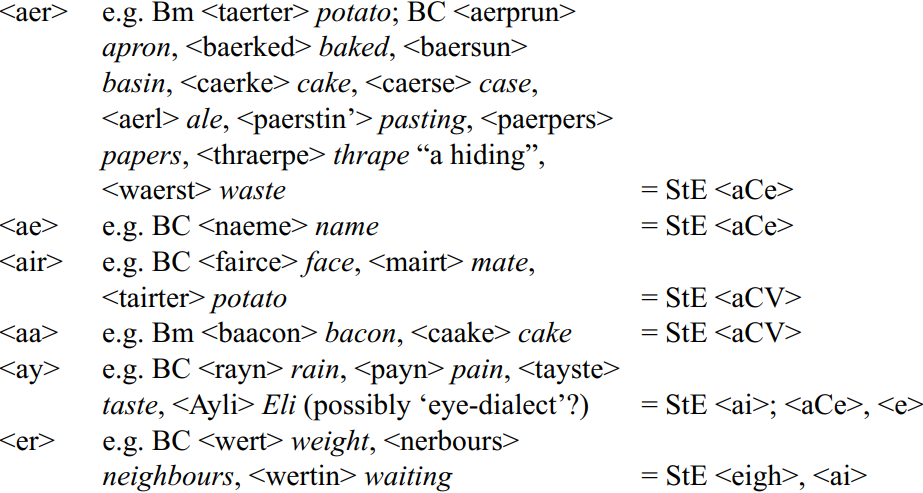
There is evidence (written, also audio) for various short-vowel realizations, apparently:
(1) [ε] in verb forms in Bm <en’t/ennit> ain’t; Bm/ BC <tek/tekkin’/tekin> take/taking; Bm/ BC <mek/mekin/med> make/making/made (the TAKE subset).
(2) [I] in Bm <in’t/inarf> ain’t/ain’t half (isn’t/isn’t half), <agin>again(st), <allis> (also Bm/ BC <allus> ) always. Note especially [I] or [i:] in Bm <causey> causeway (as in other dialects, e.g. North-eastern place-name Causey Arch).
(3) [a] in Bm/ BC <babby> baby.
Heath (1980: 87) has  for Cannock.








