Vowels GOAT
According to the BCDP data, typically  . Before /l/, there is a tendency for onset lowering (e.g. GOAL
  ). It is possible that some speakers, particularly in the Black Country, may retain a lack of distinction between NOSE and KNOWS, although according to Wells (1982: 357), the long mid mergers were generally carried through in the Midlands (typical realizations being
  ). Hughes and Trudgill (1996: 55) have WM
  , while Mathisen (1999: 109) has
 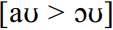 for Sandwell.
Painter (1963: 30) has BC  , realized as
  , with sporadic
 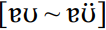 , as well as sporadic
 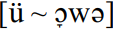 or (rare)
  , while Chinn and Thorne (2001: 22) maintain that Bm speakers’ realization here is typically “something similar to ‘ow’” (
 ), e.g. in do, mood, rude, group, flew, shoe, juice, blue.
There is some evidence (mostly written, some audio) for lack of a NOSE/KNOWS merger, in the form of  -type vowels at least in forms of the verb go (e.g. Bm <goo/a-gooin’/gu/gin’/guz> ), as well as <’um/um> home, <wunnarf> won’t half, <dun’t> don’t. Chinn and Thorne (2001: 160) claim that the feature also occurs in home in Worcestershire and Black Country, although in the latter case <wum> is said to be more frequent.
In fact, the written material may provide evidence for lack of NOSE/KNOWS merger: words especially with StE <oCe> may be respelt as follows (suggesting something like  ):
):

There is also some written evidence for variable  -type realizations in Bm/ BC <grawt>/<grort> groat(s) (cf. <grawty/grorty dick>, but also <grawty/ greaty puding ).
Heath (1980: 87) has 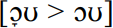 for Cannock.








