

Grammar


Tenses


Present

Present Simple

Present Continuous

Present Perfect

Present Perfect Continuous


Past

Past Simple

Past Continuous

Past Perfect

Past Perfect Continuous


Future

Future Simple

Future Continuous

Future Perfect

Future Perfect Continuous


Parts Of Speech


Nouns

Countable and uncountable nouns

Verbal nouns

Singular and Plural nouns

Proper nouns

Nouns gender

Nouns definition

Concrete nouns

Abstract nouns

Common nouns

Collective nouns

Definition Of Nouns

Animate and Inanimate nouns

Nouns


Verbs

Stative and dynamic verbs

Finite and nonfinite verbs

To be verbs

Transitive and intransitive verbs

Auxiliary verbs

Modal verbs

Regular and irregular verbs

Action verbs

Verbs


Adverbs

Relative adverbs

Interrogative adverbs

Adverbs of time

Adverbs of place

Adverbs of reason

Adverbs of quantity

Adverbs of manner

Adverbs of frequency

Adverbs of affirmation

Adverbs


Adjectives

Quantitative adjective

Proper adjective

Possessive adjective

Numeral adjective

Interrogative adjective

Distributive adjective

Descriptive adjective

Demonstrative adjective


Pronouns

Subject pronoun

Relative pronoun

Reflexive pronoun

Reciprocal pronoun

Possessive pronoun

Personal pronoun

Interrogative pronoun

Indefinite pronoun

Emphatic pronoun

Distributive pronoun

Demonstrative pronoun

Pronouns


Pre Position


Preposition by function

Time preposition

Reason preposition

Possession preposition

Place preposition

Phrases preposition

Origin preposition

Measure preposition

Direction preposition

Contrast preposition

Agent preposition


Preposition by construction

Simple preposition

Phrase preposition

Double preposition

Compound preposition

prepositions


Conjunctions

Subordinating conjunction

Correlative conjunction

Coordinating conjunction

Conjunctive adverbs

conjunctions


Interjections

Express calling interjection

Phrases

Sentences


Grammar Rules

Passive and Active

Preference

Requests and offers

wishes

Be used to

Some and any

Could have done

Describing people

Giving advices

Possession

Comparative and superlative

Giving Reason

Making Suggestions

Apologizing

Forming questions

Since and for

Directions

Obligation

Adverbials

invitation

Articles

Imaginary condition

Zero conditional

First conditional

Second conditional

Third conditional

Reported speech

Demonstratives

Determiners


Linguistics

Phonetics

Phonology

Linguistics fields

Syntax

Morphology

Semantics

pragmatics

History

Writing

Grammar

Phonetics and Phonology

Semiotics


Reading Comprehension

Elementary

Intermediate

Advanced


Teaching Methods

Teaching Strategies

Assessment
How It Works
المؤلف:
BARBARA MINTO
المصدر:
THE MINTO PYRAMID PRINCIPLE
الجزء والصفحة:
69-5
2024-09-12
1053
How It Works
The key technique is to find one word that describes the kind of idea in your grouping. This word will always be a plural noun (a) because any "kind of" thing will always be a noun, and (b) because you will always have more than one of the "kind of" idea in your grouping. "Warlike movements" is a plural noun in this sense, and so is "preparations for attack"
If you look at the inductive groupings in Exhibit 21, you will easily see that each can be described by a plural noun: schemes, steps, ways of hurting. And in each case again you can see that none of the ideas in any of the three groupings is a misfit; each fits the description of the plural noun.
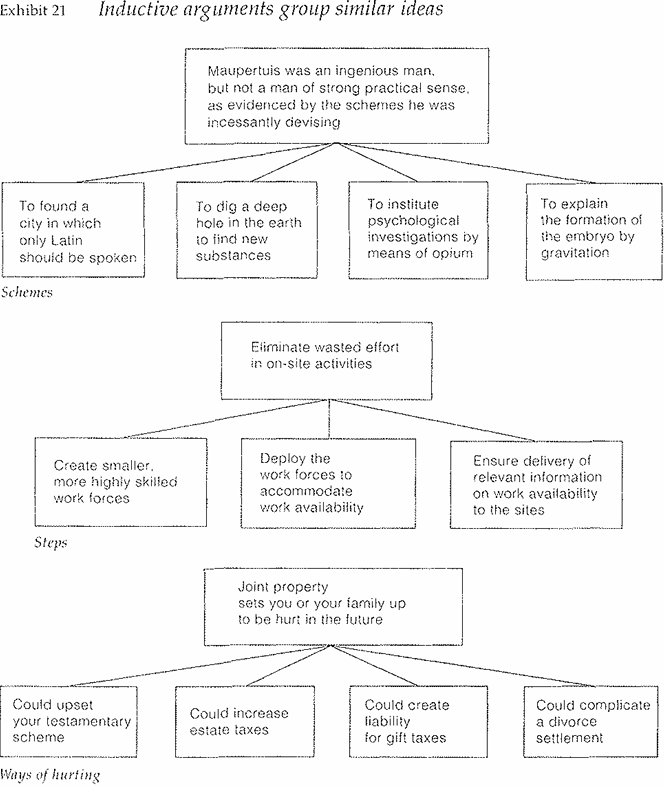
The next step is always to check your reasoning, and this is done by questioning from the bottom up. For example, if you see a man who wants to found a city in which only Latin should be spoken, dig a deep hole in the center of the earth, etc., can you infer that this is an ingenious man, but not a man of strong practical sense? Yes, you can, or at least you could when the statement was originally written.
By contrast, consider the two examples in Exhibit 22. If you see managers who don't face reality, won't countenance criticism, etc., can you infer that they mismanage because they want to? Certainly not; it's sloppy reasoning.
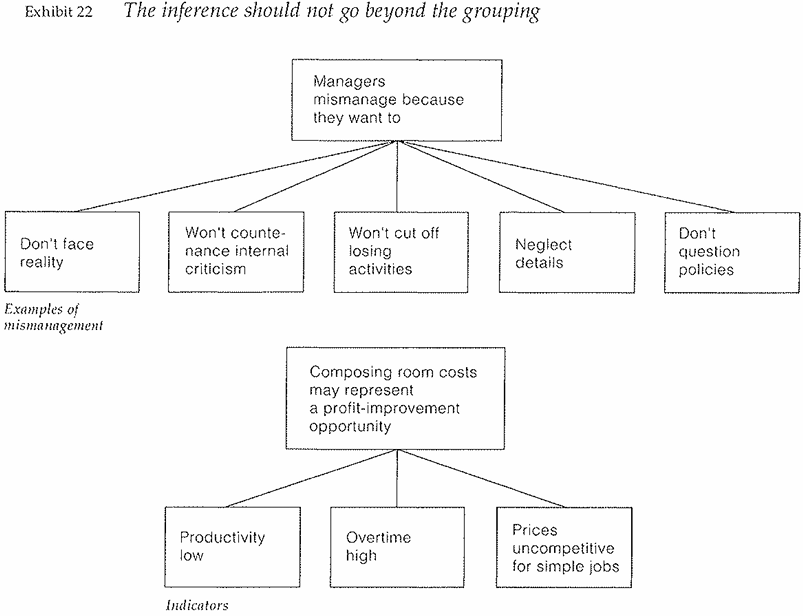
What about the next one? If productivity is low, overtime high, and prices uncompetitive, can you infer that you have a profit-improvement opportunity? Perhaps, but I can think of three or four other things that could also be labeled indicators of a profit-improvement opportunity. In that case, you know the overall point is at too high a level of abstraction in relationship to the three points grouped below, since it does not make a statement specifically and only about them.
In fact, however, this is really a deductive argument masquerading as an inductive one, as you may have remembered. The low productivity led to high over time, which led to uncompetitive prices. (Whenever you have only one piece of evidence for anything, you are forced to deal with it deductively.) Thus, the point implied at the top is something like "Our prices are high because our productivity is low."
الاكثر قراءة في Writing
اخر الاخبار
اخبار العتبة العباسية المقدسة
الآخبار الصحية

قسم الشؤون الفكرية يصدر كتاباً يوثق تاريخ السدانة في العتبة العباسية المقدسة
"المهمة".. إصدار قصصي يوثّق القصص الفائزة في مسابقة فتوى الدفاع المقدسة للقصة القصيرة
(نوافذ).. إصدار أدبي يوثق القصص الفائزة في مسابقة الإمام العسكري (عليه السلام)


