

Grammar


Tenses


Present

Present Simple

Present Continuous

Present Perfect

Present Perfect Continuous


Past

Past Simple

Past Continuous

Past Perfect

Past Perfect Continuous


Future

Future Simple

Future Continuous

Future Perfect

Future Perfect Continuous


Parts Of Speech


Nouns

Countable and uncountable nouns

Verbal nouns

Singular and Plural nouns

Proper nouns

Nouns gender

Nouns definition

Concrete nouns

Abstract nouns

Common nouns

Collective nouns

Definition Of Nouns

Animate and Inanimate nouns

Nouns


Verbs

Stative and dynamic verbs

Finite and nonfinite verbs

To be verbs

Transitive and intransitive verbs

Auxiliary verbs

Modal verbs

Regular and irregular verbs

Action verbs

Verbs


Adverbs

Relative adverbs

Interrogative adverbs

Adverbs of time

Adverbs of place

Adverbs of reason

Adverbs of quantity

Adverbs of manner

Adverbs of frequency

Adverbs of affirmation

Adverbs


Adjectives

Quantitative adjective

Proper adjective

Possessive adjective

Numeral adjective

Interrogative adjective

Distributive adjective

Descriptive adjective

Demonstrative adjective


Pronouns

Subject pronoun

Relative pronoun

Reflexive pronoun

Reciprocal pronoun

Possessive pronoun

Personal pronoun

Interrogative pronoun

Indefinite pronoun

Emphatic pronoun

Distributive pronoun

Demonstrative pronoun

Pronouns


Pre Position


Preposition by function

Time preposition

Reason preposition

Possession preposition

Place preposition

Phrases preposition

Origin preposition

Measure preposition

Direction preposition

Contrast preposition

Agent preposition


Preposition by construction

Simple preposition

Phrase preposition

Double preposition

Compound preposition

prepositions


Conjunctions

Subordinating conjunction

Correlative conjunction

Coordinating conjunction

Conjunctive adverbs

conjunctions


Interjections

Express calling interjection

Phrases

Sentences


Grammar Rules

Passive and Active

Preference

Requests and offers

wishes

Be used to

Some and any

Could have done

Describing people

Giving advices

Possession

Comparative and superlative

Giving Reason

Making Suggestions

Apologizing

Forming questions

Since and for

Directions

Obligation

Adverbials

invitation

Articles

Imaginary condition

Zero conditional

First conditional

Second conditional

Third conditional

Reported speech

Demonstratives

Determiners


Linguistics

Phonetics

Phonology

Linguistics fields

Syntax

Morphology

Semantics

pragmatics

History

Writing

Grammar

Phonetics and Phonology

Semiotics


Reading Comprehension

Elementary

Intermediate

Advanced


Teaching Methods

Teaching Strategies

Assessment
STORY BOARDING
المؤلف:
BARBARA MINTO
المصدر:
THE MINTO PYRAMID PRINCIPLE
الجزء والصفحة:
199-12
2024-10-02
1066
STORY BOARDING
Once you understand the requirements of text and exhibit slides, you are ready to design the full presentation. The approach that I take to moving from the pyramid to a presentation is as follows:
1. Write the introduction in full, putting down every word you will say in the order in which you will say it. This ensures that you have left nothing out of your beginning story, and allows you to double check that the question you are answering is really valid for the audience.
2. Have available a blank storyboard form, and write across the top of each blank slide the points from the introduction you wish to illustrate visually, plus those from the Key Line and one level below the Key Line.
3. Rough out the visual way you will illustrate each point. Generally you do this without real numbers, but simply with an indication of the types of data you would include, plus notes to yourself and the designer of the sort of relationship you want to show.
4. Script the words to be said around each slide, to ensure the set of slides flows as a story.
5. Complete the design of the slides and send them off to be properly drawn.
6. Rehearse, rehearse, rehearse!
A storyboard at its simplest is a sheet of paper turned sideways and divided into separate sections, each of which represents a blank slide. It enables you to write down the specific points that you expect to turn into slides, and to indicate which should be presented as text slides and which should be illustrated with a graphic of some sort.
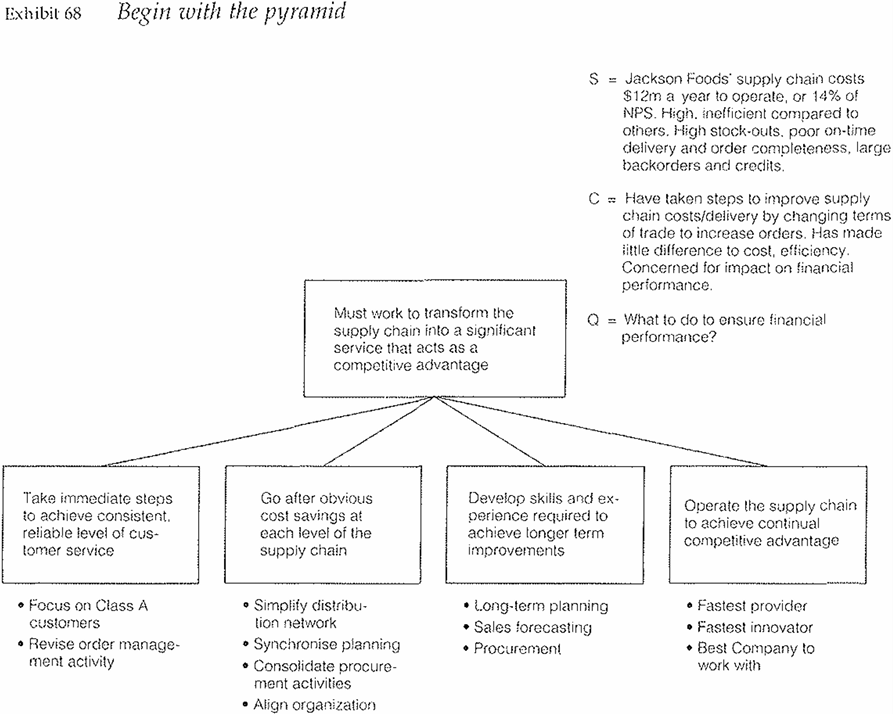
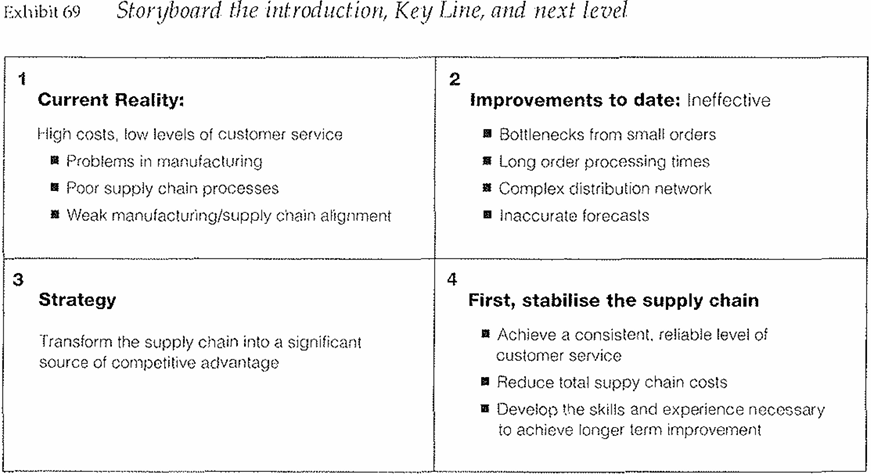
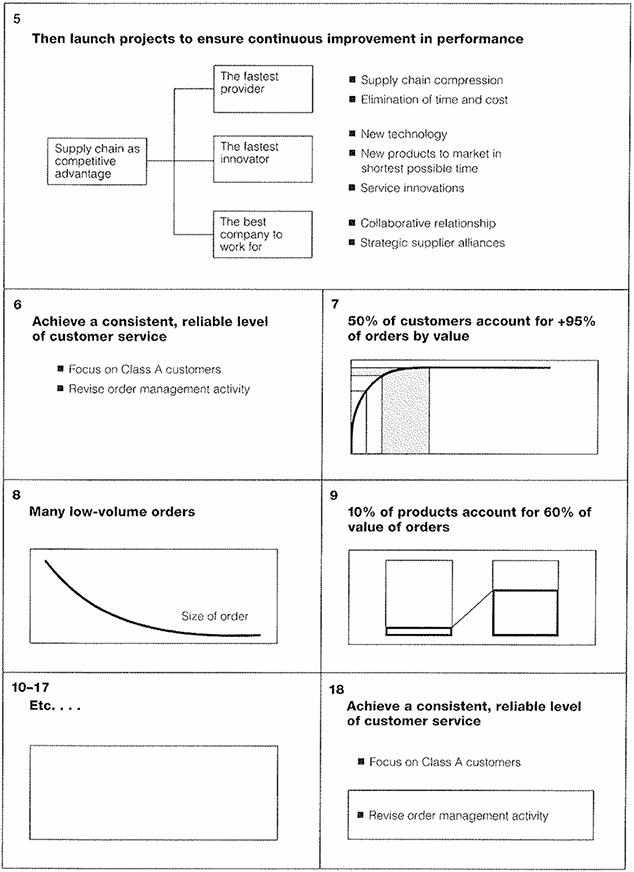
To illustrate, Exhibit 68 shows a typical pyramid, while Exhibit 69 shows how the first few slides might have looked in storyboard form. The thing to remember is that you want each slide to have a sentence or phrase at the top that conveys the point it is meant to illustrate. This device will act as a reminder both to you as you present and to the audience as it listens, particularly if you have the slide on the screen for any length of time.
We have discussed only the general steps for converting the points in a pyramid into visual presentation form. It has come nowhere near covering the detailed planning and analysis necessary to make the presentation compelling and effective for your purposes. To this end, let me recommend a wonderful book by Antony Jay called Effective Presentation: The Communication of Ideas by Words and Visual Aids, published in London in 1970 by Management Publications Ltd. (It was also published in the States as The New Oratory.)1
The book thoroughly sets out how to think about your audience, staging, presentation techniques, and rehearsal. The book is full of all sorts of insights. My favorite is "A presentation is usually a favour bestowed by those who attend on those who present." It is worth keeping in mind.
1Antony Jay, Effective Presentation: The Communication of Ideas by Words and Visual Aids, London, Management Publications Limited, 1970.
الاكثر قراءة في Writing
اخر الاخبار
اخبار العتبة العباسية المقدسة
الآخبار الصحية

قسم الشؤون الفكرية يصدر كتاباً يوثق تاريخ السدانة في العتبة العباسية المقدسة
"المهمة".. إصدار قصصي يوثّق القصص الفائزة في مسابقة فتوى الدفاع المقدسة للقصة القصيرة
(نوافذ).. إصدار أدبي يوثق القصص الفائزة في مسابقة الإمام العسكري (عليه السلام)


