

Grammar


Tenses


Present

Present Simple

Present Continuous

Present Perfect

Present Perfect Continuous


Past

Past Simple

Past Continuous

Past Perfect

Past Perfect Continuous


Future

Future Simple

Future Continuous

Future Perfect

Future Perfect Continuous


Parts Of Speech


Nouns

Countable and uncountable nouns

Verbal nouns

Singular and Plural nouns

Proper nouns

Nouns gender

Nouns definition

Concrete nouns

Abstract nouns

Common nouns

Collective nouns

Definition Of Nouns

Animate and Inanimate nouns

Nouns


Verbs

Stative and dynamic verbs

Finite and nonfinite verbs

To be verbs

Transitive and intransitive verbs

Auxiliary verbs

Modal verbs

Regular and irregular verbs

Action verbs

Verbs


Adverbs

Relative adverbs

Interrogative adverbs

Adverbs of time

Adverbs of place

Adverbs of reason

Adverbs of quantity

Adverbs of manner

Adverbs of frequency

Adverbs of affirmation

Adverbs


Adjectives

Quantitative adjective

Proper adjective

Possessive adjective

Numeral adjective

Interrogative adjective

Distributive adjective

Descriptive adjective

Demonstrative adjective


Pronouns

Subject pronoun

Relative pronoun

Reflexive pronoun

Reciprocal pronoun

Possessive pronoun

Personal pronoun

Interrogative pronoun

Indefinite pronoun

Emphatic pronoun

Distributive pronoun

Demonstrative pronoun

Pronouns


Pre Position


Preposition by function

Time preposition

Reason preposition

Possession preposition

Place preposition

Phrases preposition

Origin preposition

Measure preposition

Direction preposition

Contrast preposition

Agent preposition


Preposition by construction

Simple preposition

Phrase preposition

Double preposition

Compound preposition

prepositions


Conjunctions

Subordinating conjunction

Correlative conjunction

Coordinating conjunction

Conjunctive adverbs

conjunctions


Interjections

Express calling interjection

Phrases

Sentences


Grammar Rules

Passive and Active

Preference

Requests and offers

wishes

Be used to

Some and any

Could have done

Describing people

Giving advices

Possession

Comparative and superlative

Giving Reason

Making Suggestions

Apologizing

Forming questions

Since and for

Directions

Obligation

Adverbials

invitation

Articles

Imaginary condition

Zero conditional

First conditional

Second conditional

Third conditional

Reported speech

Demonstratives

Determiners


Linguistics

Phonetics

Phonology

Linguistics fields

Syntax

Morphology

Semantics

pragmatics

History

Writing

Grammar

Phonetics and Phonology

Semiotics


Reading Comprehension

Elementary

Intermediate

Advanced


Teaching Methods

Teaching Strategies

Assessment
Full Vowels–Reduced Vowels
المؤلف:
Mehmet Yavas̡
المصدر:
Applied English Phonology
الجزء والصفحة:
P92-C4
2025-03-07
939
Full Vowels–Reduced Vowels
Although stress is the topic we will discuss later, there is one issue that we will take up here, and this relates to reduced vowels. While all vowels of English (except [ə]) can occur in stressed syllables, many of these vowels reveal alternations with an [ə] in unstressed syllables in a morphologically related word.
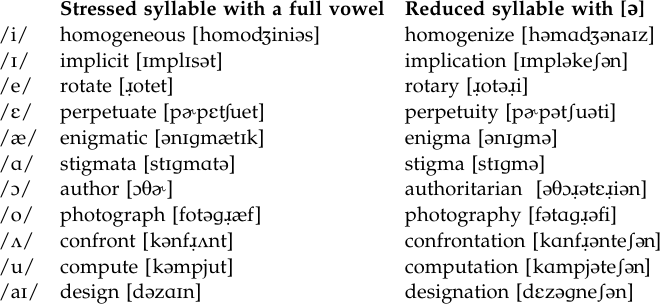
We should immediately point out, however, that a vowel’s appearance in an unstressed syllable does not necessarily result in a reduced vowel [ə]. It is perfectly possible for the English vowels to appear in full (unreduced) form in unstressed syllables (or in syllables with secondary stress), as shown in the following:
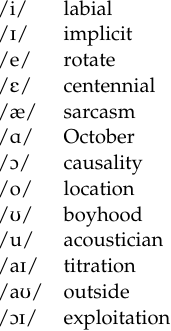
Thus, the unidirectional generalization to be made is the following: while a reduced vowel is necessarily in an unstressed syllable, a vowel in an unstressed syllable is not necessarily reduced.
Although we have consistently used [ə] in reduced syllables, it is not uncommon to find an [ɪ] in people’s speech. That is, for a word such as implication we can get [ɪmplɪkeʃən] as well as [ɪmpləkeʃən]. In general, [ɪ] is found before palato-alveolars (e.g. selfish [sεlfɪʃ], sandwich [sændwɪtʃ], marriage [mæɹ̣ɪʤ]) and velars (e.g. metric [mεtɹ̣ɪk], running [ɹ̣ Λ n ɪ ŋ]). It should be noted, however, that the syllable structure is also a factor. The influence of palate-alveolar/velar consonants is more visible when there is tautosyllabicity. For example, we tend to find [ɪ] in topic [tɑpɪk], which is likely to change to an [ə] in a related word such as topical [tɑpəkəl], because the velar, [k], is the onset of the following syllable. Individuals should check their pronunciation of such syllables and transcribe the vowels accordingly. However, since reduced syllables are necessarily unstressed, and [ə] cannot appear in a stressed syllable (but [ɪ] can), we encourage our students to use [ə] for such vowels, for practical reasons.
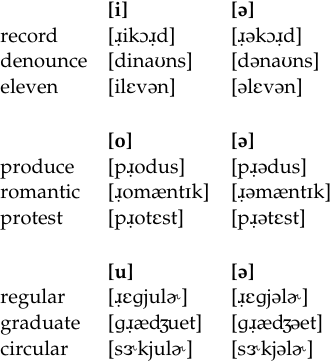
We should also point out that [ə], besides having this relationship with the unstressed [ɪ], has a special relationship with three other vowels, /i, o, u/. In unstressed syllables, the range of pronunciation values of these three vowels extends to the central [ə] area, as shown in the following:
الاكثر قراءة في Phonology
اخر الاخبار
اخبار العتبة العباسية المقدسة
الآخبار الصحية

قسم الشؤون الفكرية يصدر كتاباً يوثق تاريخ السدانة في العتبة العباسية المقدسة
"المهمة".. إصدار قصصي يوثّق القصص الفائزة في مسابقة فتوى الدفاع المقدسة للقصة القصيرة
(نوافذ).. إصدار أدبي يوثق القصص الفائزة في مسابقة الإمام العسكري (عليه السلام)


