Differences between American and British English
There are several words that receive different stresses between American and British English, which lend themselves to some groupings.
(a) The first group consists of two-syllable nouns of French origin. These words are stressed on the final syllable in American English (AE), while they receive the stress on the first (penult) syllable in British English (BE):

(b) Another group of nouns does exactly the reverse (final stress in BE, initial stress in AE):
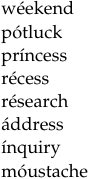
There are also some other nouns that are longer and receive initial stress in AE, but final stress in BE:

(c) Two-syllable verbs ending in -ate are generally stressed initially in AE, but finally in BE:

However, in confláte, creáte, debáte, defláte, eláte, reláte, abáte, infláte, negáte, AE, like BE, places the stress on the final syllable.
The following two groups of words have one thing in common in that one variety has, in addition to the primary stress, a secondary stress while the other variety has a reduced vowel in the equivalent syllable.
(d) Forms ending in [εɹ̣i] (spelt -ary/-ery) and [ɔɹ̣i] (spelt -ory) receive a secondary stress on the penult in AE, whereas the same syllable has a reduced vowel in BE. For example, the word secondary is [sékəndὲɹ̣i] in AE, but [sέkəndəɹi] in BE, which can turn into [sέkəndɹi] by way of deleting the reduced vowel, and thus reducing the number of syllables to three. The following list consists of such items:

* = In addition to not having the secondary stress, these items have the primary stress on the second (not first) syllable in BE.
However, if the primary stress is immediately before -ary/-ery/-ory, as in salary, bravery, ivory, lottery, elementary, anniversary, documentary, complimentary, and infirmary, there is no secondary stress in AE either.
A similar pattern to the above list (secondary in AE, reduced vowel in BE) is obtained in words ending in -mony:

(e) The other group of words (all ending in -ile) that behaves differently in the two varieties shows the reverse (i.e. reduced vowel in AE, but secondary stress in BE):

However, prófìle, réptìle, sénìle with [aɪ] have secondary stress in both AE and BE.
The above-mentioned differences between AE and BE do not mean that other varieties have to choose between these two; they may differ in their stress pat terns without necessarily copying either of them. For example, words ending in -ate, -ize are stressed on the final syllable in Indian English, Hong Kong English, and Singapore English. Thus, we get alternáte, educáte, homogeníze, terroríze (Wells 1982). Non-reduced vowels and non-initial stress on words of more than one syllable (e.g. economic, faculty, necessary) are found in Indian English and Singapore English (Wells 1982). Suffixes tend to be stressed and function words, which are reduced (e.g. of [əv]) in other varieties, are not reduced in Indian English (Trudgill and Hannah 2002). Also noteworthy is the general tendency toward fewer vowel reductions in varieties of English spoken in Hawaii, Hong Kong, Singapore, and India, as well as in the Caribbean and African varieties, which results in more of a ‘syllable-timed’ rhythm.








