

Grammar


Tenses


Present

Present Simple

Present Continuous

Present Perfect

Present Perfect Continuous


Past

Past Simple

Past Continuous

Past Perfect

Past Perfect Continuous


Future

Future Simple

Future Continuous

Future Perfect

Future Perfect Continuous


Parts Of Speech


Nouns

Countable and uncountable nouns

Verbal nouns

Singular and Plural nouns

Proper nouns

Nouns gender

Nouns definition

Concrete nouns

Abstract nouns

Common nouns

Collective nouns

Definition Of Nouns

Animate and Inanimate nouns

Nouns


Verbs

Stative and dynamic verbs

Finite and nonfinite verbs

To be verbs

Transitive and intransitive verbs

Auxiliary verbs

Modal verbs

Regular and irregular verbs

Action verbs

Verbs


Adverbs

Relative adverbs

Interrogative adverbs

Adverbs of time

Adverbs of place

Adverbs of reason

Adverbs of quantity

Adverbs of manner

Adverbs of frequency

Adverbs of affirmation

Adverbs


Adjectives

Quantitative adjective

Proper adjective

Possessive adjective

Numeral adjective

Interrogative adjective

Distributive adjective

Descriptive adjective

Demonstrative adjective


Pronouns

Subject pronoun

Relative pronoun

Reflexive pronoun

Reciprocal pronoun

Possessive pronoun

Personal pronoun

Interrogative pronoun

Indefinite pronoun

Emphatic pronoun

Distributive pronoun

Demonstrative pronoun

Pronouns


Pre Position


Preposition by function

Time preposition

Reason preposition

Possession preposition

Place preposition

Phrases preposition

Origin preposition

Measure preposition

Direction preposition

Contrast preposition

Agent preposition


Preposition by construction

Simple preposition

Phrase preposition

Double preposition

Compound preposition

prepositions


Conjunctions

Subordinating conjunction

Correlative conjunction

Coordinating conjunction

Conjunctive adverbs

conjunctions


Interjections

Express calling interjection

Phrases

Sentences


Grammar Rules

Passive and Active

Preference

Requests and offers

wishes

Be used to

Some and any

Could have done

Describing people

Giving advices

Possession

Comparative and superlative

Giving Reason

Making Suggestions

Apologizing

Forming questions

Since and for

Directions

Obligation

Adverbials

invitation

Articles

Imaginary condition

Zero conditional

First conditional

Second conditional

Third conditional

Reported speech

Demonstratives

Determiners


Linguistics

Phonetics

Phonology

Linguistics fields

Syntax

Morphology

Semantics

pragmatics

History

Writing

Grammar

Phonetics and Phonology

Semiotics


Reading Comprehension

Elementary

Intermediate

Advanced


Teaching Methods

Teaching Strategies

Assessment
Why do bilingual/EAL learners require additional educational needs at the present time in England?
المؤلف:
Sue Soan
المصدر:
Additional Educational Needs
الجزء والصفحة:
P48-C4
2025-04-02
705
Why do bilingual/EAL learners require additional educational needs at the present time in England?
According to the Statistics of Education 2002 there are over 632,000 (approximately 9.3 per cent) learners in schools in England who have English as an Additional Language (EAL). The consultation paper Aiming High: Raising the Achievement of Minority Ethnic Pupils (DfES, 2003a) not only states that this figure reflects a bilingual population that is growing, but also says that there are over 200 languages being used in England, with varying degrees of fluency by pupils. Bhattacharyya et al. (2003) found that 90 per cent of Bangladeshi and Pakistani pupils are registered as EAL learners, 82 per cent of Indian, 75 per cent of Chinese and 65 per cent of Black African. Other legislation and research have alerted the government and educators to statistics that do necessitate whole school action to ensure bilingual learners’ additional educational needs are met. In the Green Paper Every Child Matters (HMSO, 2003), the government says that it will raise the attainment of minority ethnic pupils by: ‘develop(ing) strategies for supporting bilingual learners’ (ibid.: 2.14:28). A further research paper, focusing on the attainments and participation of minority ethnic groups living in England summarizes statistics and research to reach its key findings. Of specific interest to readers, the authors found that:
■ Learners for whom English is an additional language (EAL) perform, on average, less well than pupils whose first language is English.
■ EAL learners generally make better progress between Key Stages.
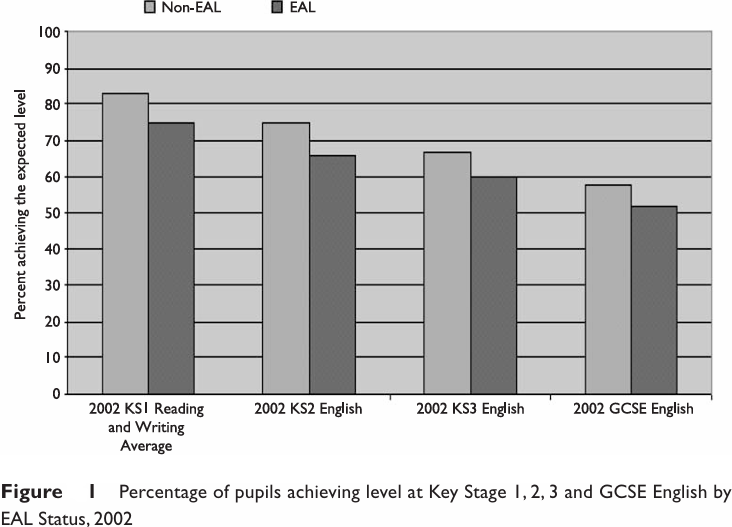
■ A smaller proportion of EAL learners achieve expected levels at each Key Stage (Figure 1). However, the performance of EAL learners does vary across ethnic groups. (Bhattacharyya et al., 2003)
Further on in Bhattacharyya et al.’s paper they include factors they found that potentially may affect the attainment of certain minority groups: ‘These include lack of English language fluency …, racial abuse or harassment, lack of role models, unfamiliarity with the workings of the education system; teaching based on unfamiliar cultural norms, histories and points of reference’ (2003: 22).
Discussion
How many bilingual/EAL learners are in your educational setting? When a bilingual learner starts at your workplace, do you make inquiries into the learner’s previous educational history, cultural experience and English language fluency or not? Would this information be thought valuable for curriculum planning and assessment?
الاكثر قراءة في Teaching Strategies
اخر الاخبار
اخبار العتبة العباسية المقدسة
الآخبار الصحية

قسم الشؤون الفكرية يصدر كتاباً يوثق تاريخ السدانة في العتبة العباسية المقدسة
"المهمة".. إصدار قصصي يوثّق القصص الفائزة في مسابقة فتوى الدفاع المقدسة للقصة القصيرة
(نوافذ).. إصدار أدبي يوثق القصص الفائزة في مسابقة الإمام العسكري (عليه السلام)


