A whole school approach
In this part a closer examination of what schools and educators can do to ensure that bilingual learners have access to an effective, quality education is provided. As Cummins said: ‘Neglect of home language and culture may be significant, but more significant are inadequate teaching methodology, unfair assessment, and lack of communication with the community’ (in Brisk, 1998: 34). Ultimately it is the type of education that is provided for bilingual learners that determines whether they are educationally successful or not. However, educators can support bilingual students better if they understand the external and internal factors that can affect the individual learner’s progress (Figure 1).
How schools use both the bilingual learners’ first languages; their cultural experiences and history within the whole curriculum, and how teaching strategies are chosen can all have a vast influence on how well the individual learner’s perform. A school’s and its staff’s attitudes towards bilingual learners can have a great effect on how well the learners are motivated to learn and be successful. Schools need to be constantly questioning their expectations of bilingual learners and their provision for them. The situational factors depicted in Figure 1 can influence how learners are viewed by educators and their peers and the personal characteristics of bilingual learners can determine how they actually manage in a mainstream English school.
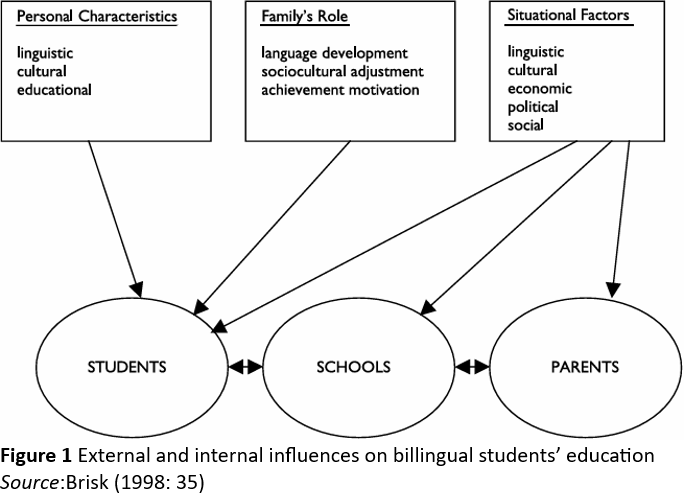
It is quite clear therefore that bilingual learners’ families hold an enormous amount of information about their previous educational achievements and situational factors. Schools need to tap into this valuable resource and forge a trusting and supportive partnership with the families so that they are able to understand many of the factors that will help them effectively educate bilingual learners.
In Evaluating Educational Inclusion (OFSTED, 2000) the following extract from an inspection report indicates how OFSTED are defining good practice for bilingual/EAL learners.
Case study
The reception teacher and home - school worker use home - visits effectively to find out about each child’s language needs. Translators are available to help parents with little or no English. This information is used well to prepare for the child starting school by enabling the school to decide on the level of language support needed … School works closely with local agencies such as speech therapy when needed … The school works hard to promote good attendance. However, it recognizes that there are times when families give a priority to the celebration of religious festivals and they ensure that parents and pupils are not stigmatized because of this. The pupils are given extra support to catch up with anything they miss during such times. This pragmatic approach does much to win parents support and to promote tolerance of different faiths and beliefs. (OFSTED,2000: 27)
Discussion
Read the extract above from an OFSTED Inspector’s report again closely and compare it to your working practices. How would an evaluation of the practice in your workplace setting compare? Do you agree with the interventions and practices of this infant school? Give reasons why you agree or disagree.
The link with bilingual learners’ parents can be supported in many ways already established in the school community, such as coffee mornings and parents’ rooms. Bilingual staff, however, can be invaluable to a school, helping support the learners in the classroom by speaking in the family language with them and encouraging the use of their first language. They can also step in to prevent the partnership between home and school becoming tense due to cultural misunderstandings. This can be illustrated in the case study below and highlights the need for constant examination of the way a school presents itself to parents and learners.
Case study
One mother was upset that her children were playing with water and other materials in the nursery. She had expected them to be formally taught the alphabet, because they were at school. The bilingual educators were able to explain to the mother that this was purposeful play children needed to learn colours and shapes, to develop concepts and vocabulary for heavy and light, full and empty. “We should explain the purpose of nursery education from the start, rather than assuming a shared understanding”(Wrigley, 2000: 105).
However, when a school does not have a bilingual member of staff, a great deal can still be achieved by recognizing and valuing the learners’ home language and culture. If this is managed by the whole-school community with a genuine wish to include all the community, it will foster trust, collaboration and thus success. As Wrigley (2000: 160) says; ‘Time and again, when I probed the reasons for the school’s success, the head would say “the staff”, and the staff would say “the pupils”.’








