Thinking about the gifted and talented
Who are the gifted and talented? Traditional conceptions of giftedness have focused on single measures of ability, most commonly the famous intelligence quotient (IQ). Simply put, the higher one’s score on an IQ test, the more able one is. Underpinning notions like IQ is the assumption that ability can be related to a ‘general intelligence factor’, which relates to an individual’s ability to reason and make connections (Koshy, 2002).
The appeal of this type of approach is obvious, and the opportunity to reduce a child’s ability to a single number was so attractive to teachers and policy-makers that it continued to dominate educational assessment until relatively recently. Over time, however, there has developed a consensus that it is not possible to capture giftedness with a single measure like IQ. Critics have shown that a high IQ is not a good predictor of later success (Winner, 2000), and that creative or divergent thinkers may perform poorly in such tests (Koshy, 2002). Nowadays, almost all educational theories of high ability tend to favor what is called ‘multi-dimensional models’ (Ziegler and Heller, 2000).
Perhaps the best-known multi-dimensional model is Gardner’s Multiple Intelligence theory (1983). Although it, too, has its critics (White, 1998), Gardner’s theory has won massive international recognition. Its key notion is that ability manifests itself in numerous ways, and that children possess multiple talents that ought to be acknowledged. In its most recent formulation, Gardner (1999) suggested nine forms of intelligence, as follows:
1 Linguistic Intelligence: including sensitivity to and love of words, spoken and written language.
2 Logical-mathematical Intelligence: logical and special mathematical thinking skills.
3 Spatial Intelligence: conception and perception of space, including spatial memory.
4 Bodily-kinaesthetic Intelligence: psychomotor abilities, coordinated movement and athletic performance.
5 Musical Intelligence: skills in producing, composing, performing and appreciating music and sound.
6 Intrapersonal Intelligence: self-awareness and sensitivity to one’s own actions, motivations and feelings.
7 Interpersonal Intelligence: social intelligence, and sensitivity to others’ actions, motivations and feelings.
8 Naturalistic Intelligence: the ability to discern patterns in the living world.
9 Existential Intelligence: reflection on the fundamental questions of existence.
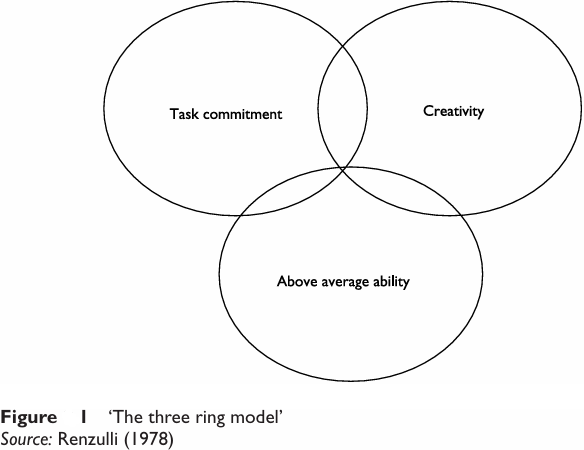
The case has also been made that giftedness and talent represent more than just academic ability. Renzulli (1973), for example, argues that giftedness is the coincidence of creativity and motivation (or task commitment, in his terms). His ‘three ring’ model (see Figure 1) offers a framework for parents and schools to ensure that children’s abilities are nurtured and supported through fostering motivation and creativity.
Discussion
■ What sort of personal and environmental factors might influence a child’s performance on an ability or intelligence test?
■ How can you identify high levels of creativity and motivation? What can you do to foster these qualities in your work with pupils?








