

Grammar


Tenses


Present

Present Simple

Present Continuous

Present Perfect

Present Perfect Continuous


Past

Past Simple

Past Continuous

Past Perfect

Past Perfect Continuous


Future

Future Simple

Future Continuous

Future Perfect

Future Perfect Continuous


Parts Of Speech


Nouns

Countable and uncountable nouns

Verbal nouns

Singular and Plural nouns

Proper nouns

Nouns gender

Nouns definition

Concrete nouns

Abstract nouns

Common nouns

Collective nouns

Definition Of Nouns

Animate and Inanimate nouns

Nouns


Verbs

Stative and dynamic verbs

Finite and nonfinite verbs

To be verbs

Transitive and intransitive verbs

Auxiliary verbs

Modal verbs

Regular and irregular verbs

Action verbs

Verbs


Adverbs

Relative adverbs

Interrogative adverbs

Adverbs of time

Adverbs of place

Adverbs of reason

Adverbs of quantity

Adverbs of manner

Adverbs of frequency

Adverbs of affirmation

Adverbs


Adjectives

Quantitative adjective

Proper adjective

Possessive adjective

Numeral adjective

Interrogative adjective

Distributive adjective

Descriptive adjective

Demonstrative adjective


Pronouns

Subject pronoun

Relative pronoun

Reflexive pronoun

Reciprocal pronoun

Possessive pronoun

Personal pronoun

Interrogative pronoun

Indefinite pronoun

Emphatic pronoun

Distributive pronoun

Demonstrative pronoun

Pronouns


Pre Position


Preposition by function

Time preposition

Reason preposition

Possession preposition

Place preposition

Phrases preposition

Origin preposition

Measure preposition

Direction preposition

Contrast preposition

Agent preposition


Preposition by construction

Simple preposition

Phrase preposition

Double preposition

Compound preposition

prepositions


Conjunctions

Subordinating conjunction

Correlative conjunction

Coordinating conjunction

Conjunctive adverbs

conjunctions


Interjections

Express calling interjection

Phrases

Sentences


Grammar Rules

Passive and Active

Preference

Requests and offers

wishes

Be used to

Some and any

Could have done

Describing people

Giving advices

Possession

Comparative and superlative

Giving Reason

Making Suggestions

Apologizing

Forming questions

Since and for

Directions

Obligation

Adverbials

invitation

Articles

Imaginary condition

Zero conditional

First conditional

Second conditional

Third conditional

Reported speech

Demonstratives

Determiners


Linguistics

Phonetics

Phonology

Linguistics fields

Syntax

Morphology

Semantics

pragmatics

History

Writing

Grammar

Phonetics and Phonology

Semiotics


Reading Comprehension

Elementary

Intermediate

Advanced


Teaching Methods

Teaching Strategies

Assessment
Visual learning
المؤلف:
Mike Blamires
المصدر:
Additional Educational Needs
الجزء والصفحة:
P144-C10
2025-04-19
838
Visual learning
Learners with ASD tend to be highly visual learners and like structure. Classroom organization can support pupils to work more independently. Figures 10.1–10.3 show visual supports produced to support the inclusion and dependent working of pupils with autistic spectrum disorders who may have difficulty understanding verbal instructions, especially when they are long and refer to routines they have not been taught explicitly, e.g. getting ready for PE. These supports can be just text if the pupil can read but they are often supported by symbols from the Rebus or Mayer Johnson sets and can be produced using word processing, desktop publishing or dedicated software such as Writing With Symbols from www.widgit.co.uk
Figure 1 is visual support showing the days of the week for a learner. This might be a resource for the whole class, which then has a display of what happens on a particular day. In a secondary school context this information may well be part of the learner’s planner with the teaching assistant role being to ensure at the beginning of the day that the learner knows what day it is, where they need to be and what equipment they need. At the end of the day, the TA may want to check that the learner is clear about what homework is needed.
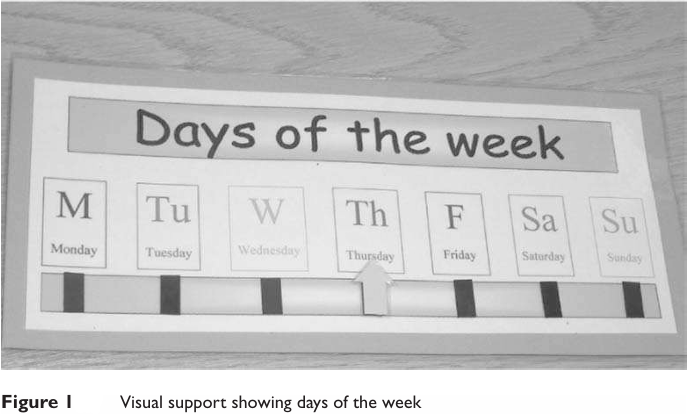
Figure 1 in Structure shows symbol-supported timetables that indicate what is happening during different parts of the day. These may be the instructions for carrying out an activity in class.
Figure 2 in Structure is an equipment prompt that has removable symbols according to the equipment requirements of a task. For older learners, the use of diagrams, charts, worksheets with pictures, spider diagrams and mind maps, videos, overhead transparencies and videos can help to make abstract concepts more concrete. As learners with ASD tend to focus on the detail rather than the big picture, it is helpful if you do have a big picture that shows the concepts being taught. Further guidance of visual strategies to improve communication can be found in Linda Hodgon’s (1996) well regarded book.
Visual supports can also include written words and sentences. The key point is that instructions that are spoken are transitory. They are here one moment and gone the next. When verbal instructions are given, try to give them in a simple form and speak slowly, allowing time for the child to process the information.
الاكثر قراءة في Teaching Strategies
اخر الاخبار
اخبار العتبة العباسية المقدسة
الآخبار الصحية

قسم الشؤون الفكرية يصدر كتاباً يوثق تاريخ السدانة في العتبة العباسية المقدسة
"المهمة".. إصدار قصصي يوثّق القصص الفائزة في مسابقة فتوى الدفاع المقدسة للقصة القصيرة
(نوافذ).. إصدار أدبي يوثق القصص الفائزة في مسابقة الإمام العسكري (عليه السلام)


