

Grammar


Tenses


Present

Present Simple

Present Continuous

Present Perfect

Present Perfect Continuous


Past

Past Simple

Past Continuous

Past Perfect

Past Perfect Continuous


Future

Future Simple

Future Continuous

Future Perfect

Future Perfect Continuous


Parts Of Speech


Nouns

Countable and uncountable nouns

Verbal nouns

Singular and Plural nouns

Proper nouns

Nouns gender

Nouns definition

Concrete nouns

Abstract nouns

Common nouns

Collective nouns

Definition Of Nouns

Animate and Inanimate nouns

Nouns


Verbs

Stative and dynamic verbs

Finite and nonfinite verbs

To be verbs

Transitive and intransitive verbs

Auxiliary verbs

Modal verbs

Regular and irregular verbs

Action verbs

Verbs


Adverbs

Relative adverbs

Interrogative adverbs

Adverbs of time

Adverbs of place

Adverbs of reason

Adverbs of quantity

Adverbs of manner

Adverbs of frequency

Adverbs of affirmation

Adverbs


Adjectives

Quantitative adjective

Proper adjective

Possessive adjective

Numeral adjective

Interrogative adjective

Distributive adjective

Descriptive adjective

Demonstrative adjective


Pronouns

Subject pronoun

Relative pronoun

Reflexive pronoun

Reciprocal pronoun

Possessive pronoun

Personal pronoun

Interrogative pronoun

Indefinite pronoun

Emphatic pronoun

Distributive pronoun

Demonstrative pronoun

Pronouns


Pre Position


Preposition by function

Time preposition

Reason preposition

Possession preposition

Place preposition

Phrases preposition

Origin preposition

Measure preposition

Direction preposition

Contrast preposition

Agent preposition


Preposition by construction

Simple preposition

Phrase preposition

Double preposition

Compound preposition

prepositions


Conjunctions

Subordinating conjunction

Correlative conjunction

Coordinating conjunction

Conjunctive adverbs

conjunctions


Interjections

Express calling interjection

Phrases

Sentences


Grammar Rules

Passive and Active

Preference

Requests and offers

wishes

Be used to

Some and any

Could have done

Describing people

Giving advices

Possession

Comparative and superlative

Giving Reason

Making Suggestions

Apologizing

Forming questions

Since and for

Directions

Obligation

Adverbials

invitation

Articles

Imaginary condition

Zero conditional

First conditional

Second conditional

Third conditional

Reported speech

Demonstratives

Determiners


Linguistics

Phonetics

Phonology

Linguistics fields

Syntax

Morphology

Semantics

pragmatics

History

Writing

Grammar

Phonetics and Phonology

Semiotics


Reading Comprehension

Elementary

Intermediate

Advanced


Teaching Methods

Teaching Strategies

Assessment
Learner participation
المؤلف:
Mike Blamires
المصدر:
Additional Educational Needs
الجزء والصفحة:
P149-C10
2025-04-21
505
Learner participation
Much recent legislation has emphasized the importance of the learner’s voice in making provision. Within the area of ASD, this can be difficult because the learner cannot readily reflect upon their experiences, especially if they are anxious after they have been involved in an incident and you are enquiring about what happened and why. As well as observation and discussion with the teacher and parents about the possible reasons for a behavior, a technique Carol Gray called comic strip conversations has been widely used. This involves the use of colored felt tip pens, the drawing of stick men with cartoon speech and thought bubbles to denote what was said and what people may have thought (Figure 1). This can be used to discover what happened leading up to an incident, so the child has an external and literal representation of what was said and meant. The colored pens are used to code the emotion of what was said. For example:
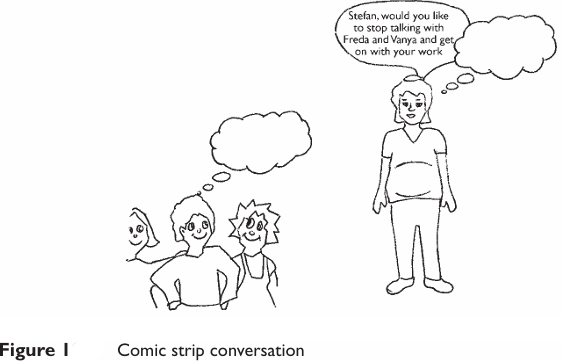
learner cannot readily reflect upon their experiences, especially if they are anxious after they have been involved in an incident and you are enquiring about what happened and why. As well as observation and discussion with the teacher and parents about the possible reasons for a behavior, a technique Carol Gray called comic strip conversations has been widely used. This involves the use of coloured felt tip pens, the drawing of stick men with cartoon speech and thought bubbles to denote what was said and what people may have thought (Figure 1). This can be used to discover what happened leading up to an incident, so the child has an external and literal representation of what was said and meant. The coloured pens are used to code the emotion of what was said. For example:
RED: Bad ideas, teasing anger, unfriendly
BLACK: Facts, things we know
GREEN: Good ideas, happy, friendly
Discussion
In Figure 1, what do you think the teacher is thinking and trying to communicate. What is the child likely to say?
With older learners, a conversation might be carried out using a word processor so that the learner with ASD can focus upon the questions and their answers. Sometimes this can be just with the adult typing.
الاكثر قراءة في Teaching Strategies
اخر الاخبار
اخبار العتبة العباسية المقدسة
الآخبار الصحية

قسم الشؤون الفكرية يصدر كتاباً يوثق تاريخ السدانة في العتبة العباسية المقدسة
"المهمة".. إصدار قصصي يوثّق القصص الفائزة في مسابقة فتوى الدفاع المقدسة للقصة القصيرة
(نوافذ).. إصدار أدبي يوثق القصص الفائزة في مسابقة الإمام العسكري (عليه السلام)


