

Grammar


Tenses


Present

Present Simple

Present Continuous

Present Perfect

Present Perfect Continuous


Past

Past Simple

Past Continuous

Past Perfect

Past Perfect Continuous


Future

Future Simple

Future Continuous

Future Perfect

Future Perfect Continuous


Parts Of Speech


Nouns

Countable and uncountable nouns

Verbal nouns

Singular and Plural nouns

Proper nouns

Nouns gender

Nouns definition

Concrete nouns

Abstract nouns

Common nouns

Collective nouns

Definition Of Nouns

Animate and Inanimate nouns

Nouns


Verbs

Stative and dynamic verbs

Finite and nonfinite verbs

To be verbs

Transitive and intransitive verbs

Auxiliary verbs

Modal verbs

Regular and irregular verbs

Action verbs

Verbs


Adverbs

Relative adverbs

Interrogative adverbs

Adverbs of time

Adverbs of place

Adverbs of reason

Adverbs of quantity

Adverbs of manner

Adverbs of frequency

Adverbs of affirmation

Adverbs


Adjectives

Quantitative adjective

Proper adjective

Possessive adjective

Numeral adjective

Interrogative adjective

Distributive adjective

Descriptive adjective

Demonstrative adjective


Pronouns

Subject pronoun

Relative pronoun

Reflexive pronoun

Reciprocal pronoun

Possessive pronoun

Personal pronoun

Interrogative pronoun

Indefinite pronoun

Emphatic pronoun

Distributive pronoun

Demonstrative pronoun

Pronouns


Pre Position


Preposition by function

Time preposition

Reason preposition

Possession preposition

Place preposition

Phrases preposition

Origin preposition

Measure preposition

Direction preposition

Contrast preposition

Agent preposition


Preposition by construction

Simple preposition

Phrase preposition

Double preposition

Compound preposition

prepositions


Conjunctions

Subordinating conjunction

Correlative conjunction

Coordinating conjunction

Conjunctive adverbs

conjunctions


Interjections

Express calling interjection

Phrases

Sentences


Grammar Rules

Passive and Active

Preference

Requests and offers

wishes

Be used to

Some and any

Could have done

Describing people

Giving advices

Possession

Comparative and superlative

Giving Reason

Making Suggestions

Apologizing

Forming questions

Since and for

Directions

Obligation

Adverbials

invitation

Articles

Imaginary condition

Zero conditional

First conditional

Second conditional

Third conditional

Reported speech

Demonstratives

Determiners


Linguistics

Phonetics

Phonology

Linguistics fields

Syntax

Morphology

Semantics

pragmatics

History

Writing

Grammar

Phonetics and Phonology

Semiotics


Reading Comprehension

Elementary

Intermediate

Advanced


Teaching Methods

Teaching Strategies

Assessment
Speech, language and communication needs (SLCN)
المؤلف:
Janet Tod and Sue Soan
المصدر:
Additional Educational Needs
الجزء والصفحة:
P170-C12
2025-04-25
1041
Speech, language and communication needs (SLCN)
Language is central to learning. It provides the main tool for teaching and learning and, by experiencing language for these purposes, children’s language develops further. Through active participation and through interaction with people and with their environment, children learn to make sense of their world. Learning and in particular, learning through the use of language is an intellectual, emotional and social activity. (Martin and Miller, 1999).
We will seek to provide an increased understanding of the process, pace and purpose of normal language development for those who support learners with speech language and communication needs (SLCN). This will be used as a basis, for providing a framework for assessing SLCN within educational contexts and identifying appropriate support strategies. Most children have not only ‘learned to talk’ but are also able to ‘talk to learn’ prior to school entry. For children who do not experience difficulties with speech, language and communication, their ability to use language to communicate, reflect and reason, and plan and monitor their own behavior appears to happen with comparative ease. However, for those who teach pupils with SLCN, progress is often frustratingly slow. Although ‘early identification’ has been enshrined within Special Educational Needs (SEN) policy for at least a decade (DfE, 1994; DfES, 2004) and is an important component of educational practice, there is little doubt that language difficulties have a long-term pervasive effect on educational attainment.
It is crucial that the development of the use of language is regarded as a whole-school responsibility with all staff having an awareness of how to support and enhance language development through their interaction with pupils.
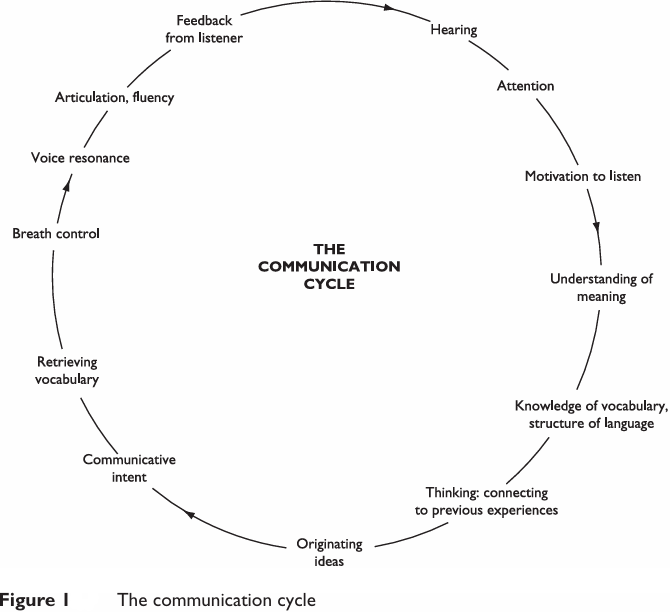
In thinking about the development and use of language, it is clear that there is a contrast between the complexity of the communication process (see Figure 1) and the apparent ease with which the majority of infants learn to understand and use language.
Figure 1 describes the processes involved in communication. The right of the diagram is concerned with ‘input’, i.e. listening and understanding that we refer to as ‘receptive language’ and the left-hand side is concerned with the output of speech and language that we refer to as ‘expressive language’. In normal language development, receptive language (i.e. understanding) precedes expressive language development. Parents and caretakers continue to talk to their babies, even though they may get limited response, in order to promote understanding of language. It is important that those who support learners with SLCN ensure that the development of receptive language is not limited by the learner’s restricted use of language. Talking, commenting on what the pupil does, reading stories, etc. are important activities for those who support learners with SLCN.
الاكثر قراءة في Teaching Strategies
اخر الاخبار
اخبار العتبة العباسية المقدسة
الآخبار الصحية

قسم الشؤون الفكرية يصدر كتاباً يوثق تاريخ السدانة في العتبة العباسية المقدسة
"المهمة".. إصدار قصصي يوثّق القصص الفائزة في مسابقة فتوى الدفاع المقدسة للقصة القصيرة
(نوافذ).. إصدار أدبي يوثق القصص الفائزة في مسابقة الإمام العسكري (عليه السلام)


