

Grammar


Tenses


Present

Present Simple

Present Continuous

Present Perfect

Present Perfect Continuous


Past

Past Simple

Past Continuous

Past Perfect

Past Perfect Continuous


Future

Future Simple

Future Continuous

Future Perfect

Future Perfect Continuous


Parts Of Speech


Nouns

Countable and uncountable nouns

Verbal nouns

Singular and Plural nouns

Proper nouns

Nouns gender

Nouns definition

Concrete nouns

Abstract nouns

Common nouns

Collective nouns

Definition Of Nouns

Animate and Inanimate nouns

Nouns


Verbs

Stative and dynamic verbs

Finite and nonfinite verbs

To be verbs

Transitive and intransitive verbs

Auxiliary verbs

Modal verbs

Regular and irregular verbs

Action verbs

Verbs


Adverbs

Relative adverbs

Interrogative adverbs

Adverbs of time

Adverbs of place

Adverbs of reason

Adverbs of quantity

Adverbs of manner

Adverbs of frequency

Adverbs of affirmation

Adverbs


Adjectives

Quantitative adjective

Proper adjective

Possessive adjective

Numeral adjective

Interrogative adjective

Distributive adjective

Descriptive adjective

Demonstrative adjective


Pronouns

Subject pronoun

Relative pronoun

Reflexive pronoun

Reciprocal pronoun

Possessive pronoun

Personal pronoun

Interrogative pronoun

Indefinite pronoun

Emphatic pronoun

Distributive pronoun

Demonstrative pronoun

Pronouns


Pre Position


Preposition by function

Time preposition

Reason preposition

Possession preposition

Place preposition

Phrases preposition

Origin preposition

Measure preposition

Direction preposition

Contrast preposition

Agent preposition


Preposition by construction

Simple preposition

Phrase preposition

Double preposition

Compound preposition

prepositions


Conjunctions

Subordinating conjunction

Correlative conjunction

Coordinating conjunction

Conjunctive adverbs

conjunctions


Interjections

Express calling interjection

Phrases

Sentences


Grammar Rules

Passive and Active

Preference

Requests and offers

wishes

Be used to

Some and any

Could have done

Describing people

Giving advices

Possession

Comparative and superlative

Giving Reason

Making Suggestions

Apologizing

Forming questions

Since and for

Directions

Obligation

Adverbials

invitation

Articles

Imaginary condition

Zero conditional

First conditional

Second conditional

Third conditional

Reported speech

Demonstratives

Determiners


Linguistics

Phonetics

Phonology

Linguistics fields

Syntax

Morphology

Semantics

pragmatics

History

Writing

Grammar

Phonetics and Phonology

Semiotics


Reading Comprehension

Elementary

Intermediate

Advanced


Teaching Methods

Teaching Strategies

Assessment
Psycholinguistic and cognitive approaches
المؤلف:
Janet Tod and Sue Soan
المصدر:
Additional Educational Needs
الجزء والصفحة:
P176-C12
2025-04-26
958
Psycholinguistic and cognitive approaches
These approaches are often adopted by professionals within educational settings and are based upon how language is processed. Using this model assessment involves looking at how language is received, interpreted and used in a range of social and subject contexts in order to identify:
■ the individual’s particular speech and language processing problem;
■ the implications for learning in group settings;
■ how curriculum delivery and assessment might be modified;
■ the social, emotional and behavioral implications of the language impairment;
■ action that needs to be taken within the framework of the Code of Practice,
i.e. School Action and School Action Plus, including the ‘different or otherwise extra provision’ delivered via Individual Education Plans;
■ roles and responsibilities within the school, including peers, for implementing enhanced provision;
■ pupil and parental expectations for success and their contribution in achieving these success criteria.
Assessment in educational settings is currently influenced by national and global policies for inclusion. In essence, inclusion is concerned with securing ‘access’, ‘engagement’ and ‘participation’ (Tod, 2000) for all learners in order to reduce barriers to achievement learning and social participation. Such a model fits well with educational assessment frameworks that seek to identify how the individual’s speech and language difficulty affects his or her confidence and competence to access the curriculum; to process the range of inputs; and to respond academically and socially.
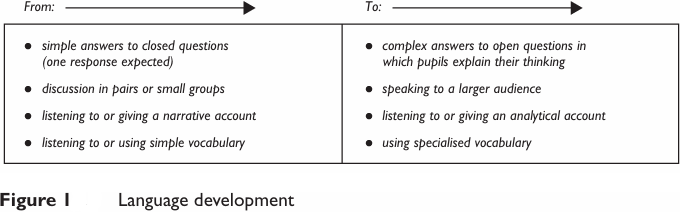
Assessment in educational contexts is very much concerned with how pupils use language. As learners progress through the education system, it is this language use that determines their progress. During the early years an individual’s use of language at home is linked to their personal needs, e.g. to ask for help, to seek information, to secure attention, to interact, etc. However, once in school the purpose of language changes. ‘Pupils’ talking and writing provides evidence of their abilities to understand, imagine, explore, analyze, make explicit, evaluate, elaborate, interpret, hypothesize, and reflect’ (SCAA ’97). We expect pupils to develop their language use as shown in Figure 1, a progression from simple to complex answers, etc.
It is therefore very useful for those who support pupils with SLCN to assess ‘how the child/young person is using language’. Once this has been established, the aim of teaching can be to consolidate the uses already evident and to increase the range. Anne Locke (Teaching Talking, 1992) provides a comprehensive assessment and teaching package. Examples from this include a useful ‘Purpose of Talk’ for infant and junior age pupils against which pupil progress can be assessed.
الاكثر قراءة في Teaching Strategies
اخر الاخبار
اخبار العتبة العباسية المقدسة
الآخبار الصحية

قسم الشؤون الفكرية يصدر كتاباً يوثق تاريخ السدانة في العتبة العباسية المقدسة
"المهمة".. إصدار قصصي يوثّق القصص الفائزة في مسابقة فتوى الدفاع المقدسة للقصة القصيرة
(نوافذ).. إصدار أدبي يوثق القصص الفائزة في مسابقة الإمام العسكري (عليه السلام)


