

Grammar


Tenses


Present

Present Simple

Present Continuous

Present Perfect

Present Perfect Continuous


Past

Past Simple

Past Continuous

Past Perfect

Past Perfect Continuous


Future

Future Simple

Future Continuous

Future Perfect

Future Perfect Continuous


Parts Of Speech


Nouns

Countable and uncountable nouns

Verbal nouns

Singular and Plural nouns

Proper nouns

Nouns gender

Nouns definition

Concrete nouns

Abstract nouns

Common nouns

Collective nouns

Definition Of Nouns

Animate and Inanimate nouns

Nouns


Verbs

Stative and dynamic verbs

Finite and nonfinite verbs

To be verbs

Transitive and intransitive verbs

Auxiliary verbs

Modal verbs

Regular and irregular verbs

Action verbs

Verbs


Adverbs

Relative adverbs

Interrogative adverbs

Adverbs of time

Adverbs of place

Adverbs of reason

Adverbs of quantity

Adverbs of manner

Adverbs of frequency

Adverbs of affirmation

Adverbs


Adjectives

Quantitative adjective

Proper adjective

Possessive adjective

Numeral adjective

Interrogative adjective

Distributive adjective

Descriptive adjective

Demonstrative adjective


Pronouns

Subject pronoun

Relative pronoun

Reflexive pronoun

Reciprocal pronoun

Possessive pronoun

Personal pronoun

Interrogative pronoun

Indefinite pronoun

Emphatic pronoun

Distributive pronoun

Demonstrative pronoun

Pronouns


Pre Position


Preposition by function

Time preposition

Reason preposition

Possession preposition

Place preposition

Phrases preposition

Origin preposition

Measure preposition

Direction preposition

Contrast preposition

Agent preposition


Preposition by construction

Simple preposition

Phrase preposition

Double preposition

Compound preposition

prepositions


Conjunctions

Subordinating conjunction

Correlative conjunction

Coordinating conjunction

Conjunctive adverbs

conjunctions


Interjections

Express calling interjection

Phrases

Sentences


Grammar Rules

Passive and Active

Preference

Requests and offers

wishes

Be used to

Some and any

Could have done

Describing people

Giving advices

Possession

Comparative and superlative

Giving Reason

Making Suggestions

Apologizing

Forming questions

Since and for

Directions

Obligation

Adverbials

invitation

Articles

Imaginary condition

Zero conditional

First conditional

Second conditional

Third conditional

Reported speech

Demonstratives

Determiners


Linguistics

Phonetics

Phonology

Linguistics fields

Syntax

Morphology

Semantics

pragmatics

History

Writing

Grammar

Phonetics and Phonology

Semiotics


Reading Comprehension

Elementary

Intermediate

Advanced


Teaching Methods

Teaching Strategies

Assessment
Epilepsy
المؤلف:
Sue Soan
المصدر:
Additional Educational Needs
الجزء والصفحة:
P228-C15
2025-05-06
887
Epilepsy
Epilepsy is a neurological disorder that affects 1 in 200 of the population.
Epilepsy is an established tendency to recurrent seizures, which occur as a result of biochemical changes in the brain. It affects children of all ages, backgrounds and levels of ability. It is not an illness or disease, but is indicative of a physical disorder. (McCarthy and Davies, 1996)
If a child only has one seizure this would not necessarily indicate epilepsy. Epilepsy means that the child has recurring seizures. The symptoms and duration vary greatly depending on the type of epilepsy, but also it affects children in different ways. Epilepsy is abnormal brain functioning and this produces fits, attacks or seizures. Children may have muscle spasms, convulsions, involuntary movements and changes in perception and consciousness. These seizures are usually over in a few seconds or minutes, the same processes that caused the seizures having triggered other mechanisms in the brain stopping them.
The Tonic–Clonic Seizures, previously known as ‘grand mal’ epilepsy, are the most disturbing for all involved and indeed can be quite frightening not only for the child experiencing the seizure, but also for other pupils and adults. In this situation the child may make a noise and then fall quite suddenly, followed by convulsive jerks. Saliva around the mouth may then start appearing and some-times bladder or bowel control might be lost. Within a few minutes the child will regain consciousness, but is quite likely to feel dazed and confused for a few hours, very tired with the possibility of a headache developing.
If this is not the first time a child experiences a seizure it is not considered a medical emergency. However, a child may have caused harm to himself when he fell or may have been unconscious for quite a long time. If this is the case, it is always better to seek medical attention.
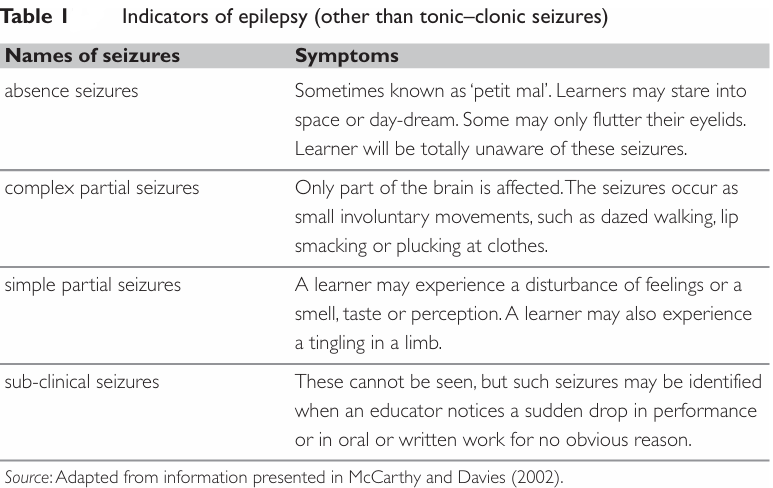
The other types of epilepsy are not so easily identified, but as one in three of the children with epilepsy fall behind academically, it is essential that educators are aware of signs that MAY indicate a neurological disorder. Table 1 in illustrates the type of epilepsy and some of the symptoms.
Discussion
As has been mentioned, learners with epilepsy experience seizures in many different ways. Can you think of a learner who may possibly be experiencing a form of epilepsy?
الاكثر قراءة في Teaching Strategies
اخر الاخبار
اخبار العتبة العباسية المقدسة
الآخبار الصحية

قسم الشؤون الفكرية يصدر كتاباً يوثق تاريخ السدانة في العتبة العباسية المقدسة
"المهمة".. إصدار قصصي يوثّق القصص الفائزة في مسابقة فتوى الدفاع المقدسة للقصة القصيرة
(نوافذ).. إصدار أدبي يوثق القصص الفائزة في مسابقة الإمام العسكري (عليه السلام)


