

Grammar


Tenses


Present

Present Simple

Present Continuous

Present Perfect

Present Perfect Continuous


Past

Past Simple

Past Continuous

Past Perfect

Past Perfect Continuous


Future

Future Simple

Future Continuous

Future Perfect

Future Perfect Continuous


Parts Of Speech


Nouns

Countable and uncountable nouns

Verbal nouns

Singular and Plural nouns

Proper nouns

Nouns gender

Nouns definition

Concrete nouns

Abstract nouns

Common nouns

Collective nouns

Definition Of Nouns

Animate and Inanimate nouns

Nouns


Verbs

Stative and dynamic verbs

Finite and nonfinite verbs

To be verbs

Transitive and intransitive verbs

Auxiliary verbs

Modal verbs

Regular and irregular verbs

Action verbs

Verbs


Adverbs

Relative adverbs

Interrogative adverbs

Adverbs of time

Adverbs of place

Adverbs of reason

Adverbs of quantity

Adverbs of manner

Adverbs of frequency

Adverbs of affirmation

Adverbs


Adjectives

Quantitative adjective

Proper adjective

Possessive adjective

Numeral adjective

Interrogative adjective

Distributive adjective

Descriptive adjective

Demonstrative adjective


Pronouns

Subject pronoun

Relative pronoun

Reflexive pronoun

Reciprocal pronoun

Possessive pronoun

Personal pronoun

Interrogative pronoun

Indefinite pronoun

Emphatic pronoun

Distributive pronoun

Demonstrative pronoun

Pronouns


Pre Position


Preposition by function

Time preposition

Reason preposition

Possession preposition

Place preposition

Phrases preposition

Origin preposition

Measure preposition

Direction preposition

Contrast preposition

Agent preposition


Preposition by construction

Simple preposition

Phrase preposition

Double preposition

Compound preposition

prepositions


Conjunctions

Subordinating conjunction

Correlative conjunction

Coordinating conjunction

Conjunctive adverbs

conjunctions


Interjections

Express calling interjection

Phrases

Sentences


Grammar Rules

Passive and Active

Preference

Requests and offers

wishes

Be used to

Some and any

Could have done

Describing people

Giving advices

Possession

Comparative and superlative

Giving Reason

Making Suggestions

Apologizing

Forming questions

Since and for

Directions

Obligation

Adverbials

invitation

Articles

Imaginary condition

Zero conditional

First conditional

Second conditional

Third conditional

Reported speech

Demonstratives

Determiners


Linguistics

Phonetics

Phonology

Linguistics fields

Syntax

Morphology

Semantics

pragmatics

History

Writing

Grammar

Phonetics and Phonology

Semiotics


Reading Comprehension

Elementary

Intermediate

Advanced


Teaching Methods

Teaching Strategies

Assessment
Action inquiry into the graphic design critique
المؤلف:
Mary-Jane Taylor & Coralie McCormack
المصدر:
Enhancing Teaching and Learning through Assessment
الجزء والصفحة:
P55-C6
2025-06-07
833
Action inquiry into the graphic design critique
The action inquiry reported here was undertaken within the context of the fourth and final year of studies in the subjects Graphic Design (GD) 4.1 & 4.2 of the Bachelor of Graphic Design course at the University of Canberra. The principal objectives of this final year of study are: preparing students to reach a suitable level to enter the profession; preparing an individual professional portfolio; developing student abilities to work independently; refining students' communication skills; and producing creative and individual project works.
To achieve these objectives students undertake self-selected and self-directed studies while consulting vigorously with their peers, colleagues and staff. As the year progresses, students take increased responsibility for their personal studies through to almost autonomous operation by the end of the year. Throughout the fourth-year program, the lecturer facilitates, rather than performs as a didactic teacher. As a 'consultant' and sometimes as a 'client' the teacher acts as a sounding board and gives verbal feedback to the student. Verbal feedback can occur in formal or informal situations, is often impromptu, and it can occur in very public arenas. Feedback may occur informally, one-on-one in the car park, formally in a class of fifty students, or informally in a tutorial of fifteen to twenty students.
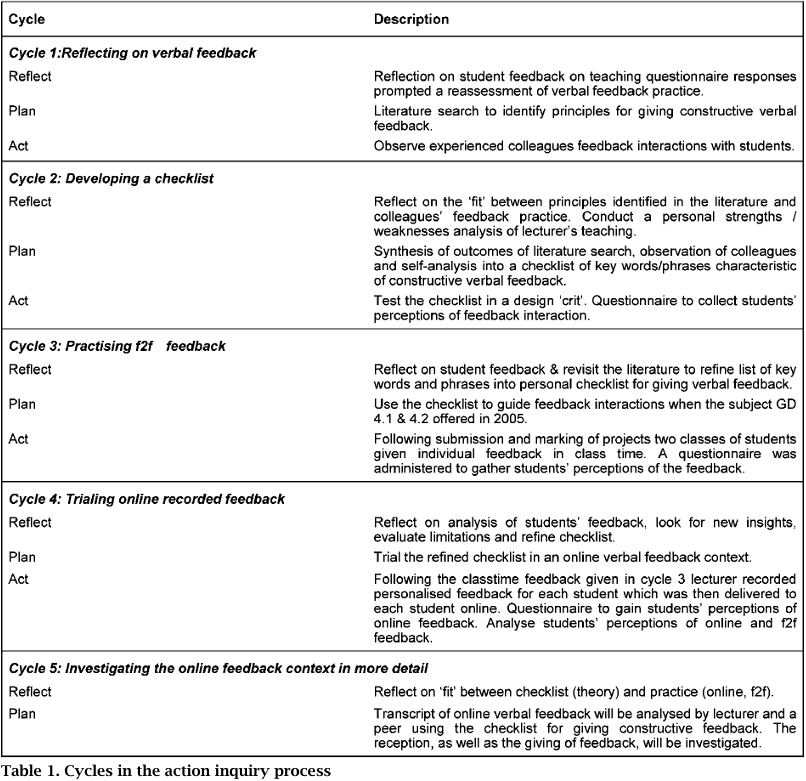
Data contributing to the action inquiry into formal oral feedback in the graphic design 'crit' has been gathered over five cycles of reflect-plan-act (Table 1).
Action inquiry cycles 1 and 2 were undertaken during 2003-2004 and have been reported elsewhere (Taylor & McCormack, 2004). A checklist for giving constructive feedback (Table 2) was developed over the first two cycles.
The outcomes of cycle 3 - embedding constructive feedback into face-to-face teaching practice - and cycle 4 - trialing the checklist in an online verbal feedback context. The fifth cycle will commence later this year.

The overall aim for cycles 3 and 4 was to improve the practice of giving feedback. In particular, the academic sought to:
• Trial a structured process for giving verbal feedback using the checklist developed in cycles 1 and 2. Read it regularly. Read it just before class. Keep a copy at hand to glance at during class. Reflect on the outcomes immediately after class.
• Practice the process of delivery based on the checklist to a point where it becomes subliminal, automatic.
• Concentrate on praise, a possible stumbling point for me.
• Try online verbal feedback. Investigate the advantages and disadvantages of online verbal feedback. And ask students for their perceptions of the delivery of this feedback.
الاكثر قراءة في Teaching Strategies
اخر الاخبار
اخبار العتبة العباسية المقدسة
الآخبار الصحية

قسم الشؤون الفكرية يصدر كتاباً يوثق تاريخ السدانة في العتبة العباسية المقدسة
"المهمة".. إصدار قصصي يوثّق القصص الفائزة في مسابقة فتوى الدفاع المقدسة للقصة القصيرة
(نوافذ).. إصدار أدبي يوثق القصص الفائزة في مسابقة الإمام العسكري (عليه السلام)


