

Grammar


Tenses


Present

Present Simple

Present Continuous

Present Perfect

Present Perfect Continuous


Past

Past Simple

Past Continuous

Past Perfect

Past Perfect Continuous


Future

Future Simple

Future Continuous

Future Perfect

Future Perfect Continuous


Parts Of Speech


Nouns

Countable and uncountable nouns

Verbal nouns

Singular and Plural nouns

Proper nouns

Nouns gender

Nouns definition

Concrete nouns

Abstract nouns

Common nouns

Collective nouns

Definition Of Nouns

Animate and Inanimate nouns

Nouns


Verbs

Stative and dynamic verbs

Finite and nonfinite verbs

To be verbs

Transitive and intransitive verbs

Auxiliary verbs

Modal verbs

Regular and irregular verbs

Action verbs

Verbs


Adverbs

Relative adverbs

Interrogative adverbs

Adverbs of time

Adverbs of place

Adverbs of reason

Adverbs of quantity

Adverbs of manner

Adverbs of frequency

Adverbs of affirmation

Adverbs


Adjectives

Quantitative adjective

Proper adjective

Possessive adjective

Numeral adjective

Interrogative adjective

Distributive adjective

Descriptive adjective

Demonstrative adjective


Pronouns

Subject pronoun

Relative pronoun

Reflexive pronoun

Reciprocal pronoun

Possessive pronoun

Personal pronoun

Interrogative pronoun

Indefinite pronoun

Emphatic pronoun

Distributive pronoun

Demonstrative pronoun

Pronouns


Pre Position


Preposition by function

Time preposition

Reason preposition

Possession preposition

Place preposition

Phrases preposition

Origin preposition

Measure preposition

Direction preposition

Contrast preposition

Agent preposition


Preposition by construction

Simple preposition

Phrase preposition

Double preposition

Compound preposition

prepositions


Conjunctions

Subordinating conjunction

Correlative conjunction

Coordinating conjunction

Conjunctive adverbs

conjunctions


Interjections

Express calling interjection

Phrases

Sentences


Grammar Rules

Passive and Active

Preference

Requests and offers

wishes

Be used to

Some and any

Could have done

Describing people

Giving advices

Possession

Comparative and superlative

Giving Reason

Making Suggestions

Apologizing

Forming questions

Since and for

Directions

Obligation

Adverbials

invitation

Articles

Imaginary condition

Zero conditional

First conditional

Second conditional

Third conditional

Reported speech

Demonstratives

Determiners


Linguistics

Phonetics

Phonology

Linguistics fields

Syntax

Morphology

Semantics

pragmatics

History

Writing

Grammar

Phonetics and Phonology

Semiotics


Reading Comprehension

Elementary

Intermediate

Advanced


Teaching Methods

Teaching Strategies

Assessment
Integration what it means
المؤلف:
Mary-Jane Taylor & Coralie McCormack
المصدر:
Enhancing Teaching and Learning through Assessment
الجزء والصفحة:
P79-C8
2025-06-12
644
Integration what it means
The aim of an integrated approach is to ensure that the various elements of learning, teaching and assessment build upon one another to produce a unified whole in order to enhance the student's overall learning experience. Thus, the elements of the learning, teaching and assessment approach adopted in this module are mutually supportive and each element forms an integral part of the whole system (Biggs, 2003).
The module was developed in line with the principles of constructive alignment which means that the learning outcomes are met by ensuring alignment of the learning, teaching and assessment strategies. In an aligned approach to learning, teaching and assessment, there is consistency throughout the system. Thus, the curriculum is stated in the form of clear objectives which specify the level of understanding required; teaching methods are selected that are likely to realize the objectives and the assessment addresses the objectives. All elements of this system address the same agenda and support each other (Biggs, 2003).
Shuell (1986) believes that it is important to bear in mind that what the student does is actually more significant in determining what is learned than what the teacher does. This highlights the importance of getting students to engage in learning activities in order to promote their own learning. According to Biggs (2003), constructivism places the emphasis on learners constructing their own knowledge, as opposed to being passive recipients of knowledge created by others. Constructive alignment thus makes the students do the real work, the lecturer acts as a facilitator between the student and a learning environment that supports the appropriate learning activities (Biggs, 2003). This philosophical approach underpinned the development of the module, Ethics in Healthcare (EIHC).
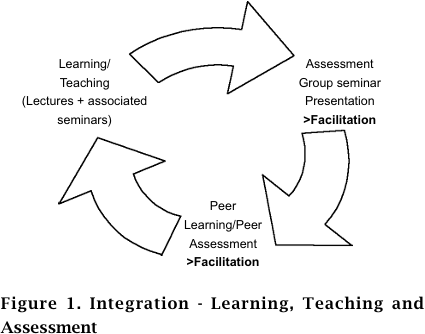
The various elements of EIHC will now be examined in order to demonstrate how integration is achieved and to illustrate the potential it has to enhance the student learning experience. The model in Figure 1 demonstrates how each element of the learning, teaching and assessment strategy builds upon the other. Each stage of this model will be considered in detail and the integrated nature of the learning, teaching and assessment approach will be examined. Firstly, the influence of the nursing curriculum guidelines on modular development will be considered.
الاكثر قراءة في Teaching Strategies
اخر الاخبار
اخبار العتبة العباسية المقدسة
الآخبار الصحية

قسم الشؤون الفكرية يصدر كتاباً يوثق تاريخ السدانة في العتبة العباسية المقدسة
"المهمة".. إصدار قصصي يوثّق القصص الفائزة في مسابقة فتوى الدفاع المقدسة للقصة القصيرة
(نوافذ).. إصدار أدبي يوثق القصص الفائزة في مسابقة الإمام العسكري (عليه السلام)


