Challenges in Assessments in a Case-Based Science Course
A case is a story, often told as a sequence of events in a particular place. Often, there are human actors woven into the case story (Shulman, 1996). A case-based approach emphasizes the active construction of knowledge gained from simulated experience. Cases should provide clear contexts in which learners can construct meanings and concepts; Morrison (2001) calls this 'actionable learning'. The context of a case is intended to enable students to put themselves in the role of being an actor in the situation; in this way they are more likely to be engaged in the learning and try to relate what they are learning to previous experiences. Cases may also help learners to develop problem-solving skills and collaborative skills that are recognized as key outcome skills that students will need in their future professional lives (Morrison, 2001).
Shulman (1996) provided a long list of potential benefits for case-based teaching and learning. For example, cases may: aid in teaching principles or concepts of a theoretical nature by showing the occasions when the theories are applicable; illustrate the precedents for practice, in abstract and context-dependent issues such as morals or ethics; train students in analytic strategies and skills; and increase students' motivation for learning. In addition, Harrington et al. (1996) remarked that teachers would also benefit from taking a case based approach to their teaching as they have a chance to reflect upon the learning process when they write and introduce the cases in their classes.
Much attention has been paid to the pedagogy, while comparatively less interest has been shown in the assessment of case-based courses. This is problematic as assessment is often the key to the overall success of any teaching innovation, as assessment has a marked effect on how teachers teach and students learn. This is often termed 'the backwash effect', e.g. Elton (2002). For example, a poorly designed or implemented assessment has the danger of wrongly focusing students' attention onto surface learning skills such as rote memorization, and so diluting or even ruining the whole purpose of the case-based approach.
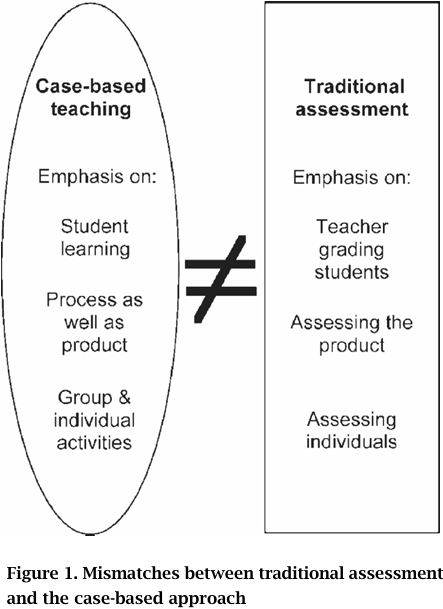
Traditional forms of assessment are not compatible with the overall constructivist nature of the case-based approach of learning and teaching. As Figure 1 summarizes, the case-based approach has characteristics that include: students taking a more prominent role in the classroom, teachers emphasizing both the learning process and the product, and teachers paying attention to both students' individual and in group performances. However, traditional assessment has teachers playing the key role, with the predominant mode being the grading of students' products in testing situations where students usually work alone. Thus, the learning process is not included in the assessment scheme and this de-emphasizes the process elements of such attributes as problem-solving, team work and communicative competence.
Employing traditional assessment in classes where the case-based approach is adopted is counter-productive. Some students who sense this limitation of traditional assessment will be de-motivated to contribute to group activities.
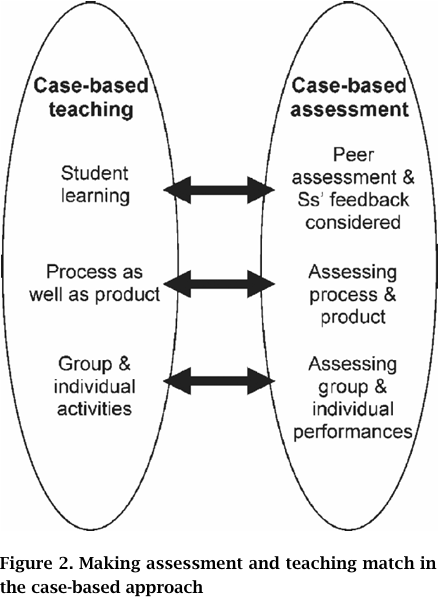
An ideal assessment design for case-based courses should match the constructivist nature of the case-based approach. As illustrated in Figure 2, the assessment process should allow students to play a more prominent role in the design of assessments and encompass a wider range of student performances. With case-based assessment, emphasis is also put on monitoring students' process in completing the case-based activities, rather than on the products alone. The 'new' assessment requires students to demonstrate competence across a range of learning processes and learning skills, such as information searching, working in groups, and making presentations, which are often not required in a traditional course.
We describe an endeavor to implement these changes in a case-based course, included in a project designed to introduce the case-based approach to the teaching of university science. The focus is on the design of this case-based assessment, rather than on the design of the cases used in the course. The case-based course and the assessment strategies were evaluated with data from both the students and the teacher.








