Findings and discussion
On the design of the assessment
Overall, the design of the assessments seemed to have strengthened the students' motivation to learn beyond the basics of the subject area. The teacher reflected that he noticed great enthusiasm on the students' part when they did self-study and also when they prepared for the case; this was considered to be the result of the fact that the course emphasized the monitoring of the different stages of the students' learning process.
The shortcomings recorded, however, included that the teacher had a much heavier workload, and that the students were unsure about the limits of their knowledge exploration before they could claim that they had fulfilled the course's expectation.
Comments on the individual assessment strategies collected from the surveys and the focus-group interview were: concerning the early consultation sessions, the teacher thought that he was successful in recognizing the self-study, group-working and problem-solving difficulties of the students before it was too late but the practice "doubled or even tripled the workload". The students felt that they actually progressed a great deal in both knowledge and learning skills through the consultation sessions and they felt "a learning curve is drawn".
Concerning the classroom observations which were designed to rate students' abilities to participate in group discussion and give effective presentations, the strategy was considered to be of high value. The physics teachers and the educational observers could easily identify evidence of good group-working and presentation skills, and they also found they gave quite high ratings to these skills.
The presentation and reporting assessments were considered fair by the students but they were less certain about how much they actually learnt from the presentations of other groups. Students thought it fair that there were strategies to track individual performances rather than assigning the same marks to all members in the same group. Individual performances were distinguished by the teacher's paying attention to individual performances in consultation sessions and in presentations, and students giving peer comments at the end of the course to rate group members' contributions. One student remarked "I can learn from others through peer-commenting". The teacher, however, remarked that the students were still not very comfortable in criticizing each other and they "gave each other very similar marks". However, when considering how much students felt they learnt from the presentation sessions, there was only some agreement with the statement in the mid-term survey that "listening to the other groups' presentations is an effective way of learning" (students: mean score = 2.84) (5 = strongly agree, 1 = strongly disagree) on all questionnaire items).
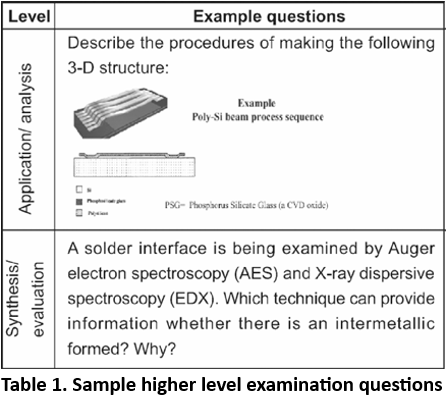
Lastly, concerning the course-end examination, the teacher was pleased that he had put effort into diversifying the nature of the questions so that many of the questions reflected the thinking skills the students had been trained in through the case-based activities in the course. As a result, questions not only required students to simply remember or understand concepts, but also to apply them, use them to analyze new situations and data, synthesize a number of ideas in order to solve problems, and evaluate strategies (Bloom's taxonomy: Bloom, 1956; revised Bloom's taxonomy: Krathwohl, 2002). Examples of the examination questions are in Table 1. Students were told that the case-based learning activities and the examination would be closely related and, naturally, this contributed to an increase in students' motivation in going through the various non-traditional case-based activities in the course.