

Grammar


Tenses


Present

Present Simple

Present Continuous

Present Perfect

Present Perfect Continuous


Past

Past Simple

Past Continuous

Past Perfect

Past Perfect Continuous


Future

Future Simple

Future Continuous

Future Perfect

Future Perfect Continuous


Parts Of Speech


Nouns

Countable and uncountable nouns

Verbal nouns

Singular and Plural nouns

Proper nouns

Nouns gender

Nouns definition

Concrete nouns

Abstract nouns

Common nouns

Collective nouns

Definition Of Nouns

Animate and Inanimate nouns

Nouns


Verbs

Stative and dynamic verbs

Finite and nonfinite verbs

To be verbs

Transitive and intransitive verbs

Auxiliary verbs

Modal verbs

Regular and irregular verbs

Action verbs

Verbs


Adverbs

Relative adverbs

Interrogative adverbs

Adverbs of time

Adverbs of place

Adverbs of reason

Adverbs of quantity

Adverbs of manner

Adverbs of frequency

Adverbs of affirmation

Adverbs


Adjectives

Quantitative adjective

Proper adjective

Possessive adjective

Numeral adjective

Interrogative adjective

Distributive adjective

Descriptive adjective

Demonstrative adjective


Pronouns

Subject pronoun

Relative pronoun

Reflexive pronoun

Reciprocal pronoun

Possessive pronoun

Personal pronoun

Interrogative pronoun

Indefinite pronoun

Emphatic pronoun

Distributive pronoun

Demonstrative pronoun

Pronouns


Pre Position


Preposition by function

Time preposition

Reason preposition

Possession preposition

Place preposition

Phrases preposition

Origin preposition

Measure preposition

Direction preposition

Contrast preposition

Agent preposition


Preposition by construction

Simple preposition

Phrase preposition

Double preposition

Compound preposition

prepositions


Conjunctions

Subordinating conjunction

Correlative conjunction

Coordinating conjunction

Conjunctive adverbs

conjunctions


Interjections

Express calling interjection

Phrases

Sentences


Grammar Rules

Passive and Active

Preference

Requests and offers

wishes

Be used to

Some and any

Could have done

Describing people

Giving advices

Possession

Comparative and superlative

Giving Reason

Making Suggestions

Apologizing

Forming questions

Since and for

Directions

Obligation

Adverbials

invitation

Articles

Imaginary condition

Zero conditional

First conditional

Second conditional

Third conditional

Reported speech

Demonstratives

Determiners


Linguistics

Phonetics

Phonology

Linguistics fields

Syntax

Morphology

Semantics

pragmatics

History

Writing

Grammar

Phonetics and Phonology

Semiotics


Reading Comprehension

Elementary

Intermediate

Advanced


Teaching Methods

Teaching Strategies

Assessment
Enriched interactions in assessments
المؤلف:
Paul Lam & Paula Hodgson & Josephine Csete
المصدر:
Enhancing Teaching and Learning through Assessment
الجزء والصفحة:
P393-C33
2025-08-09
446
Enriched interactions in
assessments
The presence of two kinds of arrow to signify the interactions in Figure 1 in Enrichment of Interaction in Online Assessments indicates the belief that interactions can be roughly classified into simple (unidirectional, with limited feedback) and enriched (bidirectional - negotiation of meanings is possible).
Table 1 illustrates how different online activities that involve students interacting with content, peers, and instructor can bring either simple or enriched interactions.
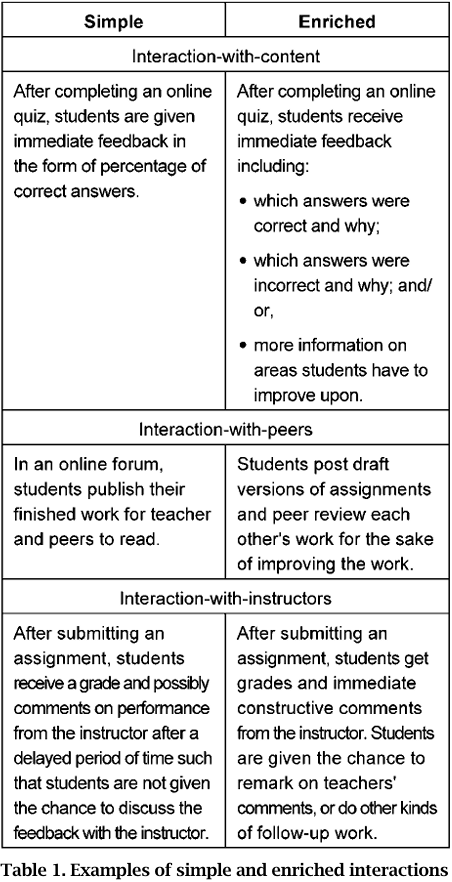
For example, the provision of clear explanatory notes as feedback after learners have submitted their answers to an online quiz is a way to enrich content-student interaction, in contrast to the typically summative quantitative results when learners complete a quiz which may indicate as little information as percentage of correct answers.
Student-student interaction can become bidirectional when in-depth discussions are encouraged rather than having online activities that merely require students to publish without peer review.
Lastly, online interaction between students and teachers is enriched when a teacher provides prompt feedback on students' performance through the online environment, in contrast to the delayed feedback that is inevitable in the conventional post-examination situation.
The authors argue that assessments that provide enriched interactions have greater potential for learning engagement and will result in improved quality of learning. With the distinction between simple and enriched interactions in mind, the authors carried out an investigation to determine, first, the overall picture concerning the kinds of online interaction that students generally engage in by studying 45 cases (which were in higher education semester-long courses) that were supported by an e-learning support project in Hong Kong (the e3Learning Project); and, second, to identify exemplars to showcase how e-learning interactions can be enriched for the benefit of students. A general picture helps to identify the current situation and indicates areas into which more effort can be put. The exemplars then help to illustrate practical ways in which these improvements can be made.
The e3Learning (enrich, extend, evaluate learning - hence e3L) Project was designed to support e-learning across three universities - the Hong Kong Polytechnic University, the City University of Hong Kong and the Chinese University of Hong Kong -over the period 2003 05. It helped teachers to use the Web in education by providing a range of services, from introducing teachers to practical ideas for using the Web in education to developing complete course websites for teachers.
The project supported the web development of over 130 sub-projects, and the outcomes of 45 of these are reported here.
الاكثر قراءة في Teaching Strategies
اخر الاخبار
اخبار العتبة العباسية المقدسة
الآخبار الصحية

قسم الشؤون الفكرية يصدر كتاباً يوثق تاريخ السدانة في العتبة العباسية المقدسة
"المهمة".. إصدار قصصي يوثّق القصص الفائزة في مسابقة فتوى الدفاع المقدسة للقصة القصيرة
(نوافذ).. إصدار أدبي يوثق القصص الفائزة في مسابقة الإمام العسكري (عليه السلام)


