Findings and discussion
Overall picture
The traditional end-of-course written exam is still the main assessment method used by universities. However, teachers are being encouraged to practice alternative assessment methods. Of the 45 websites studied, online assessments were found in 26, although there were actually 32 instances of assessment, as some of the sites had more than one online assessment. The distribution of assessments involving unidirectional and bidirectional interaction is illustrated in Figure 1.
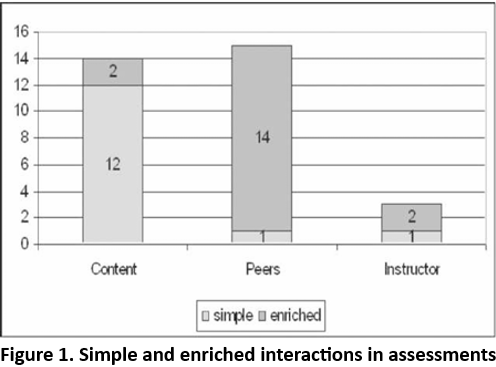
It should be noted that the identification of simple and enriched interactions among the 45 cases was not completely unambiguous but required a certain degree of subjective judgment on the part of the evaluators. For example, the present study considers interactions in websites that provide only 'yes' or 'no' feedback to learners in online quizzes (an interaction-with-content design) to be simple rather than enriched, the rationale being that this kind of yes/no quiz is easily achievable with exercises in paper format. The study considers interactions in online quizzes to be enriched when the online content explains and suggests ways for improvements based on particular input from students: e.g. the website further explains the related problem when the student makes a particular mistake. As it turned out, five of the quizzes evaluated did not provide any feedback to learners, seven provided a yes/no type of result, and two supplied explanation: one was an MC exercise with further help on the right and wrong answers, and the other was an exercise that required students to interact with an electronically simulated machine online where the system gave students realistic feedback based on how the students used the 'machine'.
As for the interaction-with-peers type of website, the study considered interactions to be simple when the students simply posted their comments or ideas but generally did not remark on each other's work or comments as recorded messages on the forum. The judgment was based solely on what was observable online and therefore does not include what happened face-to-face in the classroom. Also, the decision was made independently of whether this kind of peer interaction was a required part of the course set down by the teachers or was a result of self-motivation on the part of the students. Fourteen forums in our study recorded enriched interactions, while one forum recorded very few student-student exchanges of ideas related to the subject matter.
Similarly, the interaction-with-instructors type of website was evaluated on whether the teacher had systematically and regularly made online replies or remarks to the students' comments. The judgment was based solely on what was observable online and was regardless of what happened face to face in the classroom. Also, the decision was made independently of whether this kind of structured interaction was a predetermined characteristic of the forum laid down by the teachers early in the course or whether it was a development as the forum progressed. The study found two forums with enriched teacher-student interaction and one where the teacher did not react to students' work online.
As can be seen in Figure 1, the most noticeable result of this study is that assessments that involve interaction with peers and interaction with content were far more popular than those involving interaction with instructors (ratio is around 5 : 1).
Engaging learners with peers in online assessment was widely adopted in these cases. Also, the online assessment activities were not used to replace conventional teaching but to play a complementary role. Thus, a balance of time and effort in the preparation for and implementation of these activities is an important consideration.
Comparatively, it appears that designing activities that require students to communicate with learners online is easier. When this type of assessment task is implemented, teachers are taking on a less active role as facilitators or moderators, especially to provide a focus for discussions, to motivate learners, to provide feedback and to monitor unacceptable behavior (Salmon, 2000).
Also shown in Figure 1 are the differences in the nature of interactions that students find in the different types of website. Enriched interactions were comparatively fewer in number among assessments that were of the interaction-with-content and interaction-with-instructors types.
The teachers in the study seemed to be quite capable of facilitating enriched interaction where students communicated with their peers. Some learners who were less active in face-to-face classes became much more participative in the online environment. When learners are provided with an online open channel through which they can receive individualized feedback between peers, they become more critical and develop different perspectives through the activities provided (Laurillard, 2000).
Although the interaction-with-content type of assessment can provide individualized feedback, teachers currently design this activity for assessing student performance for grades. This is illustrated in the cases and by the fact that the ratio of simple to enriched assessment was 6 : 1. The effort needed to prepare enriched interactions in interaction-with content types of assessment can be very demanding. A great deal of development time and effort has to be put in to build interactive content materials that provide customized feedback. Teachers have to spend much time and effort monitoring students' comments and providing further feedback if they want to assist students who require extra support or demand more challenges.
The interaction-with-instructors category is noticeably the smallest, represented by three of the 32 total cases of assessment. The amount of time needed for teachers to enable enriched interaction in interaction-with-instructors assessment may explain the comparatively rare use of this type of assessment and the even rarer presence of enriched interaction in this category.
The data above seem to indicate a need to promote enriched learning experiences, especially when learners are to engage in interaction-with-content and interaction-with-instructors types of online assessment.
Among cases with enhanced interaction through assessment in this study, some cases are thought to be able to shed light on good practice that may be transferable to other courses. It is with this belief that the paper showcases some of the exemplars below to illustrate how the Web can be used to deliver enriched interactions through content, peers and instructors.








