Developers' thinking about assessment as it incorporates online elements
As assessment moves online, educational developers' fundamental understandings of assessment are either confirmed and the principles are recognized as applicable in any learning context; or alternatively, there is an awareness that some reconceptualization may be necessary. The following series of short statements about assessment, from the six participants in the study, illustrate some core understandings:
"I am looking for a balance between formative and summative assessment' (Respondent 1)
My core answer here is: it's not about the technology" (Respondent 2)
"Online materials are always simply the support for a learning activity rather than defining the activity" (Respondent 3)
"I don't think effective assessment is any different in an online environment than in any other environment" (Respondent 4)
"Assessment in a face-to-face course is not going to be as successful in an online [off shore] environment and you have to talk about the reasons why" (Respondent 5)
"The temptation with online is to automate the assessment process...because that's what the computer does well...I think formative assessment is critical, I've come around to that as being a really important tool to build into the online environment because it's so easily done in the online world" (Respondent 6)
In these comments one can recognize important beliefs about assessment: opportunities for formative assessment exist online; if it is not about the technology, then by implication the design of the learning activity is a priority; the principles of effective assessment may be applicable in any learning context but in off-campus and off-shore settings some translation of the assessment experience may be required.
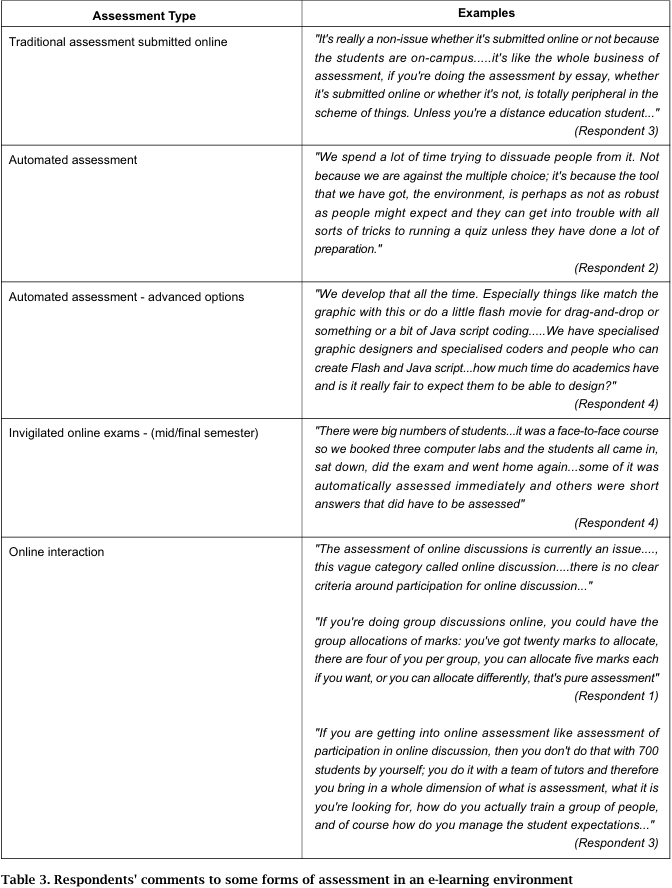
A selection of participants' responses to five of the headings in Table 2 in Research methodology is reproduced in Table 3 below as a basis for extending the discussion.
Different institutional cultures and practices in e-assessment emerge in the extracts as the respondents comment on the categories in Table 3. If an institution is primarily a traditional university, with established lectures, tutorials and laboratory sessions, then the online environment will be conceptualized in a very different way than it would be for a specialist distance education provider as suggested in the comments of respondent 3. If the learning management system is not completely tested under robust quiz conditions, as indicated by respondent 2, then the advice to academics to prepare well beforehand, is designed to ensure that student assessment occurs in a secure online environment. In this sense educational developers become an advocate for learners and for the quality of the student experience.
Where there is a specialist support team of programers, graphic designers and multi-media specialists evident in respondent 4's comments, then enhanced technology options can be implemented when the assessment activities are being designed or an invigilated online exam is being conducted.
The respondents' comments about online interaction indicate concerns in this area and perhaps a need for further research. The suggestion that this also impacts on the training of tutors illustrates that a broader systemic approach to assessment, guided by leadership, policy and support, is once again part of the solution. At a certain point the individual developers' perspectives need to be understood against the backdrop of their institutional environment to illuminate what is occurring in terms of assessment in online environments. Finally the external higher education environment in Australia, particularly government agendas implemented through the Department of Education, Science and Training (DEST), needs to considered.
The focus on online assessment invites detailed findings about the roles and practices of educational developers in learning and teaching units. This is also closely related to how new academics are supported in their teaching role and particularly their online teaching and assessment practices. Institutions can advance upon practices in these areas as they seek to align the ways they support academic staff with institutional expectations of their teaching roles.








