Conceptualizing Assessment for Online Delivery: Educational Developers' Perspectives
Conclusions
Critical elements which underpin educational development in the area of e-assessment include individual components such as the developers' conception of learning, teaching and assessment, their professional background and disciplinary orientation, their aware ness of the range of e-assessment options that can address diverse learning outcomes and the ways in which they identify and respond to critical assessment issues. In a sense though this is only half of the picture because institutional policy and leadership, how the developers' organizational context is conceptualized and the institutional quality/evaluation processes have significant impacts upon the thinking of developers.
In a broad sense the literature on assessment is imbued with such terms as deep and surface learning, aligned assessment and formative and summative assessment but there is some emerging educational development thinking, associated with constructivism, the design of active learning and educational technology, which suggests that new terminology such as affordances, interactivity and asynchronous synchronous is particularly relevant to the design of assessment in e-learning environments.
In practice though, respondents did not endorse the usefulness of such concepts. The following observations by respondent 4 illustrated the issues involved:
“I certainly talk about the capabilities of the technology. I would not use the term 'affordances'. It's to do with leading people into it without them necessarily being conscious of it. I might talk with them about where they locate quizzes online and things like that which have to do with them developing those affordances appropriately, but not necessarily the concept. I think the concept itself is confusing to lecturers rather than helpful”.
These comments suggest that even if the educational concepts were valuable they needed to be translated into an applied context that made sense to the individual academic. Respondent 6 noted that "What I'm finding is that certain terminology has almost become mainstream; a couple of things have, like formative and summative assessment".
Educational developers work as change agents, often introducing research findings into teaching and learning environments in their work with academic staff, but in this study there was no explicit endorsement of the specific usefulness of such terms as 'affordances' and 'synchronicity'. There was a clear acceptance of terminology such as 'constructive alignment' and 'formative and summative assessment', especially in terms of educational developers' own concepts of assessment. There was also a strong awareness of the capabilities of the technology that could support assessment in online settings.
With the growth of e-learning, the possibilities for assessment are most obvious in terms of automated marking but it can be argued that automation has only introduced elements of efficiency in marking and administration rather than any change in the fundamentals. After all, multiple choice marking has long been conducted using pencils and paper.
It is also significant that institutional policy and leadership, the developers' organizational context and quality issues and concerns at higher levels within the institution are just as likely to influence developers' thinking about e-assessment. Figure 1 encapsulates the beginnings of a framework for exploring critical elements in the thinking of educational developers.
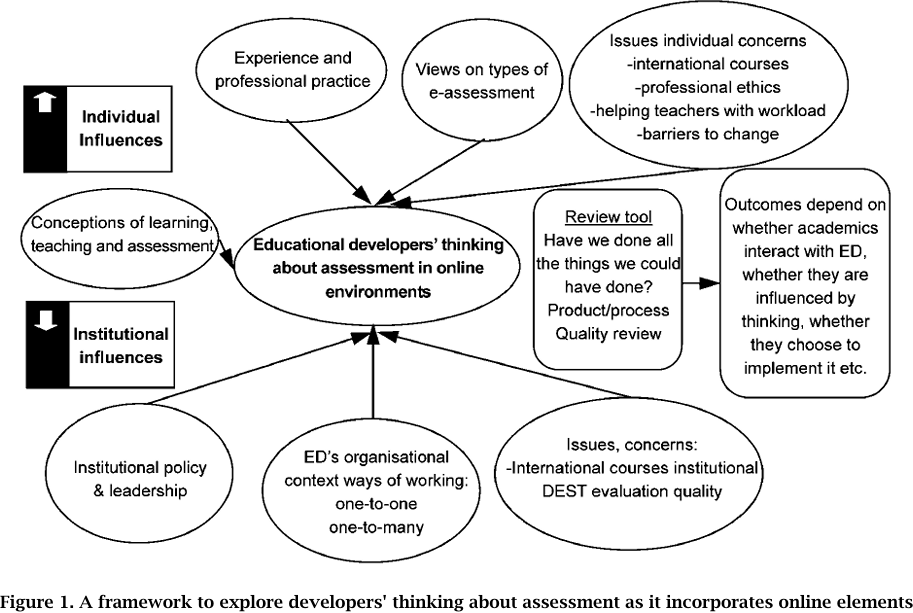
An important theme emerging in the study is that how the roles of educational developers are conceptualized within their organizational contexts influences the advice about assessment they provide to academics. The ways in which developers liaise with academics - whether they work with individuals or course teams; the level of technology support they or their unit can introduce; whether they are project-focused or relationship oriented - are of particular significance. The dynamics of relationships between individual and institutional influences are complex however and require an appreciation of the context of each educational developer, as well as the traditions of educational development that underpin their practice.








