Bloom's taxonomy
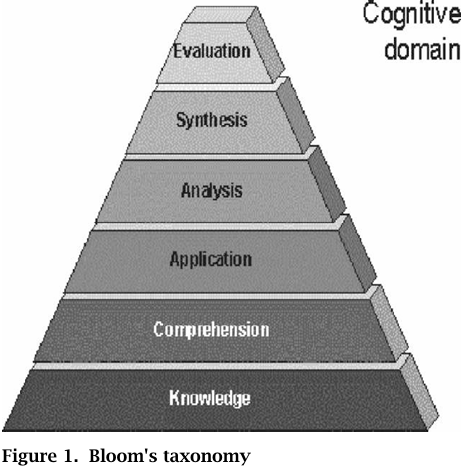
This taxonomy seems the best known and most widely used classification of cognitive learning objectives. Learning is organized as a series of levels or pre-requisites, and suggests that higher learning levels cannot be addressed until those below have been covered. Learning becomes effectively serial in structure. The model includes six levels of thinking: knowledge, comprehension, application, analysis, synthesis and evaluation as shown in Figure 1.
Each sequential level not only assumes a deeper understanding of the content, but includes the previous levels as subsets of the new level. Each of the six levels or sub-domains is typified by a specific approach to curriculum content and used typical key words in assessment. For example:
Knowledge is the recalling of appropriate, previously learned information.
• Key words: who, what, when, define, recall, recognize, find, label, list
Comprehension is the understanding of the meaning of informational materials.
• Key words: compare, demonstrate, interpret, explain, illustrate, describe.
Application is the use of previously learned information in new and concrete situations to solve problems that have single or best answers.
• Key words: apply, build, construct, classify, use, plan, model, select
Analysis is the breaking down of informational materials into their component parts, examining such information to develop divergent conclusions by identifying motives or causes, making inferences, and/ or finding evidence to support generalizations.
• Key words: why, determine, examine, simplify, distinguish, infer, categorize
Synthesis is creatively or divergently applying prior knowledge and skills to produce a new or original whole.
• Key words: predict, design, develop, combine, formulate, test, choose
Evaluation is judging the value of material based on personal values/opinions, resulting in an end product, with a given purpose, without objectively right or wrong answers.
• Key words: conclude, judge, justify, prioritize, recommend, appraise, deduce
The six levels or sub-domains of Bloom's cognitive domain offered us an effective way of deciding whether the stated course objectives aligned with the set assessment tasks. Bloom's taxonomy lists key words that assist in identifying and classifying objectives in assessment work and then mapping these against course objectives. The six sub-domains can be aligned with graduate qualities and hence can facilitate the mapping of both course objectives and assessment tasks to graduate qualities.
In the literature, a number of practitioners have shown how making the taxonomy into either a rating scale or an aid to grading, can relieve some of the complexities of setting criteria (Box, 2004; Oliver et al., 2004; Scott, 2003). We agreed that the key words and types of questions asked within each sub-domain of Bloom's cognitive domain relating to learning presented us with a tool that could be embedded within the mapping exercise. The sub-domains were set down within the mapping of set assessment tasks against course objectives, as well as within stated expectations as to graduate quality.
Other authors similarly note that that when writing objectives into course statements and tasks across a number of disciplines Bloom's taxonomy offers a way of describing and delineating learning outcomes (Coats, 2002; Writing Objectives, 2004). Their findings were highly consistent with ours, and once the team all agreed as to how this taxonomy was to be applied, a data base could be constructed from information taken out of course statements. These course statements are produced by course developers. They state course objectives and indicators towards expected graduate quality outcomes.








