On graduate qualities and course objectives
We would argue that in an appropriately designed course graduate qualities should shape course objectives, which in turn should shape assessment tasks and, assessment tasks should develop graduate qualities - as shown in Figure 1.
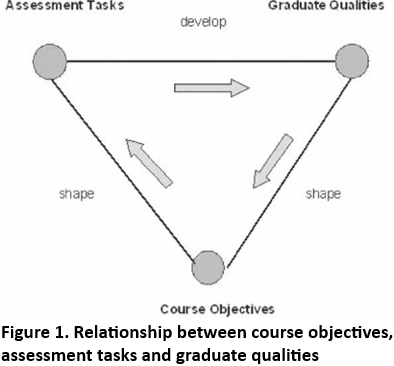
However, the mapping exercise revealed that in some courses there is little or no correlation between the three categories (assessment tasks, course objectives and graduate qualities) under consideration. It would appear that the majority of assessment tasks we mapped require students to understand and apply the content taught. If we use Bloom's cognitive domain as a guide, these assessment tasks assume that students have been guided or have learned to take their first level knowledge acquisition through the comprehension level to the application level. It is important to note here that this third level assumes that students have developed sound problem solving skills - one of the intrinsic graduate qualities. The mapping exercise indicated though, that students' previous assessments did not appear to offer them incremental development throughout their courses and did not tackle the various cognitive skills in an apparently linear formation.
A further analysis of graduate qualities in relation to the cognitive domain of Bloom's Taxonomy reveals that graduate qualities explicitly assume the first four levels of Bloom's Taxonomy (knowledge, comprehension, application and analysis) but not the top two levels. Depending on one's interpretation, the top two levels (synthesis and evaluation) are implicitly assumed in the graduate qualities. This finding was surprising given that the top two levels of Bloom's Taxonomy distinguish a traditional university education based competence from tertiary college training that emphasizes the acquisition of a skill set of competencies.
If assessment tasks determine the development of students for the real world which they enter on graduation, then graduate qualities should reflect the modern economy.
As part of the analysis of data obtained from our research, we needed to determine whether the graduate qualities provide an effective framework for the development of students in a modern, global knowledge economy. A knowledge economy is defined by the following characteristics:
1. Knowledge is the key factor in production.
2. Improving human capital is critical for GDP growth.
3. "know-why" and "know-how" is more important than know why.
4. Knowledge gained by experience is as important as formal education and training.
5. Life long learning is vital for organizations and individuals.
6.ICT releases people's creative potential and knowledge.
7. Globalization (Ministry NZ, 2005).
An analysis of the university's graduate qualities shows them as consistent with the demands of a knowledge economy and therefore they provide a suitable framework for shaping course objectives, which in turn should shape assessment tasks. Our findings provide some support to our conclusions that graduate qualities are a very useful framework for preparing students for a modern global knowledge economy.
Crucially, our work has shown (see Our findings Figure 3) that Graduate Qualities 4 'Ethical Action and Social Considerations' and 7 'International Perspectives' are those least likely to be built into course objectives or assessment tasks. Yet these closely related qualities indicate the extent to which graduates are prepared for addressing all stakeholder needs in a modern, global knowledge economy.








