

Grammar


Tenses


Present

Present Simple

Present Continuous

Present Perfect

Present Perfect Continuous


Past

Past Simple

Past Continuous

Past Perfect

Past Perfect Continuous


Future

Future Simple

Future Continuous

Future Perfect

Future Perfect Continuous


Parts Of Speech


Nouns

Countable and uncountable nouns

Verbal nouns

Singular and Plural nouns

Proper nouns

Nouns gender

Nouns definition

Concrete nouns

Abstract nouns

Common nouns

Collective nouns

Definition Of Nouns

Animate and Inanimate nouns

Nouns


Verbs

Stative and dynamic verbs

Finite and nonfinite verbs

To be verbs

Transitive and intransitive verbs

Auxiliary verbs

Modal verbs

Regular and irregular verbs

Action verbs

Verbs


Adverbs

Relative adverbs

Interrogative adverbs

Adverbs of time

Adverbs of place

Adverbs of reason

Adverbs of quantity

Adverbs of manner

Adverbs of frequency

Adverbs of affirmation

Adverbs


Adjectives

Quantitative adjective

Proper adjective

Possessive adjective

Numeral adjective

Interrogative adjective

Distributive adjective

Descriptive adjective

Demonstrative adjective


Pronouns

Subject pronoun

Relative pronoun

Reflexive pronoun

Reciprocal pronoun

Possessive pronoun

Personal pronoun

Interrogative pronoun

Indefinite pronoun

Emphatic pronoun

Distributive pronoun

Demonstrative pronoun

Pronouns


Pre Position


Preposition by function

Time preposition

Reason preposition

Possession preposition

Place preposition

Phrases preposition

Origin preposition

Measure preposition

Direction preposition

Contrast preposition

Agent preposition


Preposition by construction

Simple preposition

Phrase preposition

Double preposition

Compound preposition

prepositions


Conjunctions

Subordinating conjunction

Correlative conjunction

Coordinating conjunction

Conjunctive adverbs

conjunctions


Interjections

Express calling interjection

Phrases

Sentences


Grammar Rules

Passive and Active

Preference

Requests and offers

wishes

Be used to

Some and any

Could have done

Describing people

Giving advices

Possession

Comparative and superlative

Giving Reason

Making Suggestions

Apologizing

Forming questions

Since and for

Directions

Obligation

Adverbials

invitation

Articles

Imaginary condition

Zero conditional

First conditional

Second conditional

Third conditional

Reported speech

Demonstratives

Determiners


Linguistics

Phonetics

Phonology

Linguistics fields

Syntax

Morphology

Semantics

pragmatics

History

Writing

Grammar

Phonetics and Phonology

Semiotics


Reading Comprehension

Elementary

Intermediate

Advanced


Teaching Methods

Teaching Strategies

Assessment
THE ASSESSMENT OF THE BEHAVIOR
المؤلف:
COSTAS JOANNIDES
المصدر:
Caring for People with Learning Disabilities
الجزء والصفحة:
P43-C3
2025-10-08
278
THE ASSESSMENT OF THE BEHAVIOR
The starting point is a referral. Functional assessment is a range of strategies used to identify the antecedents and consequences that control challenging behavior. Slevin (1999) defines it as a process for gathering information that can be used to maximize the effectiveness and efficiency of support. It focuses on the person and the environment in which the behavior is occurring, takes into account the life of the person, helps to identify factors that contribute to the behavior and helps to understand why the behavior is occurring. There are approaches to functional assessment which comprise the following factors:
• Defining a specific behavior of concern: individuals identified as challenging may do several things that cause concern. A productive outcome is more likely with one specific concern as the starting point.
• Assessing the immediate circumstances that surround specific incidents of the behavior: antecedents – these are events that happened during the period before a behavior that need to be modified. These are called triggers and/or stimuli and may increase the likelihood of the behavior re occurring. This may be done by:
1. interviewing those involved with the person’s care or the person himself;
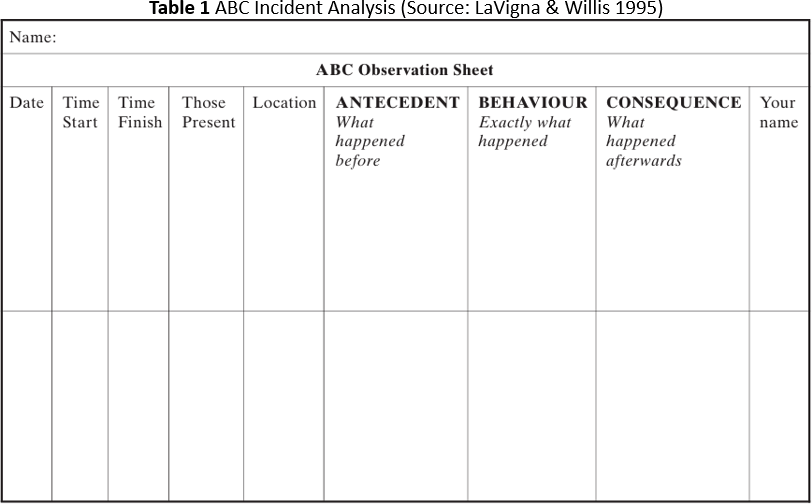
2. getting staff and carers to keep structured records of incidents, e.g. Antecedents, Behavior, Consequences (ABC) charts or incident analysis forms (see Table 1);
3. using an external observer to record incidents with scatterplot charts, such as the Motivation Assessment Scale (MAS).
• Assessing the individual: a detailed history will be required. Assessment of the key areas of individual functioning will involve detailed observations and a range of specialist assessments, such as Strategic Alternative Learning Techniques (SALT 2002/3). These will help to answer the question ‘What is reinforcing the behavior?’ and identify the function of the behavior to provide useful information to compile a functional strategy for working with the behavior.
• Assessing characteristics of individuals’ living environments: usually by observation and discussion with the person and others with whom s/he lives and works. Data are collected to confirm whether events that predict behavior are accurate and hypotheses about the function of the behavior are correct.
الاكثر قراءة في Teaching Strategies
اخر الاخبار
اخبار العتبة العباسية المقدسة
الآخبار الصحية

قسم الشؤون الفكرية يصدر كتاباً يوثق تاريخ السدانة في العتبة العباسية المقدسة
"المهمة".. إصدار قصصي يوثّق القصص الفائزة في مسابقة فتوى الدفاع المقدسة للقصة القصيرة
(نوافذ).. إصدار أدبي يوثق القصص الفائزة في مسابقة الإمام العسكري (عليه السلام)


