UNDERSTANDING CHALLENGING BEHAVIOR
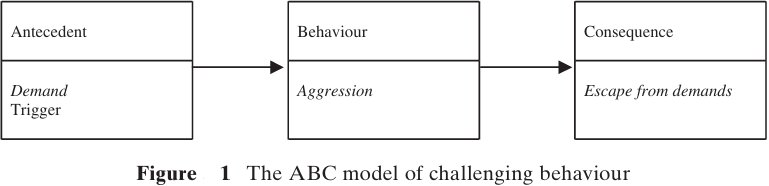
Frameworks for understanding challenging behavior have become more sophisticated over time, with important implications for assessment and intervention practices. These frameworks will be illustrated and their implications considered. An example of the assessment and intervention planning process will be illustrated. It is well recognized that ‘demands’ often set off challenging behavior. If an adult with a learning disability is asked to wash the floor, s/he may become aggressive. This often results in action to calm the person down or prevent injury to him/herself or others. The adult with a learning disability may be moved to another room or restrained, or prescribed medication and so on. In any event, s/he ends up not washing the floor. One of the earliest sensible conceptions of challenging behavior depicted exactly this pattern (see Figure 1).
The demand ‘sets off’ aggression, which results in escape from the demand. From the perspective of the carer (Figure 2), the person’s aggression ‘sets off’ their removing the demand and the aggression stops (with some luck)!
The outcome of this process can be readily seen. The adult with a learning disability is more likely to become aggressive when presented with demands and the carer is more likely to remove demands when s/he becomes aggressive.
Whatever the exact nature of the ‘thought’, s/he is likely to be feeling distressed and wanting to get rid of his/her distress. Aggressive behavior may then succeed in removing both the demand and (eventually) his/her own distress, as shown in Figure 3.

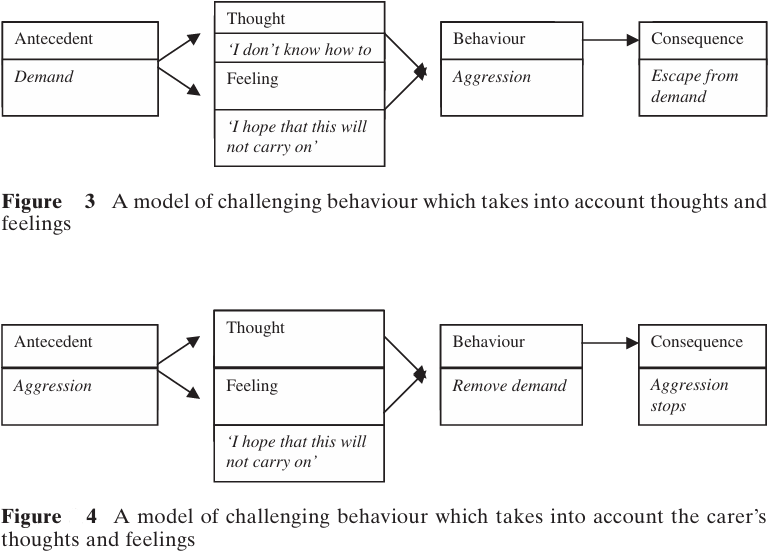
The carer may well have similar thoughts and feelings, s/he may be thinking (negatively) that sh/e does not know how to cope with the person’s behavior and s/he is almost certainly feeling distressed and frightened (see Figure 4).
This extension of these models helps us to feel that we can understand the motivation of the two parties better, and shows how negative thoughts and feelings may have maladaptive consequences. Given this depiction, it would not be surprising to find that both parties developed failure sets about these kinds of interactions (and therefore avoided them if at all possible), and both parties learned to handle their distress by seeking to escape from the distressing situation.
Expanded models may develop from the above, bearing in mind that four kinds of background factors are included: temporary personal (such as feeling tired), persistent personal (such as difficulty in understanding speech), temporary environmental (such as a lot of noise) and persistent environmental (such as a climate of social control).
The aim of any intervention is to interrupt the sequence leading to the adults with learning disabilities exhibiting challenging behavior as early as possible, so that difficulties are prevented, not just reacted to, and to develop skills to cope better with the difficulties being faced. The intervention includes:
1. Making realistic demands based on information of skill.
2. Anticipating difficulties.
3. Developing skills (coping strategies for dealing with problems, training in recognizing and dealing with distress).
4. Support for carers (guidance for preventing and managing difficulties and also joint approaches).








